

 |
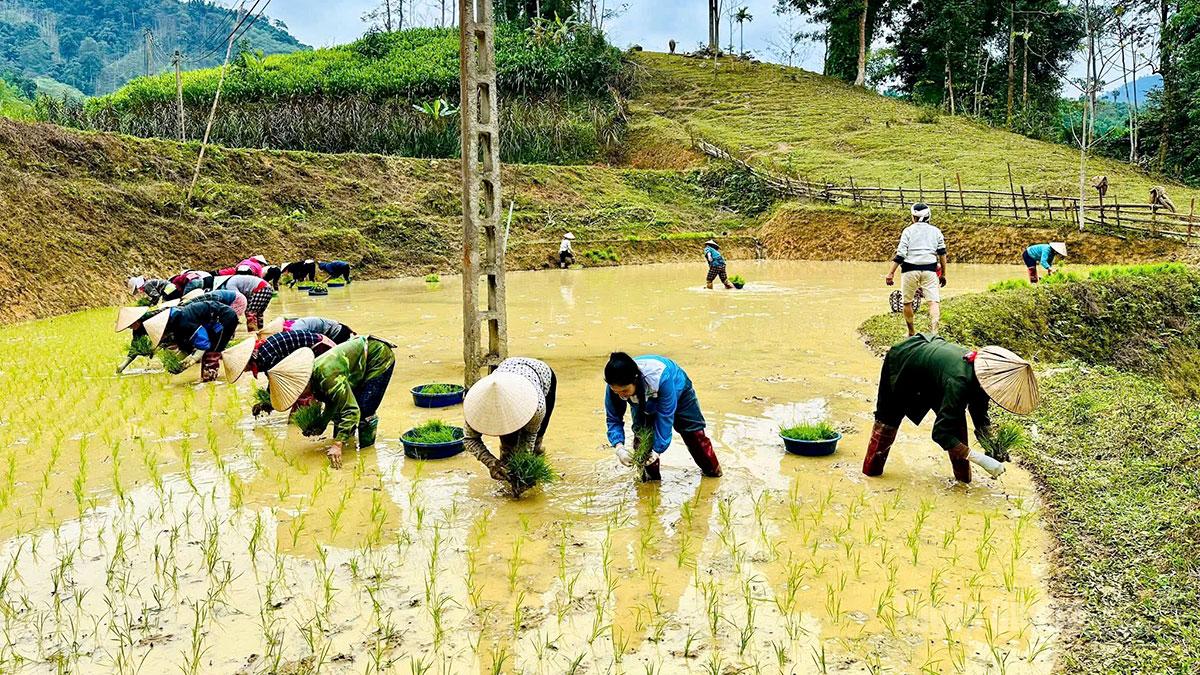
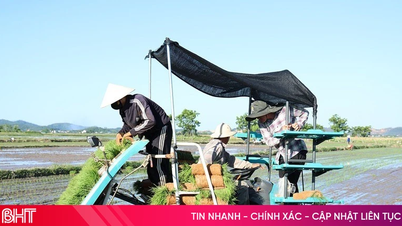
| Farmers in Quang Binh commune are planting rice for the spring crop. |
Bustling activity in the fields.
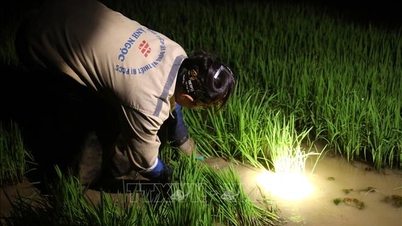
Observations in many localities throughout the province show that farmers proactively went to the fields to sow and care for their crops before Tet (Lunar New Year). After Tet, starting from the 3rd and 4th day of the holiday, people were busy checking their fields, removing the plastic coverings from the seedlings, continuing to sow rice crops, fertilizing, and completing production stages according to the seasonal schedule.
Ms. Truong Thi Quyet, from Dong Bai village, Yen Son commune, said: “This spring, my family cultivated over 1,000 square meters of rice with hybrid varieties 1 and Bac Thinh. Because 2026 does not have a leap month, my family was advised by the agricultural sector and local authorities to proactively prepare the land, sow seedlings, and plant other crops early to ensure the planting schedule and create favorable conditions for rice growth and development right from the start of the season.”
Not only in Ms. Quyet's family, but in many localities, the spirit of proactively resuming production after Tet has become a familiar practice. Farmers no longer have the mentality of "extending the Tet holiday" but quickly return to the fields to ensure the planting schedule and crop yields.
In the fields of Mang village, Bang Hanh commune, the atmosphere of hard work is also bustling. On an area of more than 800 m2 , Ms. Be Thi Phuong and her husband are busy plowing and building embankments to plant corn. "This year, my family chose the LVN99 corn variety because of its good resistance to pests and diseases and its high yield. At the beginning of the year, everyone is excited to go to the fields, hoping for a successful spring-summer crop," Ms. Phuong shared.
According to a quick report on agricultural production progress after the Lunar New Year of 2026 by the Provincial Department of Crop Production and Plant Protection, from before, during, and after the Lunar New Year, the agricultural sector closely followed the planting schedule, crop structure, and weather developments to advise and direct spring crop production.
Technical staff are assigned to closely monitor the fields, track crop growth, and promptly guide farmers on technical measures to minimize risks and improve production efficiency. For rice, the specialized agency recommends increasing the area planted with short- and medium-day varieties that are cold-tolerant, pest-resistant, and suitable for the ecological conditions of each region.
In addition, measures such as covering seedlings with plastic sheeting to protect them from the cold, thorough soil preparation, maintaining appropriate water levels, and refraining from applying nitrogen fertilizer during periods of severe cold are emphasized to protect newly transplanted rice and help the plants grow and develop favorably.
As of mid-February 2026, the entire province had planted 14,518 hectares of spring rice, reaching 53.9% of the plan. The variety structure is diverse, with many high-quality varieties such as J02, Bac Thom No. 7, Thien Uu 8, Dai Thom 8, TBR225, TBR279… being chosen by farmers, contributing to increased yield and rice value.
Along with rice, other crops were also actively planted by farmers right after Tet. The planted area of corn reached over 10,396 hectares, peanuts nearly 2,770 hectares, and soybeans over 187 hectares. Vegetables and beans continued to be harvested in staggered seasons and newly planted with an area of over 1,086 hectares, meeting market demand.
To ensure production progress, localities throughout the province have basically completed the water intake and irrigation for the spring planting season, creating favorable conditions for farmers to accelerate land preparation, planting, and crop care according to the correct seasonal schedule.
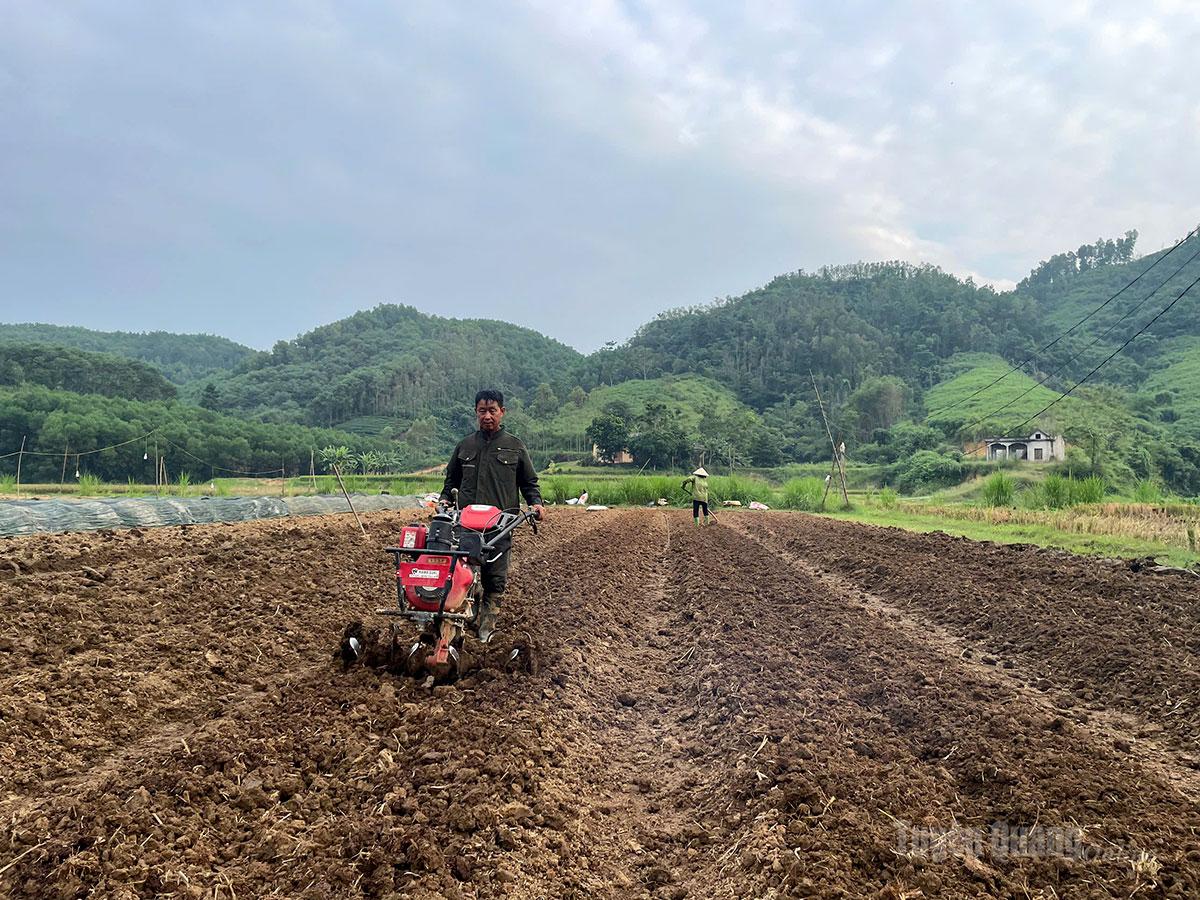 |
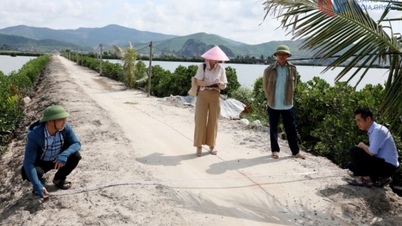
| People in Thai Son commune are preparing the land for production. |
Proactively respond to changing weather conditions.
According to relevant authorities, the weather in early 2026 will be highly variable due to the ENSO phenomenon shifting from a weak La Niña to a neutral state. Although periods of intense cold will not last long, drizzle, fog, and humid weather could increase the risk of pests and diseases on rice, vegetables, and fruit trees.
In light of this situation, the Crop Production and Plant Protection Sub-Department (Department of Agriculture and Environment) has advised people to closely monitor their fields, proactively prevent and control rice blast disease and anthracnose disease in fruit trees; apply balanced fertilization, increase the use of organic fertilizers; and absolutely refrain from transplanting rice when the average daily temperature drops below 15°C.
From the enthusiastic work ethic of the early spring days, the 2026 spring crop is expected to yield positive results. The goal of stabilizing total grain production at over 750,000 tons, building concentrated commodity production areas, and increasing product value per unit area is being gradually realized from the beginning of the year.
In the midst of the beginning of spring, on the newly planted rice fields, the lush green seedlings are taking root and coming back to life. The sounds of machinery mingled with the laughter and chatter of the farmers not only signal the start of a new planting season but also convey faith and hope for a prosperous year of the Horse (2026), with favorable weather and agriculture continuing to be a solid pillar of Tuyen Quang's rural economy .
Text and photos: Mai Dung
Source: https://baotuyenquang.com.vn/kinh-te/202602/bat-nhip-san-xuat-91e6fb9/









































![[Video] Sunset at Lap An Lagoon – Where the sun sets over the fishing nets](https://vphoto.vietnam.vn/thumb/1200x675/vietnam/resource/IMAGE/2026/05/31/1780192137701_beach-landscape-sea-water-nature-grass-745871-pxhere-com.jpeg)





























Comment (0)