

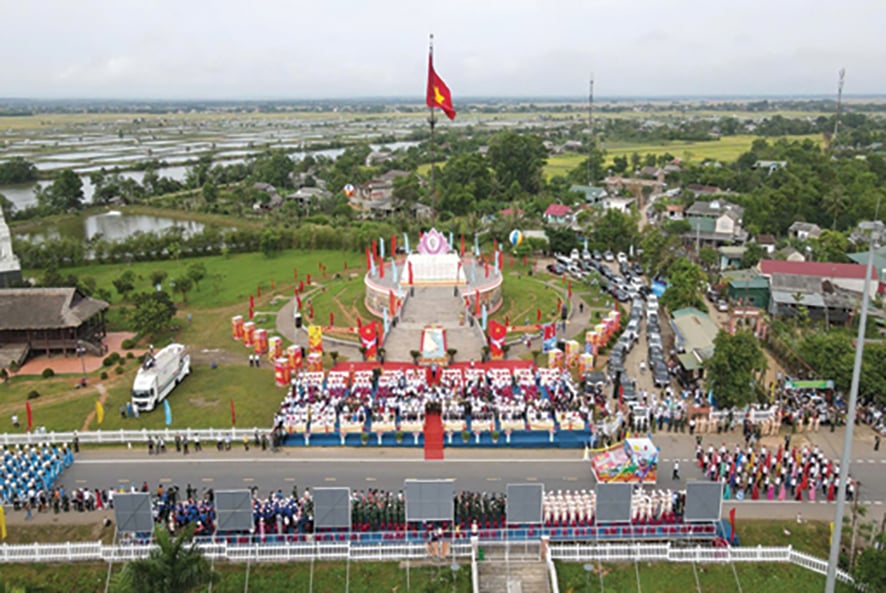
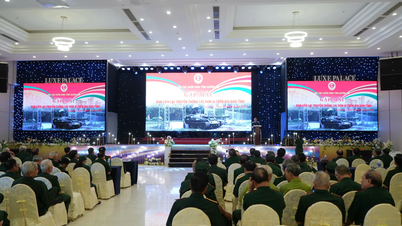
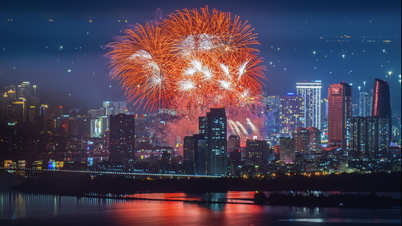
Festival at the Hien Luong - Ben Hai National Historical Site - Photo: AK
National Highway 1, beautiful like a silk ribbon, led us to Hien Luong Bridge. Along both sides of the road, the bomb craters left by the enemy were gone, replaced by rows of houses, buildings, and lush green fields. In the distance, Hien Luong Bridge was gradually appearing before our eyes. We were almost at the North bank. Everyone's heart was filled with excitement as the song "A Song by the Hien Luong River" echoed from someone's house on the South bank: "By the banks of Hien Luong, this afternoon I stand and look towards the future..." Fifty years after the country's reunification, hearing those lyrics, the melody still resonated deeply in our hearts.
Walking across this historic bridge, only a little over a hundred meters long, everyone feels a deep sense of sorrow, because despite such a short distance, the people of the two regions were separated for nearly 20 long years. Hien Luong Bridge is a testament to the atrocities of the enemy and a place that affirms the heroic fighting spirit of our army and people.
Following the signing of the Geneva Accords, the country was temporarily divided into two regions, North and South, with the 17th parallel serving as the temporary military demarcation line. Throughout this period of division, the Ben Hai River and Hien Luong Bridge were the focal points of intense and fierce fighting between our forces and the enemy. Countless touching and tragic stories unfolded on both sides of the demarcation line.
Separated by only a short distance, yet for decades children couldn't see their fathers, wives couldn't see their husbands, and relatives on both sides of the river were estranged. Every year, during holidays and festivals, people from both banks flock to the riverbanks to search for their loved ones. Because of the sheer number of people, it's difficult to recognize each other, so they stand on one side of the river, looking at the clothing and appearance, and silently guessing, "That's my family."
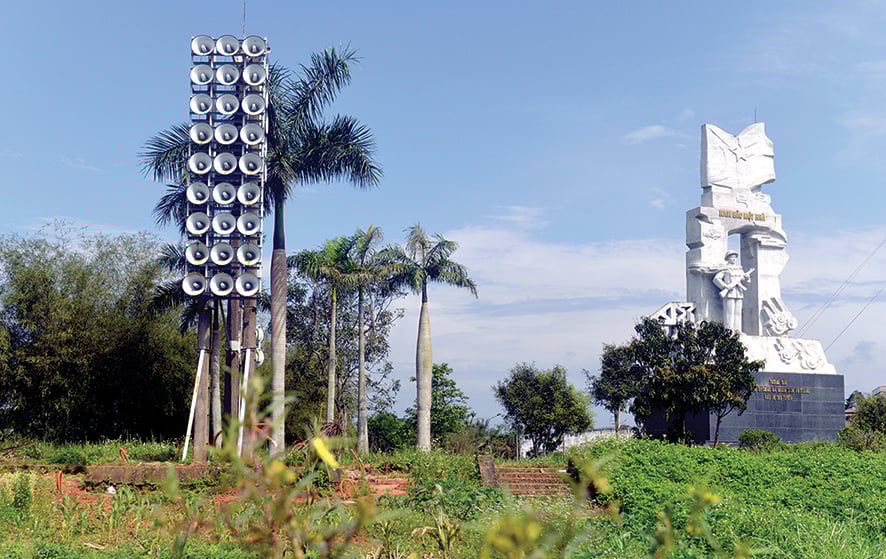
The loudspeaker system of the Voice of Vietnam radio station on the north bank of Hien Luong bridge - Photo: NGUYEN HUY THINH
When the bridge was divided in two, a white line was painted across the middle. 450 planks on one side belonged to the North, while the other half, consisting of 444 planks, was under the control of the Saigon government. Not only did the enemy try to sabotage the Geneva Accords, but they also used color to divide the bridge. Initially, they painted the southern half blue, and we immediately painted the other half blue. Then they switched to brown, and we painted it brown as well. The Hien Luong bridge constantly changed color; whatever color the enemy painted, we immediately painted the other side the same color. Ultimately, the enemy had to concede defeat, leaving the bridge a single, unified color.
Beside the historic Hien Luong Bridge stands a national symbol – the border demarcation flagpole on the northern bank. The history of this flagpole is marked by countless ups and downs and is intertwined with the unwavering fighting spirit of our nation against invading enemies. The flagpole symbolizes the indomitable fighting will of our army and people.
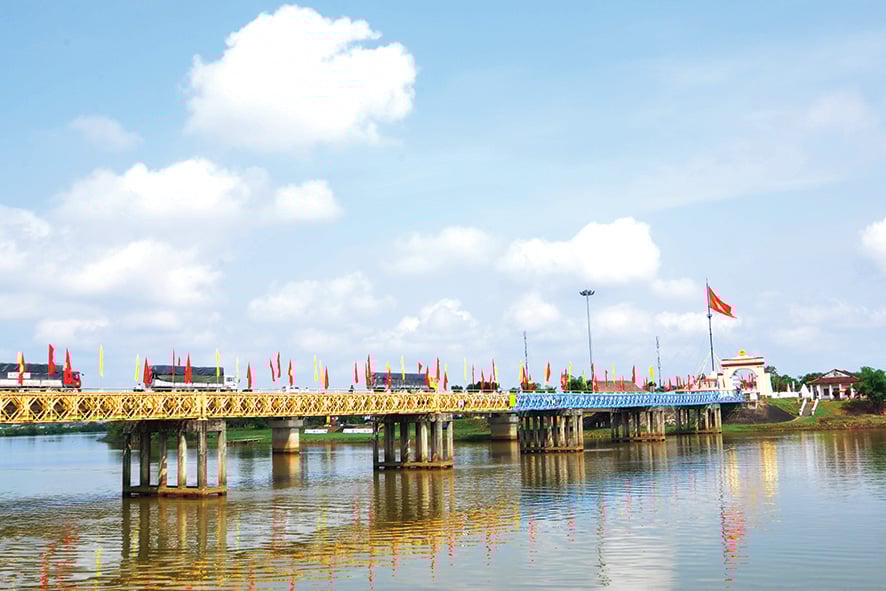
Hien Luong Bridge - Photo: TRA THIET
From May 19, 1956, to October 28, 1967, the soldiers on the front line hoisted a total of 267 large flags, erected flagpoles 11 times using wooden poles 12-18 meters high, and replaced flags 42 times due to damage from bombs. To ensure the national flag flew proudly on the front line, many soldiers bravely sacrificed their lives, and many examples of selflessness were set in protecting the national flag.
Whenever a flag was punctured by a bomb, another flag was immediately erected so that the national flag would always fly high in the Vietnamese sky. In 2001, a new flagpole, 38.6 meters high, was erected at the same location, modeled after the 1962 design. Below the flagpole, a magnificent monument was built with many reliefs expressing the aspiration for reunification and the joy of North and South Vietnam being reunited.
In 1996, a new concrete bridge was built to meet the demands of traffic development in the new era and replace the old, dilapidated bridge, while the historic Hien Luong bridge remains standing. Every day, a bustling stream of people and vehicles crosses the bridge.
It seemed everyone glanced back at the historic bridge, then looked up at the national flag fluttering on the flagpole marking the border, remembering and never forgetting a time of both suffering and heroism.
Ben Hai-Hien Luong, though a place of tragic past, is now a place the entire nation looks to with pride. Ben Hai-Hien Luong embodies the patriotic spirit, national pride, and unwavering will of the Vietnamese people.
An Khue
Source: https://baoquangtri.vn/ben-ven-bo-hien-luong-193374.htm
![[Image] Nearly 125,000 Hanoi students completed the Literature exam for the 10th grade entrance exam.](https://vphoto.vietnam.vn/thumb/1200x675/vietnam/resource/IMAGE/2026/05/30/1780117233041_ndo_br_thiet-ke-chua-co-ten-2-png.webp)






































































Comment (0)