

The ruins of a Cham tower in An Phu commune, Pleiku city, Gia Lai province, were excavated twice in 2023 and 2024 by the Center for Archaeology (Southern Vietnam Academy of Social Sciences ) in collaboration with the Gia Lai Provincial Museum. Notably, during the second excavation, archaeologists discovered a "sacred pit" with a central circular frame constructed from bricks arranged in the shape of a swastika, along with many valuable artifacts.
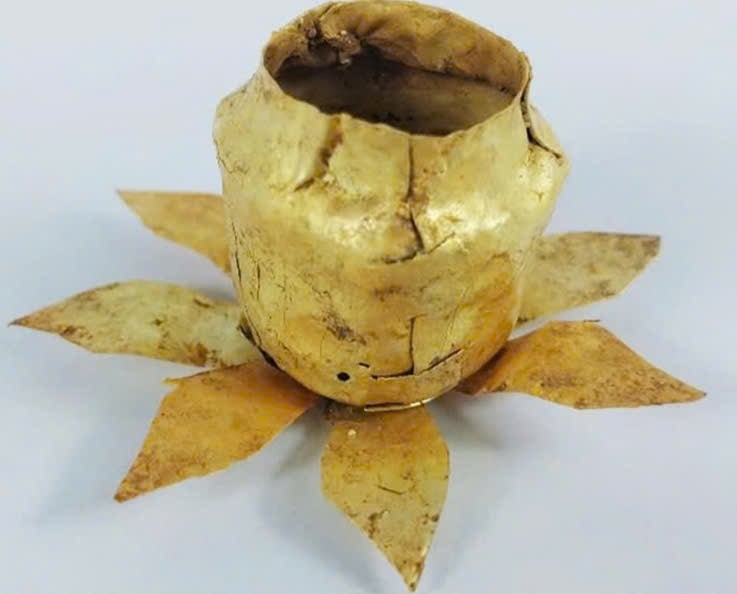
Kamandalu vase made of gold - Photo by Xuan Toan
Many mysteries remain unsolved.
The "sacred pit" or "sacred storehouse" is the central point of a Cham temple, where religious objects were placed at the beginning of construction to sanctify the structure. Inside the "sacred pit" in An Phu, archaeologists have found a collection of artifacts, including a rectangular gold fragment engraved with ancient characters, the content of which refers to the Buddhist verse "Dependent Origination"; a Kamandalu vase placed on an eight-petaled golden flower; and dozens of artifacts made of glass and precious stones.
Excavation results have essentially outlined the appearance of an ancient Cham temple in the An Phu commune area. The An Phu site has been identified as consisting of a main temple in the center with an architectural scale of approximately 7m on each side, and a surrounding wall measuring about 32-33m, creating a unified architectural whole. This is a Buddhist temple dating back to the 9th-10th centuries.
So, what else is there to research and explore in the Cham tower complex in An Phu? According to researchers, many mysteries still lie deep underground, yet to be unearthed. A 1928 report by the French Institute of Far Eastern Studies (page 605) states: To the east is the Bomon Yan tower (number 150 in the list). The tower can be recognized from afar by its arched pillars and crossbeams connected to the openings on the entrance gate. The special construction techniques of the Cham people allowed the arched pillars to be tightly connected without the need for written records. Three stones of the altar base still lie upside down at the location of the ancient tower, making this structure even easier to identify. Notably, there was once a statue of a seated figure in a dignified posture like a king (numbered 5 in the 1925 inventory) currently stored in the warehouse of the French Resident in Kon Tum.
At the center is the Ron Yan tower, separated from Bomon Yan by a stream, near a Catholic chapel. The tower sits on a high mound, its surrounding walls in ruins, fragments of religious statues scattered on the ground. Here, two bronze feet of a statue were found, currently stored in the warehouse of the Kon Tum Consulate. Unfortunately, the current state of the Ron Yan tower is no longer intact as described by researcher MH Maspero. All the bricks on the tower's surrounding walls have been removed, leaving behind traces of dilapidation.
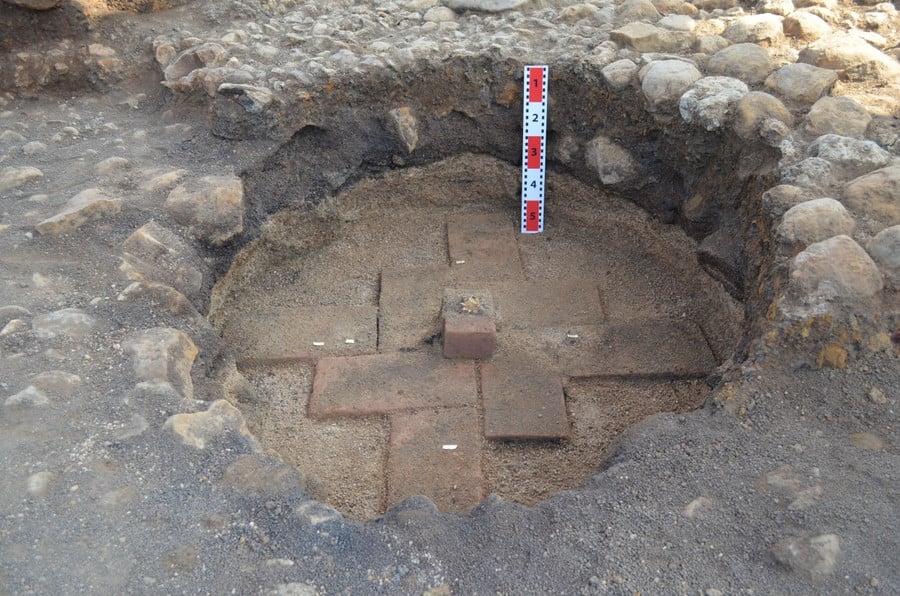
The structure of the Sacred Pit at An Phu historical site. Photo: Xuan Toan
To the west lies a smaller structure, built on mounds that locals call "tombstones." This structure may be a remnant from the destruction of nearby buildings, now hidden in the surrounding bushes. It is located directly west of the two previous monuments and about 400 meters from the Ron Yan tower.
Thus, the Plei Wao village area (now An Phu commune) does not consist of just one, but a complex of three architectural structures located along an East-West axis, approximately 400 meters apart. The An Phu ruins, excavated in 2023 and 2024, are one of these three structures. So where are the other two located?
According to the book "History of Gia Lai from its origins to 1975" (Social Sciences Publishing House, 2019) edited by Dr. Nguyen Thi Kim Van, the Cham tower in the An Phu area is identified as being located in Phu Tho (now An Phu commune, Pleiku city). Father Nguyen Hoang Son stated that the foundation of this tower is currently beneath the foundation of Phu Tho church. If this information is accurate, a second Cham ruin may be located beneath Phu Tho church.
The straight-line distance from the recently excavated An Phu Cham ruins to Phu Tho Church is approximately 710m – relatively consistent with the French School of Far Eastern Studies' report of about 800m. Thus, the third ruin may be located at the midpoint on the straight axis connecting the An Phu ruins with Phu Tho Church.
An opportunity to unravel the mystery of the An Phu Cham Tower.

The author stands beside a stone block originating from the Cham ruins of An Phu at Phu Tho church. Photo: XH
If the information from the 1928 report of the French School of Far Eastern Studies and the information provided by Father Nguyen Hoang Son are accurate, then the location of the third Cham ruin may be midway along the line connecting the An Phu ruins with the present-day Phu Tho church. The distance between the first and last structures is approximately 800m, consistent with historical records.
The discovery of the third ruin not only completes the picture of the Cham tower complex in An Phu but also serves as important evidence of the development and influence of Cham culture in the Central Highlands. If archaeologists continue to expand excavations and research in the future, it is highly likely that the mysteries of the Cham tower ruins in An Phu will be solved, contributing to shedding more light on the cultural history of the Cham people in Gia Lai.
Hopefully, one day, the mysteries of the Cham tower ruins in An Phu will be revealed, helping future generations to better understand the development and influence of Cham culture in the Central Highlands region.
Ngo Xuan Hien (Dan Toc Newspaper)
Source: https://baophutho.vn/phe-tich-thap-cham-o-an-phu-pleiku-bi-an-van-con-nam-trong-long-dat-229895.htm
![[Photo] Secretary of the National Assembly Party Committee, Chairman of the National Assembly presides over the meeting of the Standing Committee and Executive Committee of the National Assembly Party Committee.](https://vphoto.vietnam.vn/thumb/1200x675/vietnam/resource/IMAGE/2026/06/03/1780480353201_ndo_br_bnd-2585-jpg.webp)


![[Photo] General Secretary and President To Lam presides over a meeting with the Central Organizing Committee.](https://vphoto.vietnam.vn/thumb/1200x675/vietnam/resource/IMAGE/2026/06/03/1780482764658_a1-bnd-4741-3342-jpg.webp)
![[Photo] First session of the 14th Congress of the Vietnam Trade Union](https://vphoto.vietnam.vn/thumb/1200x675/vietnam/resource/IMAGE/2026/06/03/1780465947883_ndo_br_img-3852-jpg.webp)












































![[Video] Sunset at Lap An Lagoon – Where the sun sets over the fishing nets](https://vphoto.vietnam.vn/thumb/1200x675/vietnam/resource/IMAGE/2026/05/31/1780192137701_beach-landscape-sea-water-nature-grass-745871-pxhere-com.jpeg)



































Comment (0)