



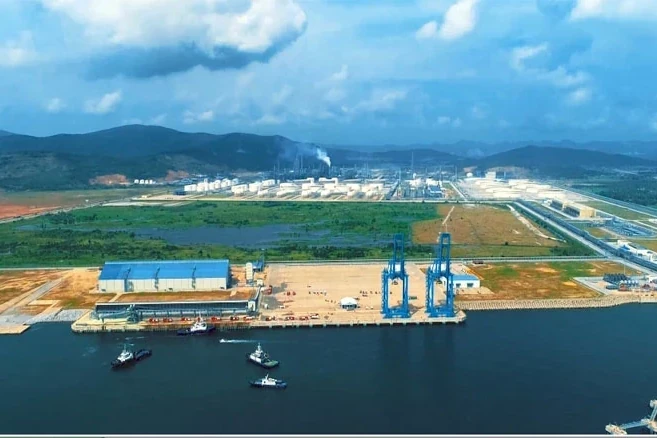
The Nghi Son Economic Zone, one of the country's eight key coastal industrial zones, is rapidly developing.
Overcoming the "big waves"...
In the early 2020s, the global economy faced unprecedented upheavals: the COVID-19 pandemic disrupted global supply chains, strategic competition among major powers intensified, geopolitical conflicts spread, and trade uncertainties arose. Vietnam, with its highly open economy, was predicted to suffer severe consequences. However, instead of being swept away by the "big wave," by leveraging its internal strengths and combining them with external forces, the Vietnamese economy successfully withstood the onslaught and surged forward, maintaining one of the world's highest growth rates.
The period 2021-2025 marks a significant milestone as Vietnam achieved and surpassed 22 out of 26 key socio-economic targets; in 2024 and 2025 alone, all 15 targets were completed exceeding expectations. The average GDP growth rate during this period reached approximately 6.3% per year, exceeding the target set in the 2021-2025 socio-economic development plan. By 2025, economic growth is projected to exceed 8%, placing Vietnam among the leading countries in ASEAN and the world , despite still being affected by external shocks.
Looking at the breadth and depth of these figures, it's clear that Vietnam has not only recovered from the crisis but also restructured and accelerated its growth under unprecedentedly difficult conditions. The size of the economy increased from $346 billion in 2020 to $510 billion in 2025, placing Vietnam 32nd in the world's economic rankings. GDP per capita is 1.4 times higher than in 2020, placing Vietnam in the group of upper-middle-income countries, exceeding the set target.
Amidst global export volatility and increasing trade protectionism, Vietnam's export turnover still exceeded $900 billion, placing its total trade in the top 20 globally. Supply chains and import/export markets have been diversified. Currently, Vietnam has trade relations with over 230 economies and 34 export markets, while 24 import markets have a value exceeding $1 billion. This not only reflects the strength of an "open" economy but also demonstrates its ability to adapt quickly to complex external changes.
The economic structure continues to shift in the right direction. The processing and manufacturing industry is developing well; the localization rate is improving. Agriculture is gradually developing towards ecological, green, circular, and high-tech applications. The service and tourism sectors are recovering and developing. Public investment in key national projects is spreading widely, connecting regions and inter-regions. Economic institutions are undergoing strong reforms, especially from 2025 onwards, Vietnam affirms that the private sector is the most important driving force of the economy; a number of large-scale, multi-sector private economic groups capable of competing in the international market are beginning to form. Economic zones, industrial parks, and tourist areas linked to coastal urban chains are forming and developing strongly; free trade zones have been established in some localities; economic growth poles and centers for innovation, science, technology, education, and training are beginning to form in major cities...
It can be said that the resilience of the Vietnamese economy does not stem from random factors, but from a combination of macroeconomic stability, flexible policies, an increasingly attractive investment environment, and a dynamic business sector. During this term, business conditions have improved significantly, institutions have become more open, and non-market barriers have been proactively removed. These reforms have created a favorable environment for domestic businesses to thrive and contribute to the global value chain.
Many prestigious international organizations such as the International Monetary Fund (IMF), Standard Chartered Bank, and the World Bank (WB) have highly praised Vietnam's economic performance and growth prospects. The IMF ranks Vietnam among the top 10 fastest-growing economies in the world; Standard Chartered forecasts Vietnam to be among the top 5 fastest-growing countries in Asia; and the WB includes Vietnam among the 21 economies with outstanding performance by 2025.

A view of Vietnam Dairy Products Joint Stock Company - Lam Son Dairy Factory in Le Mon Industrial Park.
At the regular government press conference in December, held on the afternoon of January 8th, Deputy Minister of Finance Nguyen Duc Chi affirmed: From an economic and financial perspective, the Vietnamese economy has demonstrated and continues to demonstrate strong adaptability and resilience in the face of major shocks. This is built upon experience in governance, resilience in overcoming difficulties, and an unceasing desire for innovation. As Prime Minister Pham Minh Chinh once emphasized: “Whenever we face difficulties, our nation and our country become even more resilient and experienced to rise up and respond more effectively to reality. Currently, our country has matured and possesses sufficient resilience to adapt flexibly and effectively to all fluctuations in the world and the region.”
This very foundation is becoming a key factor in strengthening the confidence of the people, the business community, and investors; creating momentum to promote the search for new opportunities, expand production and business, and make practical contributions to the socio-economic growth and development of the country in the coming period.
...to the aspiration to rise
If the past term was a period of proactively responding to external impacts, then the present and upcoming period is one in which Vietnam sets the aspiration not only to rise more strongly, but also to achieve breakthroughs beyond the old growth standards. Specifically, the target for average GDP growth in the 2026-2030 period is to achieve double-digit growth, accompanied by a strong shift towards high value-added industries and sectors; GDP per capita is expected to reach approximately US$8,500 by 2030; the proportion of manufacturing industry in GDP is expected to reach approximately 28%; the proportion of the digital economy is expected to reach approximately 30%; and the contribution of total factor productivity (TFP) to economic growth is expected to exceed 55%.
A new growth model, linked to a comprehensive restructuring of the economy, promoting industrialization and modernization, and using science, technology, innovation, and digital transformation as the main driving forces, is expected to be established. The focus of this model is to improve productivity, quality, efficiency, added value, and competitiveness of the economy; gradually forming a new mode of production based on the data economy, digital economy, green economy, and sustainable development.
Four major pillars of transformation will be established: digital transformation, green transformation, energy transformation, and structural transformation, along with the quality of human resources. These are not only global trends but have become intrinsic requirements of the development process, aiming to create new productive forces with higher knowledge content, gradually reducing dependence on cheap labor and resource exploitation.

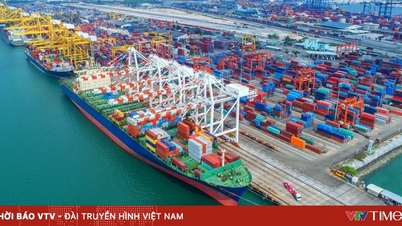
Ships dock at Nghi Son Port, transporting goods for export to the world.
Based on this mindset, Vietnam has clearly defined the need to renew traditional growth drivers on the foundation of science, technology, and innovation, while simultaneously forming new growth drivers. This involves developing strong growth poles, key economic regions, dynamic urban areas, and new-generation special economic zones with regional and international spillover effects. The national development space is reorganized towards closer regional linkages, maximizing the comparative advantages of each locality and economic region.
In the industrial sector, development orientation has expanded from foundational industries such as energy, mechanical engineering, metallurgy, new materials, and chemicals to emerging strategic industries: semiconductors, artificial intelligence, robotics and automation, biotechnology, environmental industry, renewable energy, and new energy. Simultaneously, large-scale, modern industrial complexes are being gradually formed at the regional and inter-regional levels, creating value chains capable of international competitiveness.
Agriculture and rural economy are also being placed within a new development mindset, shifting from purely production to a green, ecological, and circular agricultural economy. The focus is on developing large-scale commodity production areas, strongly applying science and technology and digital transformation; linking production with deep processing, building brands, and expanding export markets.
In the service sector, the development strategy emphasizes improving quality and competitiveness, focusing on high value-added services such as finance, banking, insurance, logistics, e-commerce, and digital assets. The formation of international financial centers, new-generation free trade zones, and large logistics centers connected to seaports and international transit airports is expected to open up new development opportunities for the economy.
At the same time, Vietnam advocates for selective foreign investment attraction, prioritizing high-tech, low-emission projects with the potential for technology spillover effects, management expertise, and human resource training. The connection between the FDI sector and the domestic economy is being strongly promoted to form a more in-depth production and business ecosystem and increase the localization rate in the value chain...
These orientations reflect a fundamental shift in Vietnam's economy: from extensive growth—based on capital and labor—to intensive growth, based on innovation, science and technology, the digital economy, and sustainable development. This is a change not only in the economic model but also in development thinking, requiring stronger, more coordinated policies aimed at the long-term competitiveness of the nation.
Nevertheless, the road ahead still presents many challenges, as the gap in labor productivity between Vietnam and developed economies remains high; the need to improve the quality of human resources, disparities between regions, and increasing pressure from climate change are creating new problems for development strategies. However, looking back at the journey so far, it can be affirmed that Vietnam not only possesses the resilience to overcome difficulties but is also cultivating a strong will to rise for the next stage of development.
And from that foundation, aspirations on this new path no longer remain mere "declarations," but are gradually becoming a driving force for action, a concrete development program for the country's future. This is the premise for us to continue "creating something out of nothing," "making the difficult easy, turning the impossible into the possible"—through innovative thinking, through resilience forged through challenges, and with unwavering faith in the path of rapid and sustainable development in this era of national progress!
Text and photos: Minh Hang
Source: https://baothanhhoa.vn/bien-ap-luc-thanh-dong-luc-than-toc-but-pha-274791.htm

![[Photo] Speaker of the National Assembly inspects election preparations in Dong Nai](https://vphoto.vietnam.vn/thumb/1200x675/vietnam/resource/IMAGE/2026/03/05/1772685006217_ndo_br_7-resize-6037-jpg.webp)













![[Infographics] Beware of fake news and malicious misinformation ahead of the 16th National Assembly and People's Council elections for the 2026-2031 term.](https://vphoto.vietnam.vn/thumb/402x226/vietnam/resource/IMAGE/2026/03/05/1772680210299_infographics-ca-w1200t0-di2609d272d4094924t11600l1-cover-info3.webp)


























![[Photo] Speaker of the National Assembly inspects election preparations in Dong Nai](https://vphoto.vietnam.vn/thumb/402x226/vietnam/resource/IMAGE/2026/03/05/1772685006217_ndo_br_7-resize-6037-jpg.webp)




















Comment (0)