

THE STRIPED TIGER - THE NATIVE ANIMAL OF SAIGON
This logo is a black ink drawing with many details, most notably the image of two striped tigers in powerful and graceful poses, "guarding" a shield in the middle. The tiger is the native mascot of Saigon, a city famous for its fierce tigers – the "king of the jungle" during the early days of its settlement.
Ancient historical records note that the tigers of Can Gio and Hoc Mon were the most notoriously ferocious. Today, tigers remain a common image on stone screens in the courtyards of temples and pagodas in Saigon and Southern Vietnam.
Meanwhile, at the top of the shield is a sawtooth-shaped city wall, in the European style, symbolizing the city. Inside the shield is an image of a 19th-century merchant ship, with two large masts bearing flags and a smokestack in the middle, gliding on the water. Perhaps the merchant ship and the water symbolize both trade and the city's openness to the world .
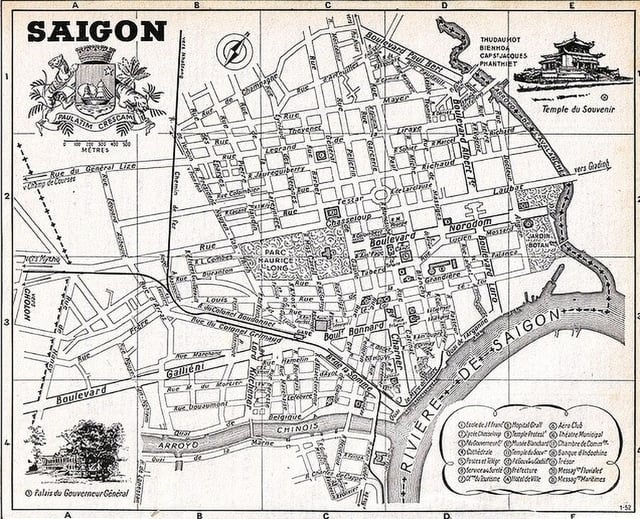
Saigon logo on a city tourist map before 1945.
PHOTO: AUTHOR'S ARCHIVE
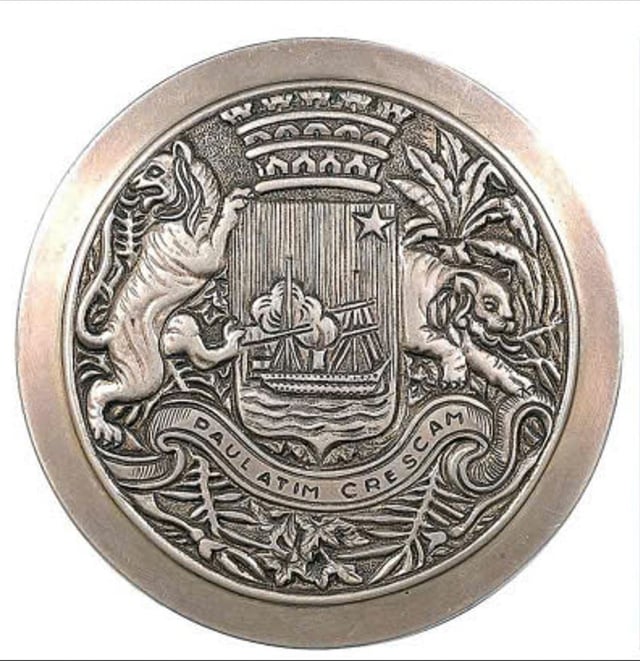
The Saigon logo is represented by a circle on metal.
PHOTO: AUTHOR'S ARCHIVE
On the other hand, above the merchant ship, on the right, is a large five-pointed star, representing the Morning Star, guiding the ship. Perhaps the author intended to imply that the city is always looking towards the future, synonymous with a pursuit of modern civilization. The imagery of the citadel, the sailing ship , and the river , along with their arrangement, seems similar to the logo of Paris (dating back to the 14th century, perfected in 1853). Could it be that the designer and the city council at the time intended Saigon to be the Paris of the East? Many French and foreign tourists have later made similar observations when visiting the city.
Against the backdrop of the logo are several tropical branches and leaves, most notably banana leaves, very Vietnamese. Below the shield and the two tigers is a silk ribbon bearing the Latin inscription: PAULATIM CRESCAM, meaning "Slowly growing stronger." Indeed, the latter half of the 19th century was a period of gradual development for modern Saigon. Then, in the first half of the 20th century, Saigon rapidly grew, becoming a modern and complete city, catching up with and rivaling Singapore, Penang, Hong Kong, and many other prosperous port cities in East Asia.
In the early 1930s, as the French government intensified its efforts to promote Indochina to the outside world in order to attract tourists and investors, the Ville de Saigon logo appeared widely in many books, newspapers, and documents in various languages.
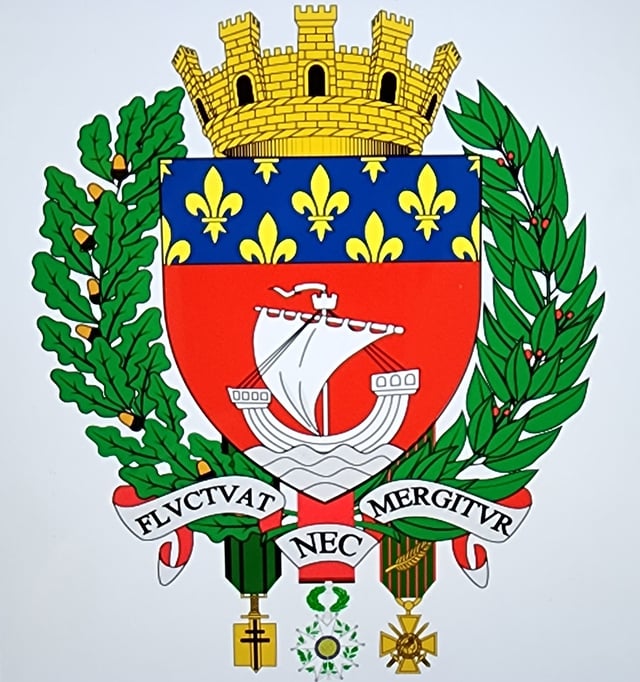
Paris city logo
PHOTO: AUTHOR'S ARCHIVE
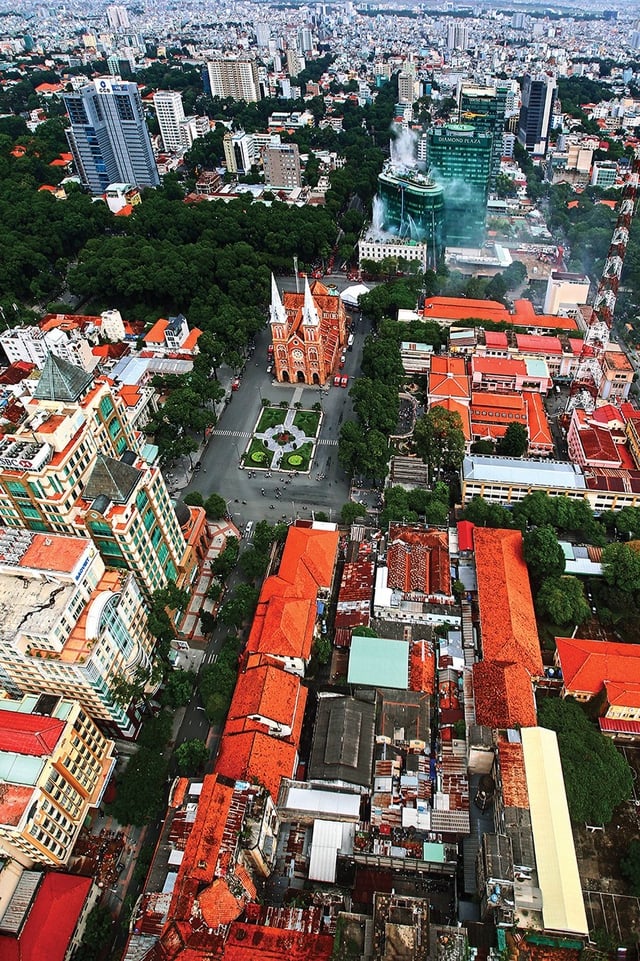
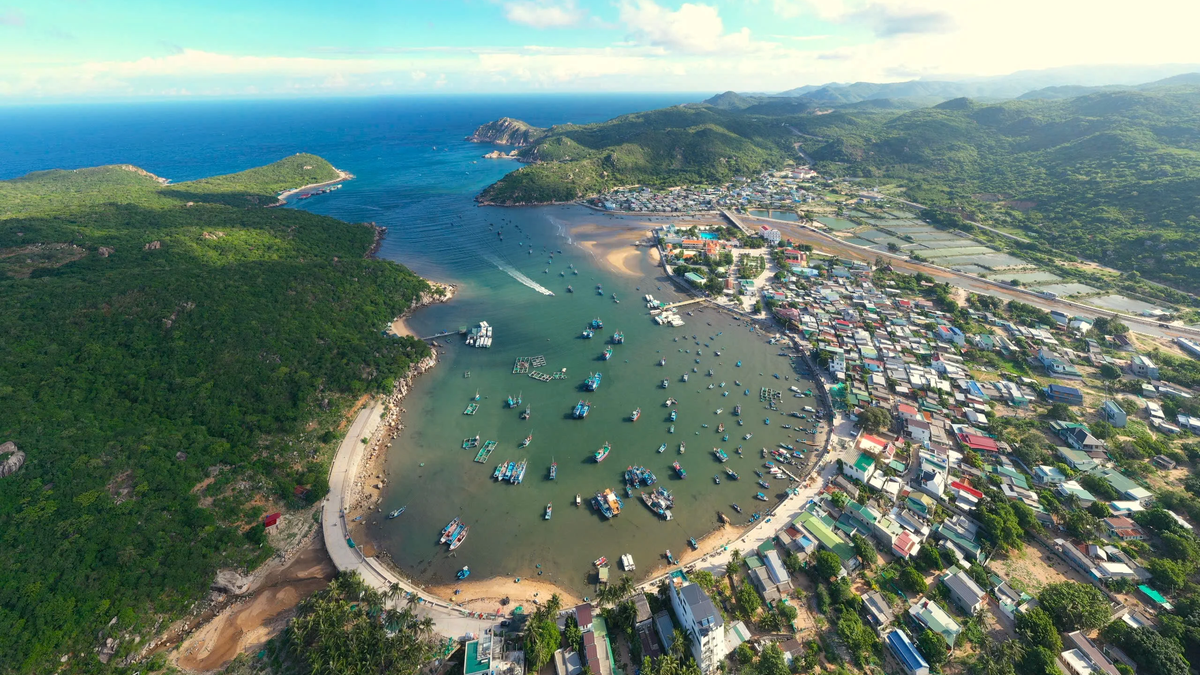
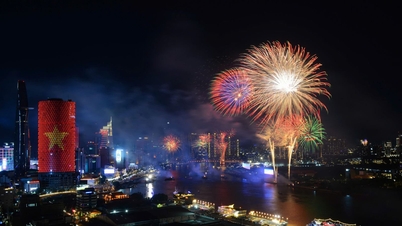
Saigon - Ho Chi Minh City viewed from above.
PHOTO: GIAN THANH SON
In particular, in 1942, at the Indochina International Fair and Exhibition (held in Tao Dan Park), the Saigon city logo was incorporated into commemorative metal medals in a bronze-brown color. The artist positioned the logo within a circle and slightly modified the shape of the citadel and merchant ships. Notably, the two French flags were omitted (at this time, the Japanese had occupied Indochina, and the French colonial administration was forced to prioritize strengthening the role of the Vietnamese).
To this day, the creator of the old Saigon emblem remains unknown. It is only known that this logo existed until 1949-1950 on city hall documents. After that, city administration shifted to the Vietnamese, under the Bảo Đại government, so the logo may no longer have been used. However, for many decades afterward, a large relief depicting the French-era Saigon logo could still be seen inside the City Hall (the current headquarters of the Ho Chi Minh City People's Committee) and on the facade of Saigon Hospital on Lê Lợi Street. After 1975, these reliefs were no longer seen in these locations.
Looking back at the symbols of old Saigon, we can recognize that they encompassed elements of history, spirituality, geography, and economics , as well as a development philosophy.
Source: https://thanhnien.vn/bieu-trung-sai-gon-dau-tien-185250419205126776.htm






































































Comment (0)