

Located at 46 Tran Phu Street, Hoi An City ( Quang Nam Province), the Fujian Assembly Hall is one of the favorite stops for both domestic and international tourists when visiting Hoi An.
The assembly hall was built in 1690 by people who migrated from Fujian (China) to live and establish it in Hoi An.
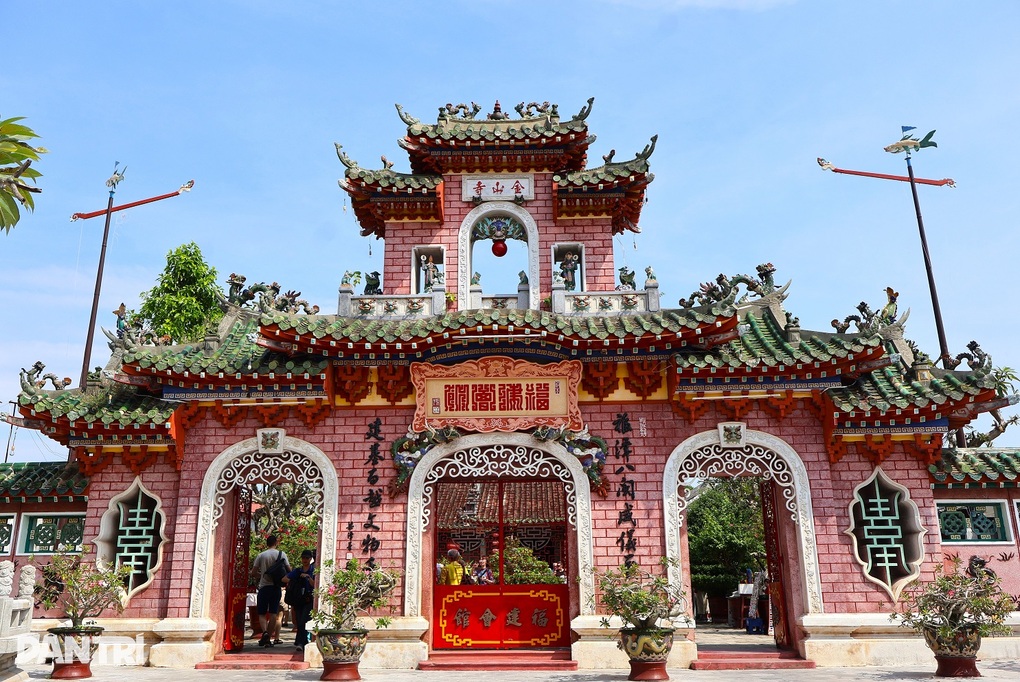 The Tam Quan gate leads to the Fujian Assembly Hall (Photo: Ngo Linh).
Previously, the assembly hall was built entirely of wood; it was rebuilt in 1757 with bricks and a tiled roof as it is today.
The assembly hall is a place of worship for the Goddess Thien Hau and other protective deities of rivers, water, money, children, and ancestors; it is also a meeting place for mutual support among compatriots from Fujian, who were among the earliest and most numerous to arrive in Hoi An.
With its magnificent and splendid architecture, adorned with eye-catching red colors and intricate patterns, the assembly hall stands out even more, enriching the architecture of Hoi An's old town.
In 1990, the Fujian Assembly Hall was recognized as a national historical and cultural relic.
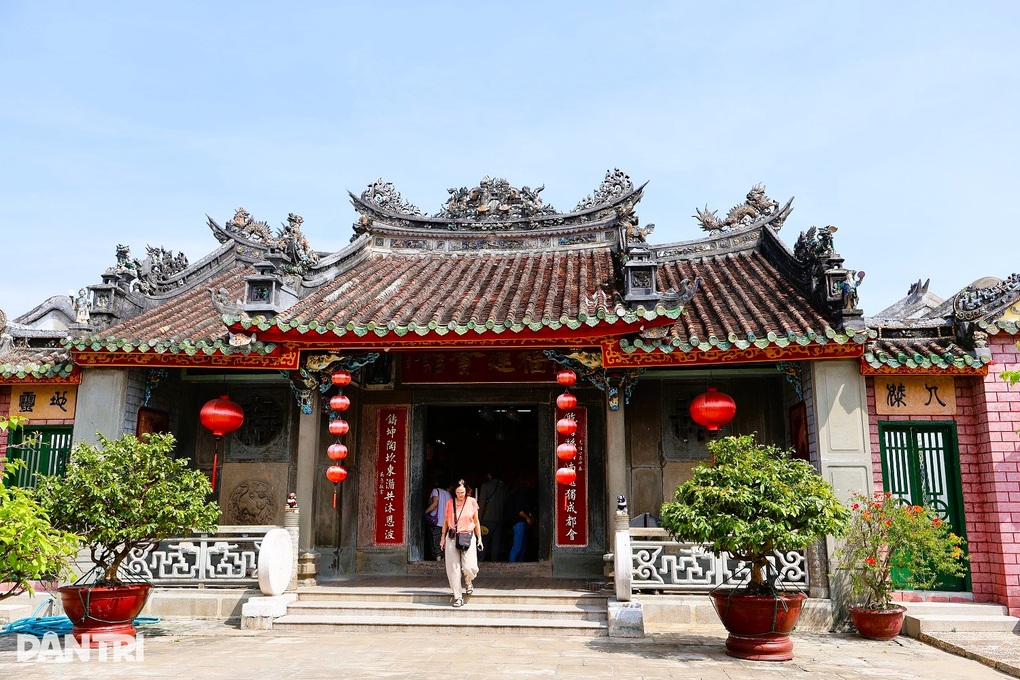 The architecture has strong Chinese influences (Photo: Ngo Linh).
The assembly hall was built in the shape of the Chinese character "三" (three), consisting, in order: the gate, courtyard, landscaped area, and two rows of buildings on the east and west sides, the main hall, the back courtyard, and the rear hall.
The Tam Quan Gate is the entrance to the assembly hall. Above the Tam Quan Gate is the inscription "Kim Son Tu". On either side of the gate are statues of Ông Nhật and Bà Nguyệt, two deities representing heaven and earth, yin and yang. From the Tam Quan Gate, visitors can see three main entrances, each with its own meaning: Heaven, Earth, and Man.
The main hall is dedicated to the worship of Thien Hau Thanh Mau, the goddess of the sea, who helps seafarers return safely. To her right and left are the deities Thien Ly Nhan and Thuan Phong Nhi, respectively, who accompany her to help the people.
To the right of the main hall, there is also a model of the merchants' ship that met with disaster. This ship was formerly used for seafaring and dates back to 1875, with many distinctive details.
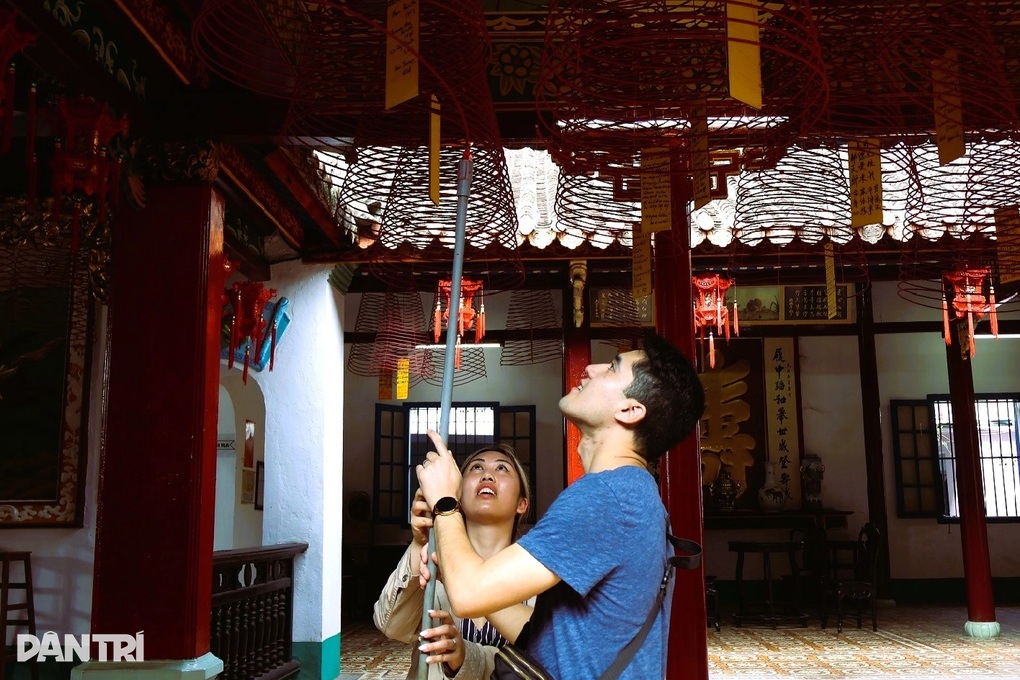 Tourists attach prayer tags to incense coils, which can burn for 30 days (Photo: Ngo Linh).
Moving inside, visitors will reach the inner sanctuary. This is where the six Royal Family Deities, twelve midwives, and three goddesses of childbirth are worshipped. Additionally, visitors can light large incense sticks to pray for health, wealth, and good fortune for their family and loved ones in this area.
What's special is that the incense sticks can burn for up to 30 days. After the incense burns out, people in the temple will burn the pieces of paper with your wishes written on them. This is what makes the prayers even more sacred.
Furthermore, the assembly hall also preserves many valuable artifacts, including: bronze bells, statues, bronze drums, incense burners, and 14 exquisite horizontal plaques… Therefore, this place not only has historical significance but also immense cultural value.
The Fujian Assembly Hall in Hoi An is busiest on holidays and the first and fifteenth days of each lunar month. On the Lantern Festival (15th day of the first lunar month), the Thien Hau Festival (23rd day of the third lunar month), and other special occasions, the assembly hall hosts numerous festive activities annually.
Source: https://dantri.com.vn/du-lich/hoi-quan-hon-300-tuoi-mang-dam-net-trung-hoa-giua-long-hoi-an-20241113122355254.htm











![[Video] The craft of making Dong Ho folk paintings has been inscribed by UNESCO on the List of Crafts in Need of Urgent Safeguarding.](https://vphoto.vietnam.vn/thumb/402x226/vietnam/resource/IMAGE/2025/12/10/1765350246533_tranh-dong-ho-734-jpg.webp)




























































Comment (0)