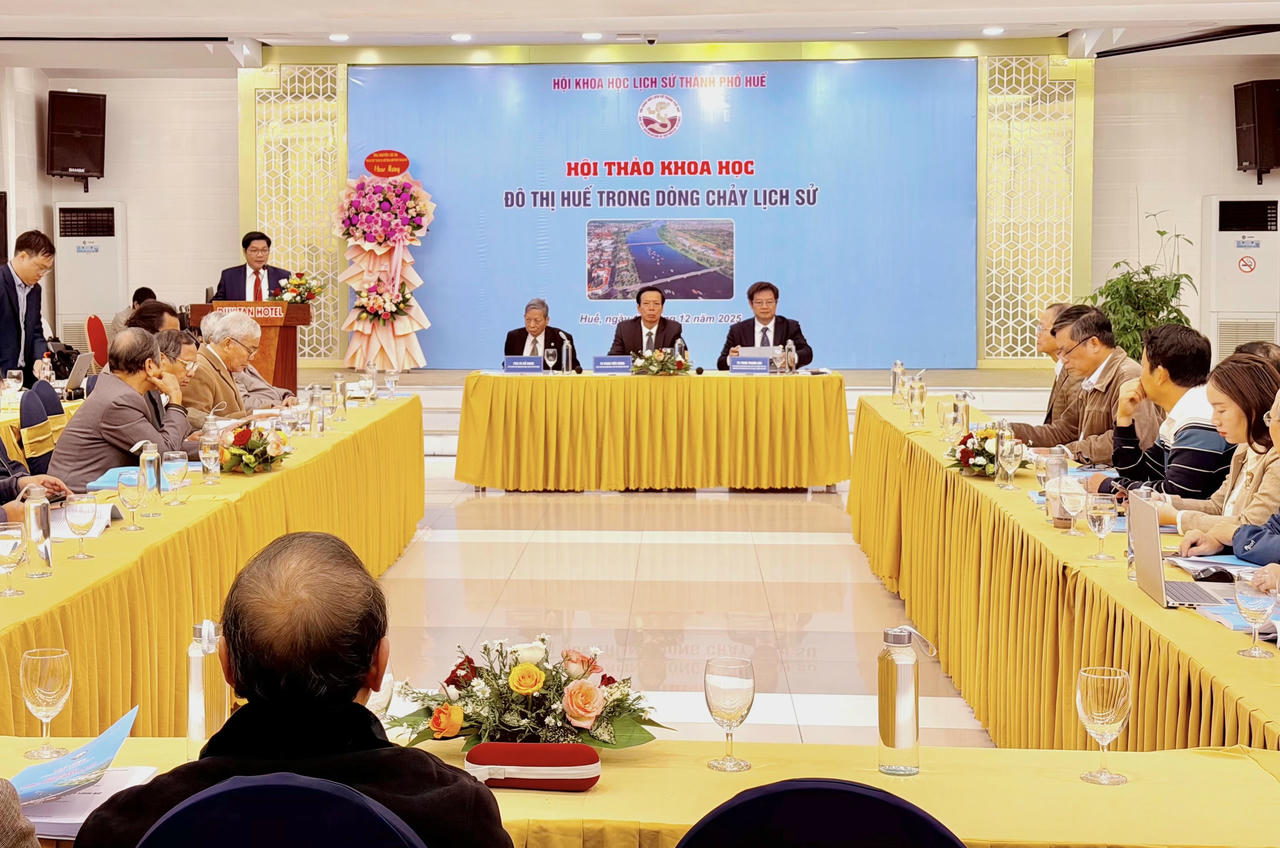
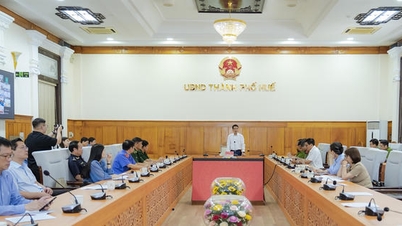
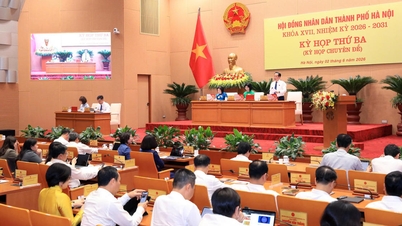
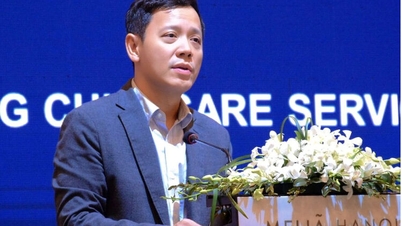
The scene at the conference.
The workshop was assessed as a profound scientific activity, focusing on discussing the urban identity of Hue and its development orientation in the new context. The Organizing Committee announced that it had received 31 papers, of which 22 outstanding papers were selected for direct presentation at the workshop.
The workshop's content revolved around three main groups of issues: the process of formation and development of Hue city through different periods; identifying the distinctive values and identity of Hue city; and the challenges facing current urban development in relation to the goal of becoming a centrally-governed city by 2025.

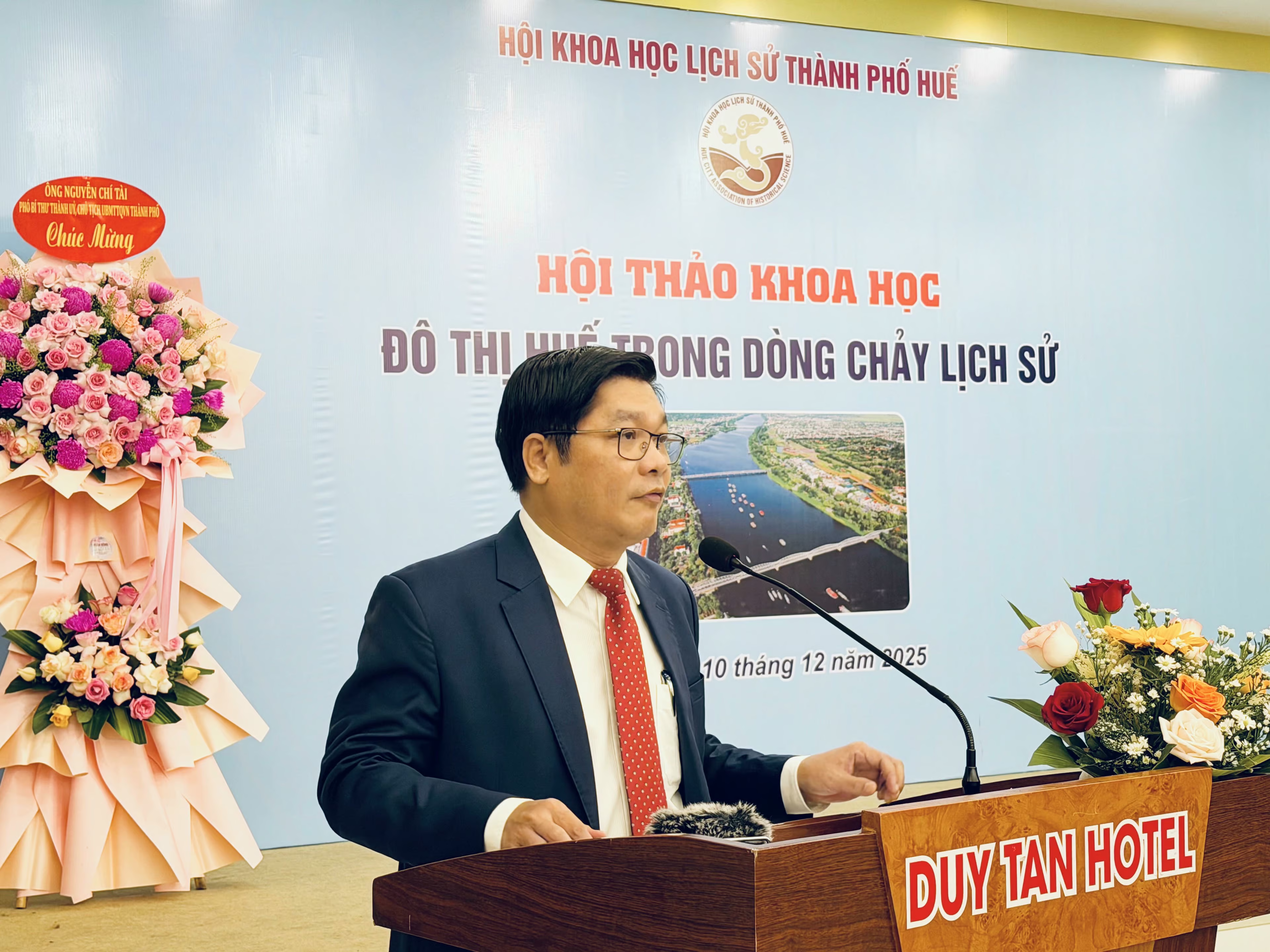
The leaders of Hue City delivered the opening remarks at the workshop.
In the thematic group on the formation and development of Hue city through different periods, many noteworthy presentations focused on clarifying the initial structure and important transformations of Hue city. These included studies such as: "The Ancient Champa Citadel in Hue" (Nguyen Xuan Hoa), "Thuan Hoa - Phu Xuan - Hue in the process of national history" (MSc. Nguyen Anh Tuan), "From land reclamation and village establishment to the urban development of Phu Xuan - Hue" (Dr. Thai Quang Trung), "Thanh Ha - a trading port city during the Nguyen Lords' era in the 17th - 18th centuries" (Assoc. Prof. Dr. Do Bang), and "The urban development process of Hue from the beginning of the 20th century to the present" (Dr. Le Thi An Hoa).
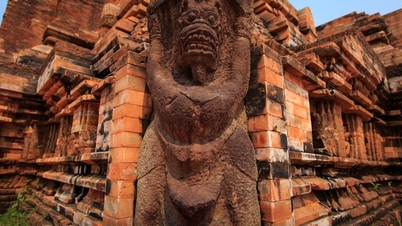
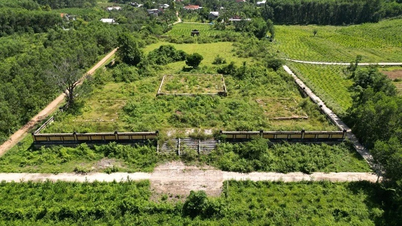
In his study "Ancient Champa Citadel in Hue," researcher Nguyen Xuan Hoa examines historical documents, including records in Li Dao Yuan's *Shui Jing Zhu* (6th century) about Tuong Lam district, the capital of Khu Lat, and the Lam Ap kingdom – which many scholars believe corresponds to the area of present-day Thua Thien - Hue. From this, the author hypothesizes that Thanh Loi may have been the Khu Lat citadel of Lam Ap, while also considering the transformation of this site into Hoa Chau and then Hoa Chau citadel of Dai Viet.
The author observes that the search for traces of ancient Champa citadels in Hue, from the Lam Ap period to before 1306, still has many gaps and hidden aspects in research. However, based on existing discoveries and works, this study hopes to contribute to a more systematic perspective and open up avenues for further in-depth research on Champa heritage in the Hue region.
In her paper "The Commercial Activities of the Nguyen Lords in Dang Trong in the 17th-18th Centuries Linked to the Development of the Hue Urban Area in History," Dr. Hoang Thi Anh Dao argues that the Nguyen Lords had an open policy and established trade relations with countries such as China, Portugal, the Netherlands, England, and France. It was thanks to this open trade policy that the Hue urban area historically developed into a bustling trading port and urban center. On the one hand, this contributed to the prosperous development of the newly settled land, improving the lives of the people; on the other hand, it provided essential goods for the Nguyen Lords' capital in Phu Xuan.
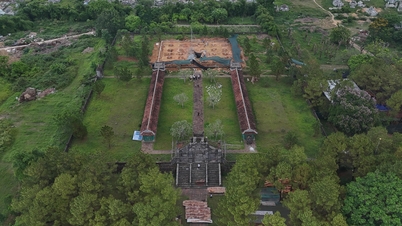
In the group of issues related to identifying the distinctive values and urban identity of Hue, many diverse approaches were noted, ranging from architecture and culture to urban planning. Typical examples include: “Hue Imperial City - the pinnacle of Vietnamese architectural and construction art in the 19th century” (Dr. Phan Tien Dung); “The role of religious and belief architecture in creating the identity of Hue heritage city” (MSc. Nguyen Huu Phuc); “Hue city viewed from national-level ceremonial relics of the Nguyen dynasty” (Dr. Huynh Thi Anh Van); and “The school system along the Perfume River before 1975: From symbols of knowledge to the transformation of the urban landscape” (Assoc. Prof. Dr. Nguyen Tat Thang and colleagues).
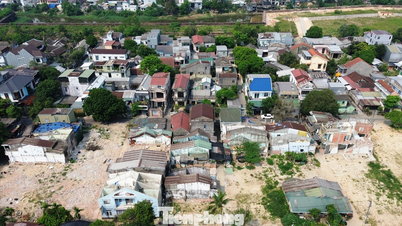
In her study "Some Characteristics of Urban Planning in Hue during the French Colonial Period (from the late 19th century to the first half of the 20th century)", Ms. Nguyen Thu Hang outlines three core characteristics that shaped the Hue urban model. Firstly, the bipolar structure with the Perfume River as a natural boundary: the North bank maintained its role as the political , ceremonial, and traditional Citadel center, while the South bank developed into an administrative and commercial center following the modern European urban model. Secondly, the Perfume River served as the main planning axis, simultaneously separating spaces, acting as a landscape axis, and connecting the city, guiding the layout of public buildings and creating balance with the heritage of the North bank. Thirdly, the localization aspect in the modernization process, where French-style planning was adjusted to suit the local natural conditions, culture, and feng shui, thereby forming an urban area with a reasonable building density, a gentle flow, and a unique aesthetic identity of Hue.
In his study "Tung Thien Vuong Palace: A Cultural Imprint of the Aristocracy in the Urban Heritage Flow of Hue," Dr. Tran Van Dung stated: "In the historical flow of Hue city, Tung Thien Vuong Palace stands out as a typical testament to the cultural values of the Nguyen Dynasty's aristocracy – a class that contributed to shaping the refined, elegant, and erudite identity of the imperial capital. More than just an architectural work bearing the strong imprint of the royal court, this palace is also a unique cultural space, a place where the values of court literature and art converge and spread to folk life, thereby contributing to the cultural foundation of Hue's urban heritage."
In the section on current urban development issues, the scientists focused on analyzing the challenges facing the current urban development of Hue, emphasizing the need to preserve heritage alongside modern development. Notable topics include: “From the Nguyen Dynasty's water management philosophy to contemporary challenges in Hanoi, Hue, and Ho Chi Minh City” (Assoc. Prof. Dr. Nguyen Tat Thang, MSc. Tran Cong Nhat); “The decisive role of the Perfume River in the formation and sustainable development of Hue city” (Dr. Nguyen Dinh); “Hue city: An approach to heritage preservation and promotion” (Assoc. Prof. Dr. Nguyen Van Manh); and “Hue - from a historical city to a heritage, green, and smart city in the new era” (Dr. Phan Thanh Hai).
In his research on "Hue - From a historical city to a heritage, green, and smart city in the new era," Dr. Phan Thanh Hai stated: "Today, Hue is rising to a new level, transforming from a historical city into a heritage city, from a conservation city into a creative city, and from a traditional city into a green and smart city. The spirit of 'streamlined administration - expert governance - refined culture' is evident in all aspects of life. The two-tiered government model, comprehensive digital transformation, and the development of creative cultural and tourism industries are building an image of Hue as a dynamic, humane, and sustainable city."
In their paper "Architecture and Landscape of Hue Imperial Gardens in the Ecological Urban Structure," authors Le Nguyen Huu Duy, Dr. Nguyen Ngoc Tung, and Dr. Bui Thi Hieu affirmed that a comprehensive study of the history of formation, architectural and landscape characteristics, and cultural and ecological values of Hue Imperial Gardens is an important scientific basis for proposing appropriate conservation solutions in the new context. Conservation work not only aims to preserve a rare type of heritage, but also contributes to maintaining urban identity, strengthening Hue's "cultural DNA," and moving towards a sustainable heritage urban development model in the 21st century…
The discussions and exchanges of opinions at the workshop contributed to a clearer understanding of the urban values of Hue through each historical period; at the same time, they proposed many solutions and scientific arguments to serve the future urban development orientation. Many researchers continued to clarify the geopolitical factors in the early formation of Hue's urban space, the relationship between the royal city and the commercial city, as well as the potential of the heritage city in a sustainable development strategy.
The Organizing Committee stated that the scientific results from the workshop will serve as an important basis for policy planning, urban planning, and the implementation of targeted programs in Hue City in the coming period.
Source: https://baophapluat.vn/nhan-dien-gia-tri-de-phat-trien-hue-thanh-do-thi-di-san.html


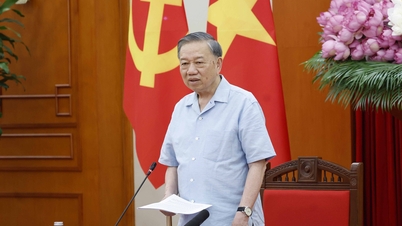
![[Photo] General Secretary and President To Lam presides over a meeting on preparations for the review of one year of operation of the three-tiered government system.](https://vphoto.vietnam.vn/thumb/1200x675/vietnam/resource/IMAGE/2026/06/02/1780391821195_a1-bnd-4595-9717-jpg.webp)



















































Comment (0)