

Mr. Hoang Viet Trung, Director of the Hue Monuments Conservation Center, said that in the near future, this unit will move to a new working location, returning the space of the Privy Council (also known as Tam Toa, Phu Xuan ward, Hue city), formerly an important agency of the Nguyen Dynasty.
According to Mr. Trung, the unit will develop a plan to renovate and exploit appropriate services to promote the Privy Council relic, orienting this place to become a heritage education address for young generations.
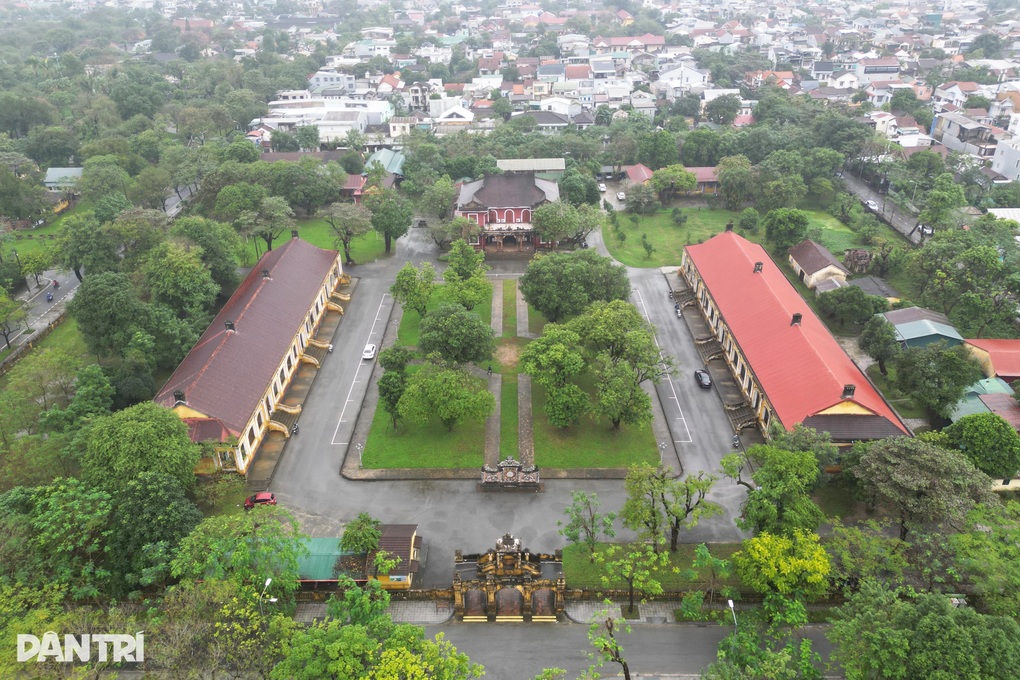
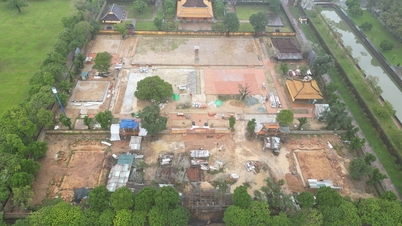
The Nguyen Dynasty Privy Council relic is currently located at 33 Tong Duy Tan, Phu Xuan ward, Hue city (Photo: Vi Thao).
In the future, the Privy Council relic will connect with the Nguyen Dynasty Imperial Academy (after restoration), the Royal Antiquities Museum, as well as other relics in the southeast corner of Hue Imperial Citadel, creating a unique, international-class cultural, historical and educational space to serve tourists and residents.
According to historical documents, the location of the Privy Council (or Tam Toa) was formerly the capital of Phu Xuan, chosen by Lord Nguyen Phuc Khoat to build in 1738.
After its construction, this place became the political and cultural center of Dang Trong region of the Nguyen lords until 1775. After that, the capital was occupied by Trinh army (1775-1786), then became the capital of Tay Son dynasty (1786-1801).

Many rare antiques were displayed at the Privy Council on the occasion of Vietnam Cultural Heritage Day (Photo: Vi Thao).
In 1802, King Gia Long ascended the throne, the capital Phu Xuan was demolished, this location was used to build a residence for Prince Dam (later King Minh Mang).
In the 20th year of Minh Mang (1839), this land was taken back to build Giac Hoang national temple, the temple was listed by King Thieu Tri as one of the 20 scenic spots of the imperial capital at that time.
According to cultural researcher Nguyen Xuan Hoa, the remaining vestige of Giac Hoang Pagoda today is Phuong Thanh well, built of blue stone.
When the capital Hue fell (1885), the royal court moved all Buddha statues and worship objects from Giac Hoang Pagoda to Dieu De National Temple (Bach Dang Street, Phu Xuan Ward).

Phuong Thanh Well, the remaining vestige of Giac Hoang Temple, one of the 20 scenic spots of the former Hue Capital (Photo: Vi Thao).
The entire architecture of Giac Hoang Pagoda was demolished by the French colonialists to build three new buildings, including the Privy Council, the Economic Museum, and the Ministry of Health Office, collectively known as Tam Toa, completed in 1903, under the reign of King Thanh Thai.
From 1955 to 1975, under the old regime, the two side buildings became offices of local judicial agencies, while the main building (ie the Privy Council) was used to hear cases from first instance to appeal.
In 1975-1976, the Thien Hue Military Administration Committee was stationed and worked in this area. In the period 1976-1989, Tam Toa became the headquarters of the Binh Tri Thien Provincial Party Committee, then the Thua Thien Hue Provincial Party Committee.
From October 2000 to present, Tam Toa was transferred and became the headquarters of the Hue Monuments Conservation Center.
The Privy Council relic was ranked as a national relic by the Ministry of Culture and Information (now the Ministry of Culture, Sports and Tourism) in 2004.
According to researchers, the Privy Council was established by King Minh Mang in 1834 to consult on confidential matters, especially military matters.
The Privy Council was initially located in the Ta Vu house (inside the Hue Imperial Citadel). After the fall of Hue in 1885, this agency had to move to the residence of the Ministry of Rites, then the Ministry of War (the headquarters of the Six Ministries on Nguyen Chi Dieu Street, Phu Xuan Ward today) and finally moved to the Giac Hoang Pagoda grounds in 1903.
Source: https://dantri.com.vn/du-lich/di-tich-vien-co-mat-trieu-nguyen-thu-phu-phu-xuan-mot-thoi-20251206095215587.htm


![[Photo] National Assembly Chairman Tran Thanh Man attends the VinFuture 2025 Award Ceremony](/_next/image?url=https%3A%2F%2Fvphoto.vietnam.vn%2Fthumb%2F1200x675%2Fvietnam%2Fresource%2FIMAGE%2F2025%2F12%2F05%2F1764951162416_2628509768338816493-6995-jpg.webp&w=3840&q=75)
![[Photo] 60th Anniversary of the Founding of the Vietnam Association of Photographic Artists](/_next/image?url=https%3A%2F%2Fvphoto.vietnam.vn%2Fthumb%2F1200x675%2Fvietnam%2Fresource%2FIMAGE%2F2025%2F12%2F05%2F1764935864512_a1-bnd-0841-9740-jpg.webp&w=3840&q=75)






























































Comment (0)