

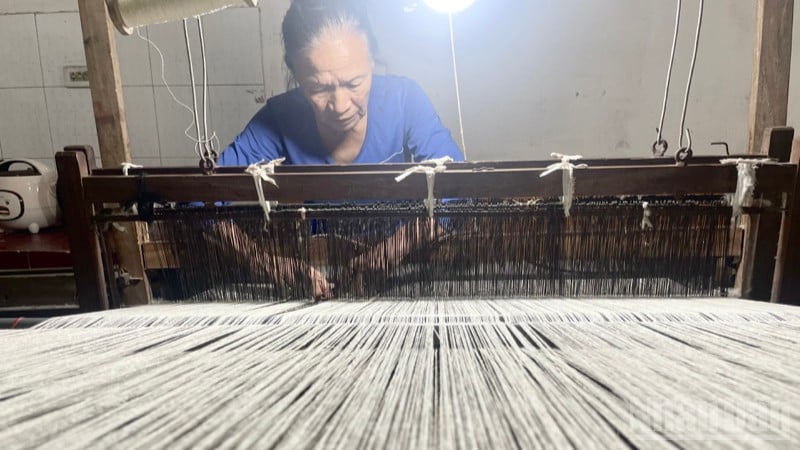
Artisans of Nam Cao linen weaving village.
Right from the beginning of the village, the sound of weaving looms resounds, evoking the bustling life of the long-standing craft community. The people not only preserve the traditional craft but also expand the experiential space for tourists to visit, learn and fully appreciate the value of a typical fabric.
Although there are not many manual looms operating in the "foot-stepping, hand-pulling" way anymore, in Nam Cao village (Le Loi commune, Hung Yen province) today, semi-manual looms with improved motors have significantly increased productivity.
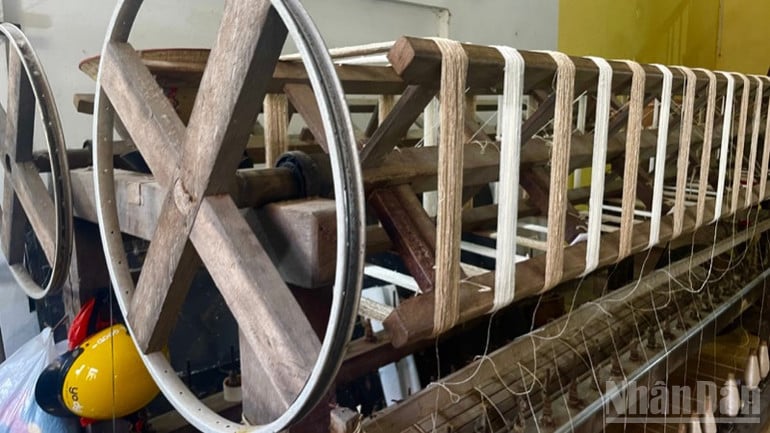
Semi-manual looms increase productivity.
Previously, each weaver could only make 2-3 meters of fabric per day, but now they can make 30-40 meters thanks to improved equipment. However, some special fabrics still need to be woven on a loom to ensure the quality and sophistication of the product.
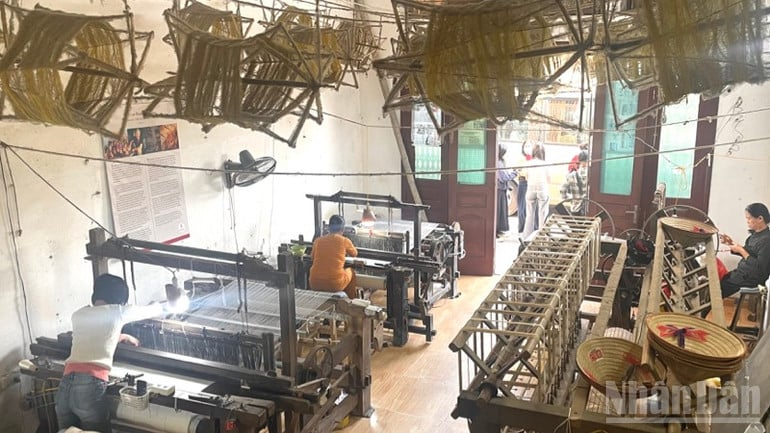
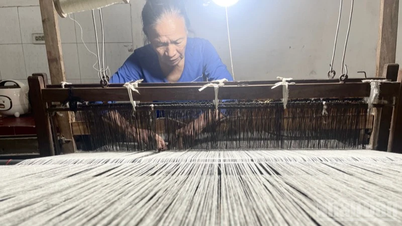
Bustling working atmosphere at the loom.
Historically, Nam Cao linen weaving village had a period of brilliant development. After many changes, production activities are now mainly concentrated in two enterprises, a few households, the main one of which is Nam Cao Linen Weaving Cooperative. Established in 2016, the cooperative has gradually built mulberry growing and silkworm raising areas, proactively providing raw materials for members and associated households. Up to now, the unit has supported nearly 90 households to maintain the profession, creating stable jobs for about 150 workers directly participating in the stages of spinning, weaving and finishing products.
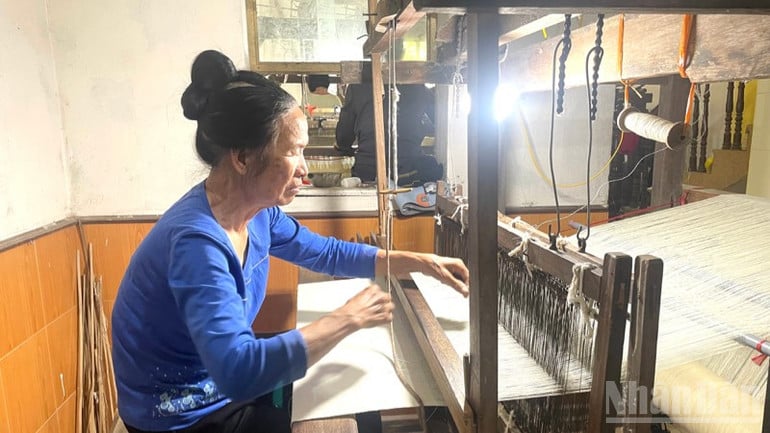
The color of the silk gradually appears with each swing.
Mr. Ha The Cong, Head of the Culture and Society Department of Le Loi Commune, said: In the 1980s, the linen weaving profession was very prosperous. Nam Cao linen products were exported to international markets. However, around 1990, the profession declined, many households had to switch to other jobs. Currently, the commune still has two large production facilities, including the Nam Cao Linen Weaving Cooperative, maintained and promoted by dedicated people, bringing products abroad while supporting people to expand production scale. Currently, the commune has planned a 29-hectare western area. In the coming time, the cooperatives will be moved here to create a space to preserve the craft village associated with developing cultural and ecological tourism , opening a more sustainable direction for the traditional profession.
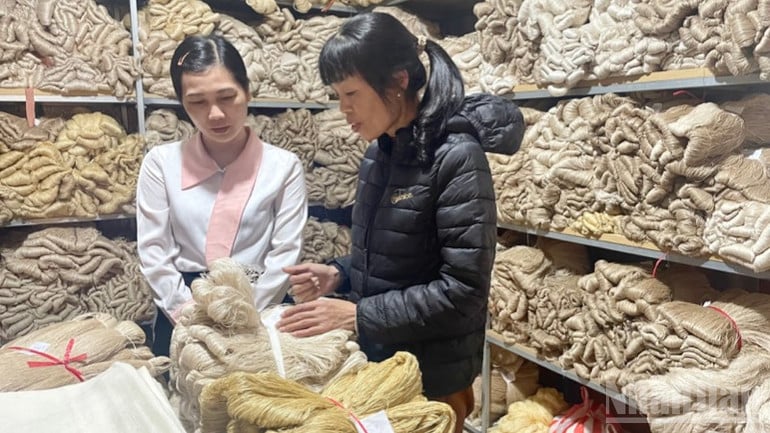
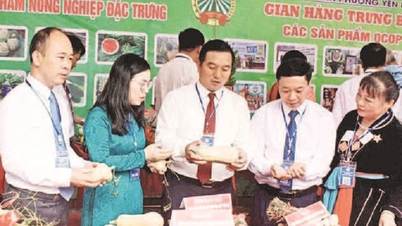
Introduce products to visitors.
Nam Cao linen products are woven from the cored silk, creating a natural rough but soft and airy material. The production process requires meticulousness and diligence in all stages: growing mulberry, raising silkworms, spinning, winding, spinning, weaving and dyeing. The stage of spinning silk from silkworm cocoons is the most difficult. Workers must soak their hands in water for 8-10 hours to spin silkworms. Each day, each worker can only spin 70-100 grams of linen.
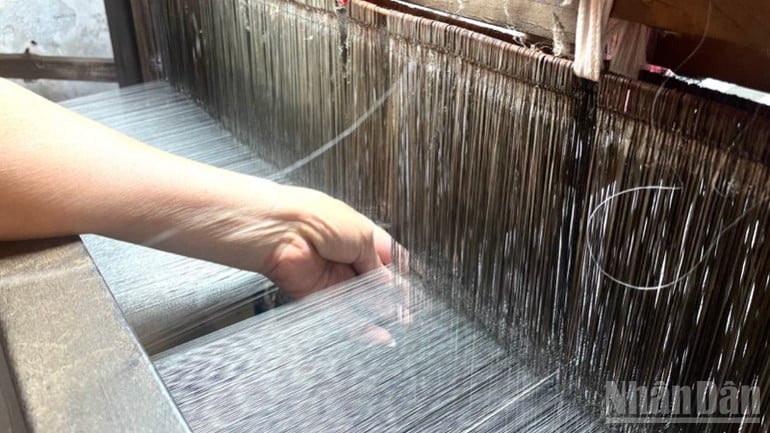
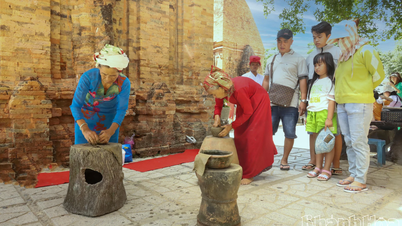
The silky threads.
With its natural materials and diverse applications, Nam Cao linen is used to produce fabrics, ao dai, skirts, scarves, bags, blankets, pillowcases, decorative products, etc. Recently, the Nam Cao linen silk bedding set of Nam Cao Linen Weaving Cooperative was recognized as a 4-star OCOP product. This is a great source of encouragement for artisans who persevere in their profession.
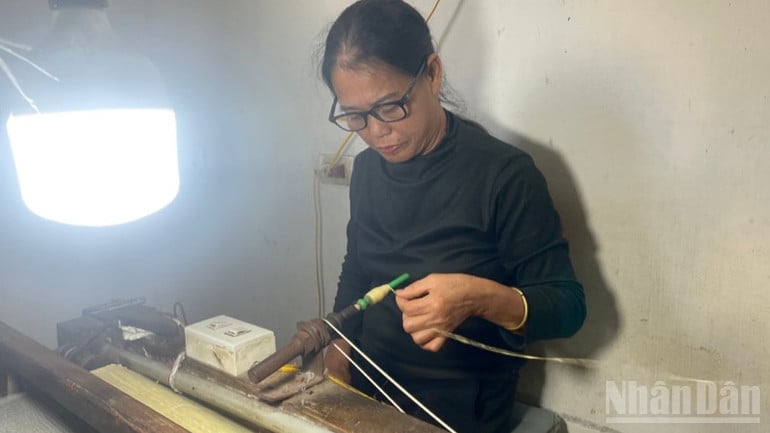
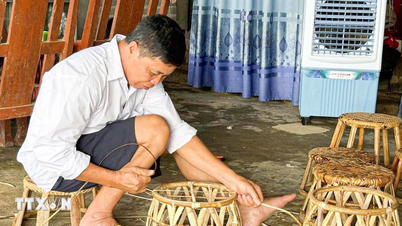
The workers are persistent in keeping their profession.
Not only preserving the traditional craft, Nam Cao linen weaving village is focusing on developing experiential tourism. The village has begun to welcome domestic and foreign visitors to visit and learn about the production process; visitors can listen to artisans tell stories about the craft, directly spin yarn, weave fabric, dye scarves... thereby spreading the cultural value of the craft village in contemporary life.
NGOC LIEN
Source: https://nhandan.vn/bon-the-ky-gin-giu-va-lan-toa-di-san-nghe-det-dui-nam-cao-post928228.html
![[Photo] 60th Anniversary of the Founding of the Vietnam Association of Photographic Artists](/_next/image?url=https%3A%2F%2Fvphoto.vietnam.vn%2Fthumb%2F1200x675%2Fvietnam%2Fresource%2FIMAGE%2F2025%2F12%2F05%2F1764935864512_a1-bnd-0841-9740-jpg.webp&w=3840&q=75)

![[Photo] Cat Ba - Green island paradise](/_next/image?url=https%3A%2F%2Fvphoto.vietnam.vn%2Fthumb%2F1200x675%2Fvietnam%2Fresource%2FIMAGE%2F2025%2F12%2F04%2F1764821844074_ndo_br_1-dcbthienduongxanh638-jpg.webp&w=3840&q=75)















![[Infographic] Air pollution and recommendations from the Ministry of Health](https://vphoto.vietnam.vn/thumb/402x226/vietnam/resource/IMAGE/2025/12/05/1764950568593_screen-shot-2025-12-05-at-222015-png.webp)



























































Comment (0)