

Nguyen Dynasty woodblocks are a particularly rare heritage, besides their historical value, they also have value in terms of the art of making. Therefore, the woodblocks were recognized by UNESCO as a Documentary Heritage under the Memory of the World Program in 2009. This is the first World Documentary Heritage of Vietnam.
With invaluable resources, in 2016, the Prime Minister approved the project "Preserving and promoting the value of Nguyen Dynasty Woodblocks - World Documentary Heritage".
Extremely rare heritage
The Nguyen Dynasty Woodblocks are currently preserved at the National Archives Center IV (Cam Ly Ward - Da Lat, Lam Dong Province), including 33,976 plates, temporarily divided into more than 100 books with many topics such as history, geography, politics - society, military, law, culture - education, religion - ideology - philosophy, language - writing; literature and poetry.
This is a reliable source of historical data, still quite intact for research, comparison, serving the study of Vietnamese history in many fields. Director of the National Archives Center IV Nguyen Xuan Hung said that Nguyen Dynasty Woodblocks are a special type of document in terms of form, content and production method; they are the originals of famous official documents and official histories of Vietnam compiled and printed mainly under the Nguyen Dynasty. Woodblocks were formed mainly by the technique of reverse engraving Han Nom characters on wood to print books, were commonly used in the feudal period and are still preserved today.
Woodblock documents are chronicles that were compiled and engraved very elaborately. Only by approaching these valuable documents can one see the talent of the Vietnamese people. Having talked with Mr. Nguyen Thanh Chau, former lecturer of Han-Nom at Da Lat University, I learned that the most common type of wood used to make engraving boards is Thi wood. This wood is tough, soft and smooth, and is difficult to crack or warp, so the engravings on it are not crooked. The book Dai Nam Nhat Thong Chi also records that the woodblocks were also made from Nha Dong tree, commonly known as Song Mat, with white wood grain, shining like ivory. Therefore, after hundreds of years, the woodblocks are still in quite good condition.
Nguyen Dynasty woodblocks have some engraved in Chinese calligraphy (plain, simple characters), many engraved in Chinese calligraphy (Chinese calligraphy), many engraved with diagrams, maps, paintings, and motifs. The letters on the woodblocks are very small in size, with many strokes, and some are delicate. Even after hundreds of years, when printed, the letters on the paper are still sharp.
Many experts believe that woodblocks are not only valuable documents, but also demonstrate the skillful art of engraving. According to Han-Nom teacher Nguyen Thanh Chau, the pinnacle of the Nguyen Dynasty woodblock making technique is the art of carving in detail every line of patterns, motifs, maps, drawings and the king's seal. It can be seen that woodblocks have very high artistic value.
In the massive woodblock heritage of nearly 34 thousand plates, the National Archives Center IV is currently preserving precious books printed from the Nguyen Dynasty woodblocks, such as: Dai Viet Su Ky Toan Thu, Dai Nam Thuc Luc, Kham Dinh Dai Nam Hoi Dien Su Le, Minh Menh Chinh Yeu, Dai Nam Nhat Thong Chi... All are preserved by a modern specialized "warehouse within a warehouse" system.
Spreading the value of woodblock documents
Over the years, the National Archives Center IV has become an attractive destination for domestic and international tourists on their journey to explore and experience the land of thousands of flowers, Da Lat. Along with visiting the "first palace" on the plateau built in 1958, visitors can also visit and learn about the Nguyen Dynasty Woodblocks Heritage, which is preserved, displayed and introduced here.
Director of the National Archives Center IV Nguyen Xuan Hung said that in 2007, the center officially opened and opened the archival document exhibition area. Two years later, the book “Nguyen Dynasty Woodblocks - Overview” was compiled in the form of an e-book and a printed book to publish and introduce the woodblock documents to domestic and international researchers.
On that basis, the center continues to compile and publish many books and documentaries from the woodblock values, such as two books "Thang Long-Hanoi examination results through the Nguyen Dynasty Woodblock documents", "Nguyen Dynasty Woodblocks - The Decree on the Transfer of the Capital and Some Masterpieces", or the book "Complete collection of meritorious officials of the Nguyen Dynasty through the Woodblock documents - World Documentary Heritage"...; carry out thematic exhibitions "World Documentary Heritage of Imperial Records and Woodblocks - Historical Values from Memory" and "Nguyen Dynasty with the Compilation of National History" using glass paintings to serve the public to enjoy and learn. In recent years, the center has organized many activities of publication, exhibition and introduction to promote the heritage value, bringing woodblock documents closer to the public.
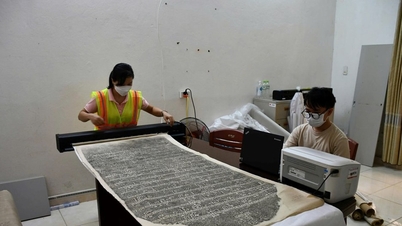
Nowadays, with the development of science and technology, the National Archives Center IV has promoted the application of AI, contributing to improving the efficiency of archiving work, while strongly spreading the value of documents to the public. Currently, the center uses 3D Mapping technology to create interactive image blocks in three-dimensional space.
In the “Nguyen Dynasty Woodblock Space Digital” area, when touching the screen, visitors can see vivid images of woodblock documents and can watch the compilation and printing process through Hologram projection technology. Viewers can also enjoy famous woodblock works with VR 360 virtual reality technology… “Technology has brought documentary and historical heritage closer to the public, very lively and attractive”, shared tourist Le Thi Ha from Hanoi.
However, AI applications require strict compliance with certain principles, such as compliance with the 2024 Archives Law and regulations on cybersecurity, state secrets, intellectual property, and personal data protection. At the same time, there must be solutions to protect digital documents and AI-processed data from the risk of unauthorized access, cyber attacks, and data loss; and to ensure the integrity, accuracy, and objectivity of documents to prevent the risk of AI misinterpretation.
According to Mr. Hung, to make AI a powerful tool in archiving, it is necessary to build and perfect a legal corridor, synchronous technical standards; make strategic investments in technology infrastructure, data platforms and the key factor is to develop high-quality human resources.
Source: https://baolamdong.vn/phat-huy-gia-tri-tai-lieu-moc-ban-trieu-nguyen-408241.html


![[Photo] Cat Ba - Green island paradise](/_next/image?url=https%3A%2F%2Fvphoto.vietnam.vn%2Fthumb%2F1200x675%2Fvietnam%2Fresource%2FIMAGE%2F2025%2F12%2F04%2F1764821844074_ndo_br_1-dcbthienduongxanh638-jpg.webp&w=3840&q=75)


































![[VIMC 40 days of lightning speed] Da Nang Port: Unity - Lightning speed - Breakthrough to the finish line](https://vphoto.vietnam.vn/thumb/402x226/vietnam/resource/IMAGE/2025/12/04/1764833540882_cdn_4-12-25.jpeg)








































Comment (0)