

The traditional bamboo and rattan weaving profession has long become a unique cultural feature, contributing to the unique cultural appearance of the Thai ethnic group in Dien Bien province.
Not simply a means of labor serving daily life, weaving also contains valuable folk knowledge, accumulated over many generations and passed down as an important part of community life.
Until now, this traditional profession still exists in every household, becoming a stable livelihood for people and a symbol of enduring cultural identity in the face of changing times.
Rich cultural identity from talented hands
The Thai people in Dien Bien have a long history of rattan and bamboo weaving and are closely associated with community production. The first products were simple household items - trays, baskets, trays, etc.
However, over time, with the creativity and skillful hands of craftsmen, weaving techniques have become increasingly sophisticated and diverse in design, serving both daily life, religious and production needs.
Nowadays, the bamboo and rattan weaving profession is strongly developed in the communes of Na Tau, Muong Ang, Na Sang, Muong Cha... Here, the most easily recognizable characteristic of the products of the Thai people is the rusticity and simplicity of shape but reaching a high level of sophistication in technique.
The artisan must not only be skillful but also have a deep understanding of the materials, from choosing rattan and bamboo to splitting, shaving and weaving techniques.
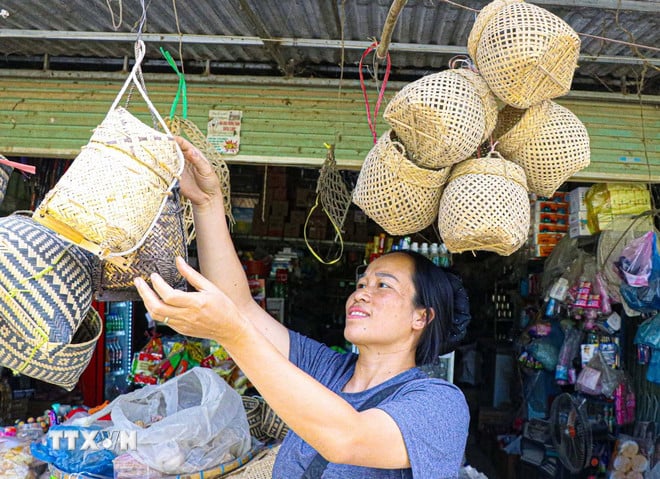
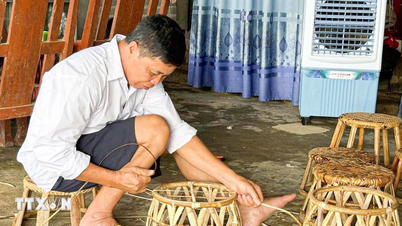
With their skillful hands, the Thai people have created sophisticated woven products in diverse shapes and used for many purposes in people's lives. (Photo: Phan Quan/VNA)
To make a durable and beautiful product, the craftsman must be meticulous right from the stage of choosing the raw materials. Bamboo used for weaving is usually old trees, although the appearance is not eye-catching, but it is flexible and sturdy.
Rattan or reed must be old, high-growing, yellow or dark green to ensure softness and durability over time. Smooth, unbroken, unconnected bamboo fibers will create a product that is both beautiful and sturdy.
After splitting the bamboo, the craftsman shaves the bamboo to make it smooth, even, and soft so that when weaving, the seams are tight together, creating continuity and firmness.
Depending on the product, Thai people use different weaving techniques: single bamboo basket, double bamboo basket, triple bamboo basket… With each technique, the craftsman's hands seem to put into it all their patience, skill and artistic soul.
Products can have many shapes: cylindrical body, square bottom, round mouth, ladder shape, flared shape... all based on the purpose of use and the creativity of the artisan.
Keeping the profession in the modern flow
Besides its cultural value, bamboo and rattan weaving also contributes significantly to economic development in Thai ethnic areas.
In Na Sang commune (Muong Cha district), the bamboo and rattan weaving profession is still maintained by dozens of households, especially in Co Dua, Na Sang 1 and Na Sang 2 villages.
Thanks to the increasing demand for environmentally friendly products, rattan and bamboo products have become popular. Businesses and traders regularly purchase them, helping people feel secure in their production.
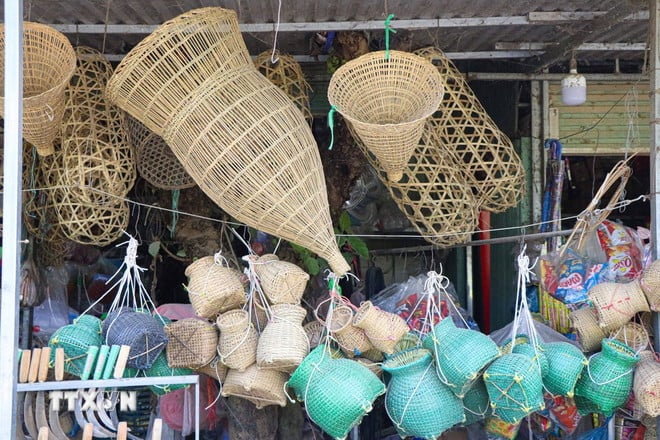
Although the household items are simple in shape, the production techniques are very sophisticated, requiring the meticulousness of talented and skillful hands. (Photo: Phan Quan/VNA)
Each month, many households can sell dozens of products, with income ranging from several hundred thousand to several million VND depending on the design and complexity.
Products such as trays, trays, and baskets cost from 50,000 to 400,000 VND, while especially sophisticated products such as rattan rice trays can cost more than 1 million VND.
Not only does it bring a stable income, traditional crafts also create jobs for people during their off-season, helping them stay connected to their village and their ancestors' culture, while reducing the pressure of leaving work.
National intangible cultural heritage - new pride
With profound cultural and social values, the Ministry of Culture, Sports and Tourism has decided to recognize “The rattan and bamboo weaving technique of the Thai people in Dien Bien province” as a national intangible cultural heritage. This is a great honor for the Thai people in particular and Dien Bien province in general, and at the same time affirms the lasting value of a traditional craft rich in national identity.
This event opens up a new direction for the bamboo and rattan weaving profession, especially in connection with tourism development.
Localities are encouraging people to invest in more designs and create products that combine traditional patterns with modern styles, turning familiar items into typical souvenirs of Dien Bien.
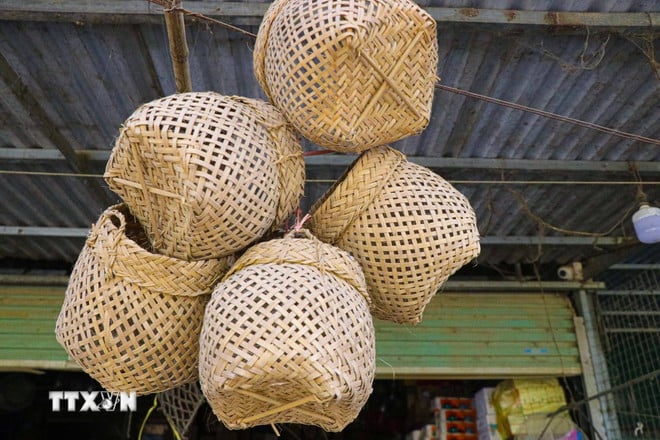
Although the household items are simple in shape, the production techniques are very sophisticated, requiring the meticulousness of talented and skillful hands. (Photo: Phan Quan/VNA)
According to the leaders of Dien Bien province, in the coming time, the cultural sector will focus on building mechanisms and policies to support the preservation and promotion of the weaving profession, accompanying businesses and people in diversifying products, expanding the tourism market, and enhancing the economic value of heritage.
Along with that is propaganda and promotion work to raise community awareness, turning heritage into real assets - an important resource for sustainable development.
The bamboo and rattan weaving profession of the Thai people in Dien Bien is not only a testament to the creativity of the mountain residents, but also a symbol of the community's resilience and cultural fortitude in the face of changes in modern society.
The State's recognition is the driving force for traditional crafts to continue to be preserved, so that each rattan and bamboo product not only has practical value, but also tells a story about culture, about people and about the land of Dien Bien with rich identity./.
(Vietnam+)
Source: https://www.vietnamplus.vn/nghe-may-tre-dan-cua-nguoi-thai-di-san-ben-vung-giua-dong-chay-hien-dai-post1075297.vnp
![[Photo] Cat Ba - Green island paradise](/_next/image?url=https%3A%2F%2Fvphoto.vietnam.vn%2Fthumb%2F1200x675%2Fvietnam%2Fresource%2FIMAGE%2F2025%2F12%2F04%2F1764821844074_ndo_br_1-dcbthienduongxanh638-jpg.webp&w=3840&q=75)





























































Comment (0)