

The national target program on socio -economic development in ethnic minority and mountainous areas for the 2021-2030 period has special significance, is an unprecedentedly large resource, helping to synchronously solve difficult problems that have lasted for decades, making an important contribution to changing the face of ethnic minority areas and improving the quality of people's lives.
This is the sharing of Mr. Nguyen Quoc Luan, Director of the Department of Ethnic Minorities and Religions, Lao Cai province, National Assembly delegate of Lao Cai province with reporters of VietnamPlus Electronic Newspaper on the sidelines of the 10th session of the 15th National Assembly.
Big "boost" for poor provinces
- Sir, the National Target Program for Socio-Economic Development of the Region The program for ethnic minorities and mountainous areas in the period 2021-2030 has completed phase 1 (2021-2025). As one of the provinces with a majority of ethnic minority people, how do you assess the significance of this program for Lao Cai?
Mr. Nguyen Quoc Luan: For Lao Cai - where ethnic minorities account for nearly 58% of the population - the National Target Program for Socio-Economic Development in Ethnic Minority and Mountainous Areas has a very special significance. This is not only the largest resource ever for ethnic minority areas but also an important "push" to help the province synchronously solve difficult, decades-long problems such as lack of housing, clean water, basic infrastructure and sustainable livelihoods.
After 5 years of implementation, 100% of communes have car roads to the center, 100% of commune health stations are solid; more than 9,000 households have been supported to build new or repaired houses; tens of thousands of households have been provided with domestic water; hundreds of essential infrastructure works have been put into use.
Livelihood models, production development, value chain linkages, etc. have helped the income of ethnic minorities in the province increase more than twice compared to 2021 - before the Program implementation. The poverty rate in ethnic minority areas has decreased by an average of 6.7% per year. The material and spiritual life of the people has clearly improved, and people's trust in the major policies of the Party and the State has been strongly strengthened.
- One of the key projects of the Program in phase 1 is to preserve and promote the traditional cultural values of ethnic minorities in association with tourism development. Could you tell us about the significance of this content for ethnic minorities as well as the results that Lao Cai has achieved in the implementation?
Mr. Nguyen Quoc Luan: As a place where ethnic minorities live with many unique cultural features, preserving and promoting traditional cultural values associated with tourism development is one of the contents of special importance to Lao Cai province.
Culture is the “soul” of each ethnic group, a priceless asset that, if not preserved, will quickly disappear. When associated with tourism, these values are not only strongly restored but also become a new livelihood, helping people earn more income, creating jobs on the spot, contributing to sustainable poverty reduction and affirming the position of ethnic groups in the Vietnamese ethnic community.
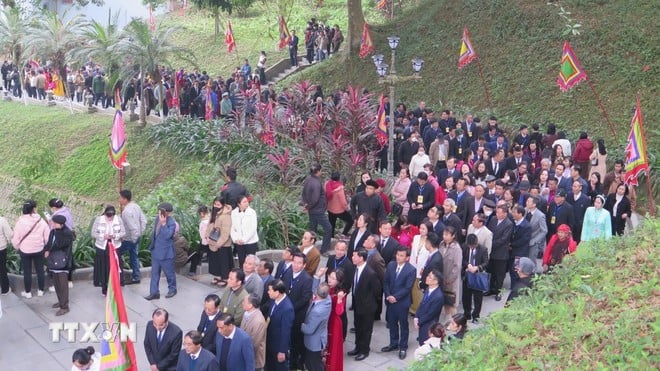
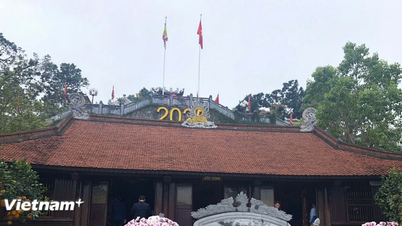
A large number of tourists attend the incense offering ceremony at Thuong Temple, Lao Cai city, Lao Cai. (Photo: Huong Thu/VNA)
During the 2021-2025 period, Lao Cai has vigorously implemented this project and achieved many clear results. The province has supported the restoration of the Hoang A Tuong House relic; built and upgraded 9 typical community tourism spots; formed villages to preserve the unique culture of the Phu La and Bo Y ethnic groups; organized 6 traditional festivals, 25 folk culture clubs, and 54 art troupes. We also carried out 5 programs to promote ethnic culture, built 105 community bookcases, and supported dozens of folk artists in the work of teaching heritage...
These activities have contributed significantly to restoring, preserving and promoting the unique cultural identity of ethnic groups, creating a new look for community tourism.
More preciously, the people have become the subject of conservation, each restored festival, each preserved and maintained craft is accompanied by real income from tourism. Many households in Bac Ha, Sa Pa, Bat Xat, Nghia Lo, Van Chan, Luc Yen, Van Yen... have stable jobs thanks to the homestay model, local tour guides, and cultural performances. This shows that cultural conservation is not only to preserve the past, but also to open up a new, sustainable development path for the future.
Need strong decentralization to localities
- From practice In the past 5 years, in your opinion, what are the remaining problems and limitations in program implementation?
Mr. Nguyen Quoc Luan: Besides the very positive results, the implementation of the Program over the past 5 years in Lao Cai also has some shortcomings and limitations.
The progress of implementation and disbursement of some projects, especially the capital for public services, is still slow compared to the requirements. Some policies, when put into practice, still have problems and lack of synchronization; adjustments and guidance are sometimes not timely and not complete, leading to confusion in local implementation.
At the grassroots level, the capacity of a number of staff is still limited. Harsh natural conditions, high material prices, and lack of legal material mines near infrastructure investment projects under the Program also put great pressure on project progress.
The main reasons are the large amount of work, the wide scope of the program while the initial mechanisms and policies are still lacking and inconsistent; there are no specific mechanisms and policies; some contents are still inadequate compared to the reality of the highlands. Some regulations on subjects, support levels, and investment procedures are not suitable, not creating strong enough motivation; commune-level officials change frequently and lack experience.
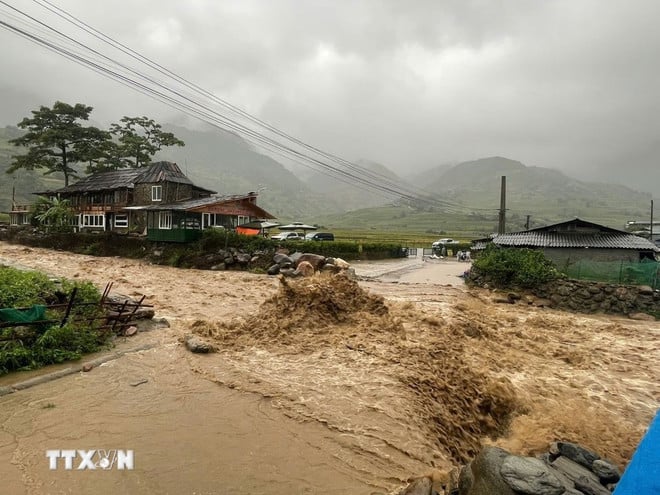
Floods cause heavy damage in Lao Cai. (Photo: VNA)
In addition, natural disasters, flash floods, and landslides – such as the circulation of storm Yagi in 2024 and storm Bualoi in 2025 – have forced many items to be adjusted and redone, significantly affecting progress.
- The Government has decided to merge three national target programs including: New Rural Development, Sustainable Poverty Reduction, Socio-Economic Development in Ethnic Minority Areas into one common national target program. How do you evaluate this policy? In your opinion, what needs to be done to further promote the effectiveness of national target programs to improve the quality of life for ethnic minorities in the coming time? What is the core issue that needs to be focused on?
Mr. Nguyen Quoc Luan: The Government's decision to merge three national target programs is a major policy, completely correct and consistent with reality. These three programs have many similar goals, objects, locations and contents. When designed synchronously, they will avoid duplication, disperse resources, reduce procedures, reduce management costs and especially create a stronger spread at the grassroots level.
From the implementation practice in Lao Cai, I think that the integration decision is a very important direction, helping localities to be more proactive in integrating resources, arranging projects in order of priority, suitable to the characteristics of each region and each ethnic group.
In the 2021-2025 period, although the initial implementation was slow due to waiting for the system of guiding documents, the disbursement results of the National Target Program for Ethnic Minorities and Mountainous Areas still reached a quite high level, even higher than the total disbursement of both the new rural and poverty reduction programs combined. This proves that when the mechanism is smooth and decentralized, localities can completely implement quickly, effectively and on target.
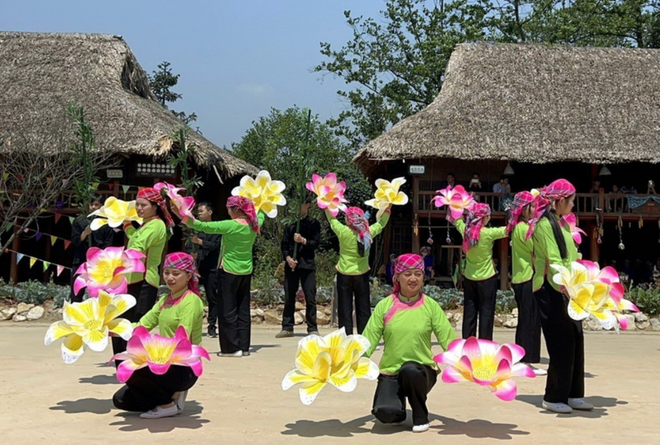
Performance introducing ethnic costumes at Ban May, Sa Pa (Lao Cai). (Photo: Quoc Khanh/VNA)
However, to maximize the effectiveness of the merger and ensure sustainability in the coming time, in my opinion there are three core issues that need to be focused on.
First of all, it is necessary to perfect the institutional framework, especially clearly defining the agency in charge of the content of the ethnic minority component. The program has 2 components. Component 1 on new rural areas and sustainable poverty reduction. Component 2 on socio-economic development in ethnic minority areas. I recommend that the National Assembly should clearly stipulate in the Resolution that the State management agency on ethnic groups be the agency in charge of the content of component 2 to ensure that ethnic policies are implemented continuously, uniformly, without division and with the highest efficiency.
In addition, it is necessary to strengthen decentralization and delegation of authority to localities along with accountability. Investment mechanisms, livelihood support, and infrastructure must be more flexible and practical, while promoting administrative procedure reform, simplifying and shortening overlapping processes. When localities are given more authority, we can proactively adjust the project portfolio, choose models suitable to natural conditions, farming practices and culture of each ethnic group.
Finally, the core issue that needs to be focused on is improving the quality of human resources in ethnic minority areas. If we want people to escape poverty sustainably, we must invest heavily in education, vocational training associated with employment, community economic development, support for ethnic minority businesses and cooperatives; people must be the center, the main participants. This is the key to moving from simple support to creating long-term livelihoods.
Along with that, it is necessary to preserve and promote the cultural identity of ethnic groups associated with tourism; develop essential infrastructure; improve the quality of grassroots cadres; at the same time, strengthen guidance, inspection, supervision, and promptly remove obstacles right at the village and commune levels so that the program can be put into practice.
When the three programs are operated as a unified whole, I believe that the effectiveness for ethnic minorities will be stronger and more sustainable, people will have a more prosperous and happier life, and will be in line with the goal of "no one is left behind" set by the Party and State.
- Thank you very much./.
(Vietnam+)
Source: https://www.vietnamplus.vn/chuong-trinh-muc-tieu-phat-trien-dan-toc-thieu-so-thay-doi-dien-mao-vung-cao-post1081265.vnp
![[Photo] National Assembly Chairman Tran Thanh Man attends the VinFuture 2025 Award Ceremony](/_next/image?url=https%3A%2F%2Fvphoto.vietnam.vn%2Fthumb%2F1200x675%2Fvietnam%2Fresource%2FIMAGE%2F2025%2F12%2F05%2F1764951162416_2628509768338816493-6995-jpg.webp&w=3840&q=75)


![[Photo] 60th Anniversary of the Founding of the Vietnam Association of Photographic Artists](/_next/image?url=https%3A%2F%2Fvphoto.vietnam.vn%2Fthumb%2F1200x675%2Fvietnam%2Fresource%2FIMAGE%2F2025%2F12%2F05%2F1764935864512_a1-bnd-0841-9740-jpg.webp&w=3840&q=75)





































































Comment (0)