


Agreeing with the National Assembly's approval of the Program's investment policy, delegates emphasized that this is a major policy of strategic significance, consistently demonstrating the Party and State's viewpoint on prioritizing the development of rural areas and ethnic minority areas, narrowing regional gaps and ensuring equal development opportunities for all people.
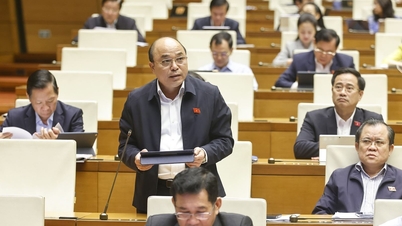
Delegate Ho Thi Minh (Quang Tri) stated: Integrating 3 national target programs into a comprehensive program for the 2026 - 2035 period is a necessary institutional breakthrough, avoiding the dispersion of resources and overlapping policies. However, integration does not mean losing the specificity of each policy area, especially ethnic policies. Therefore, the delegate suggested that the Drafting Committee and the Government need to clarify the governing role of the management agency.
The delegate said that ethnic policy is a specific field, which has been implemented synchronously over many terms. The national target program on ethnic groups is the policy that has the most direct and profound impact on ethnic minorities and mountainous areas. Therefore, the Ministry of Ethnic Minorities and Religions - the agency assigned to perform the state management function on ethnic affairs - must take the leading role, not just play the "coordinating" role as in the submitted documents. "The second component specific to ethnic minority areas is guided by the Ministry of Ethnic Minorities and Religions. So when there are problems such as slow disbursement, who is responsible?" The delegate wondered and recommended that it is necessary to clearly state the authority of the Ministry of Ethnic Minorities and Religions in taking the lead in directly allocating capital for component 2 instead of just coordinating and guiding.
Regarding resources and capital allocation, the Government's Submission stated that the total resources mobilized to implement the Program for the 2026 - 2030 period are expected to be 1.23 trillion VND; of which, the central budget capital accounts for only 8% (100 trillion VND), the local budget accounts for 33% (400 trillion VND), mobilized from people and businesses is 28%; the remaining amount is mobilized from other national target programs and policy credit.
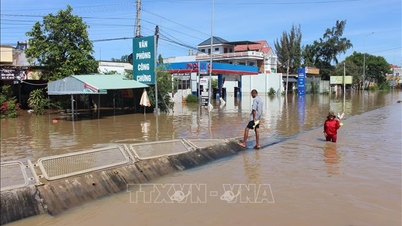
Delegate Ho Thi Minh analyzed that in reality, ethnic minority and mountainous areas, especially localities in the Central and Central Highlands regions, are still facing difficulties, and most of them receive subsidies from the central budget balance. Applying the 33% counterpart spending is very difficult for localities and can easily lead to outstanding debts in basic construction; therefore, the Government needs to rebalance. In order for the Resolution to be truly feasible and humane, the delegate suggested reviewing the capital structure and exempting the counterpart spending for poor communes and areas that are frequently affected by natural disasters such as the Central and Central Highlands provinces.
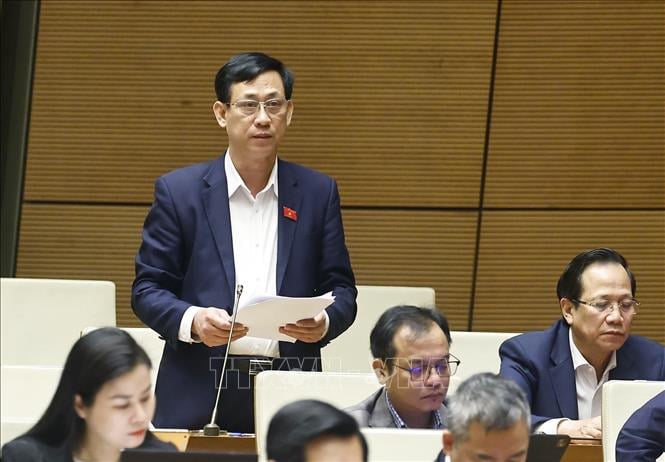
Also concerned about the issue of capital allocation to implement the Program, delegate Mai Van Hai (Thanh Hoa) pointed out that, in the conditions of merging provinces and implementing the 2-level local government model, the scale of the province and communes is much larger than before, the need for investment capital for infrastructure and the completion of new rural criteria after the arrangement is very large. Many mountainous provinces and communes still face budget difficulties, while the majority of communes' main investment source is land use rights grant money for new rural construction investment. Currently, this capital source is not as good as in the previous period, localities only receive 80 to 85% of land use fees, so it will be even more difficult to have counterpart capital to implement the program.
Therefore, to ensure the feasibility of capital sources, delegates proposed to balance the central budget and have solutions to mobilize other legal capital sources such as capital from enterprises, cooperatives, and people in implementing the Program; in which it is necessary to increase the central budget capital for the socio-economic development component of ethnic minority and mountainous areas.
Analyzing the capital structure and allocation mechanism for the implementation of the Program, delegate Ha Sy Huan (Thai Nguyen) said that the central budget capital only accounts for 100 trillion VND, the local budget is 400 trillion VND, showing that the proportion of the central budget is not commensurate with the leading role. Meanwhile, the local counterpart rate is quite high, causing the financial burden to be concentrated mainly in the locality, creating great pressure on disadvantaged provinces, especially ethnic minority and mountainous areas with high poverty rates. Therefore, the delegate proposed to review and clarify the ability to balance the central budget, consider adjusting the capital structure to ensure that the central budget plays a leading role in both proportion and leadership in the implementation of the Program. Accordingly, increase the proportion of the central budget in the total state budget to a reasonable level to ensure the effective implementation of the Program.
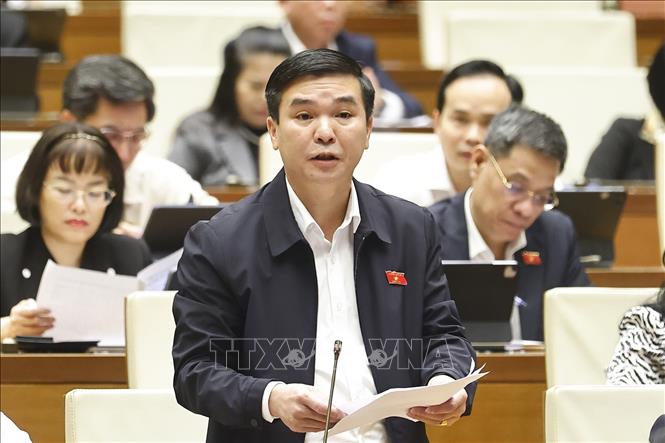
Besides concerns about capital structure, delegates also paid attention to the principle of allocating central capital, to ensure resources are used with the right focus, creating breakthroughs for poor core areas.
Delegate Ha Sy Huan pointed out that the current principles are still not very general and do not have quantitative criteria, so it is difficult to avoid the spread and leveling of capital allocation when organizing implementation. The delegate suggested quantifying and zoning beneficiaries to concentrate resources and ensure priority for specific goals to carry out important tasks.
Appreciating the principle of prioritizing extremely difficult areas and ethnic minority areas, delegate Do Van Yen (Ho Chi Minh City) said that, to be suitable for reality, the Drafting Committee needs to add allocation criteria according to "the level of target completion and disbursement efficiency of the previous period". Linking capital allocation with implementation efficiency will create strong motivation for localities in management work, while reducing the situation of slow capital disbursement or scattered investment, thereby promoting progress and improving the efficiency of the Program.
Source: https://baotintuc.vn/thoi-su/ngan-sach-trung-uong-giu-vai-tro-chu-dao-trong-chuong-trinh-muc-tieu-quoc-gia-20251205112935491.htm


![[Photo] Cat Ba - Green island paradise](/_next/image?url=https%3A%2F%2Fvphoto.vietnam.vn%2Fthumb%2F1200x675%2Fvietnam%2Fresource%2FIMAGE%2F2025%2F12%2F04%2F1764821844074_ndo_br_1-dcbthienduongxanh638-jpg.webp&w=3840&q=75)













































































Comment (0)