

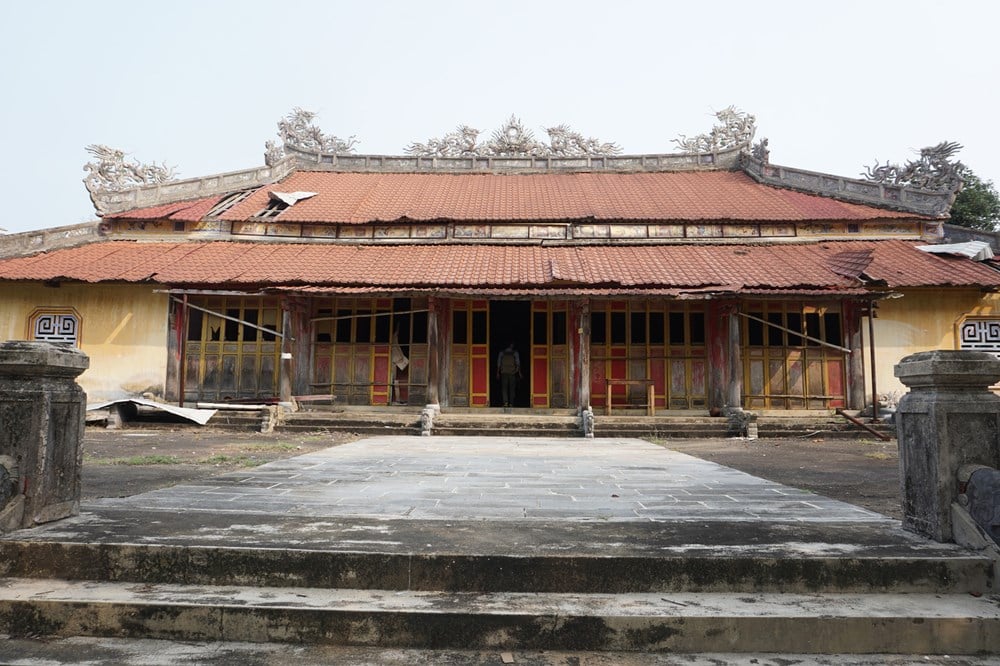
The Thai To Temple was rebuilt in 1972 by Lady Tu Cung and the Nguyen Phuc Clan Council on the old foundation. Photo taken before the demolition to implement the project. Photo: S. THUY
Thai Mieu relic is located in the southeast corner of Hue Imperial City, is one of the five important temples built early under the Nguyen Dynasty. This is the place to worship the Nguyen Lords, built by King Gia Long right after ascending the throne.
The Thai Mieu relic complex is an architectural complex with more than 10 construction items built on an area of over 14,900 m2. In which, the main construction of Thai To Mieu has a wooden architecture built in the style of double houses "trung thiem diep oc" and is the largest wooden construction in Hue Imperial City.
The project "Preservation, renovation, restoration and overall embellishment of Thai Mieu relic" (phase 1) - phase 1 has a budget of 52 billion VND, started in October 2024 and is expected to be completed after 4 years.
The project has an investment scale of the following items: renovating and restoring the foundation of Thai To Temple (area 1,917 m2); preserving, renovating and restoring Thai Mieu Mon and the system of gates and walls in the Thai Mieu area including Dien Hy Mon, Quang Hy Mon, Tuc Tuong Mon, Hien Thua Mon; protecting the foundation traces with a total area of 1,078 m2, including the following works: Ta/Huu Tung Tu, Muc Tu Dien, Tho Cong Tu and Tuy Thanh Cac.
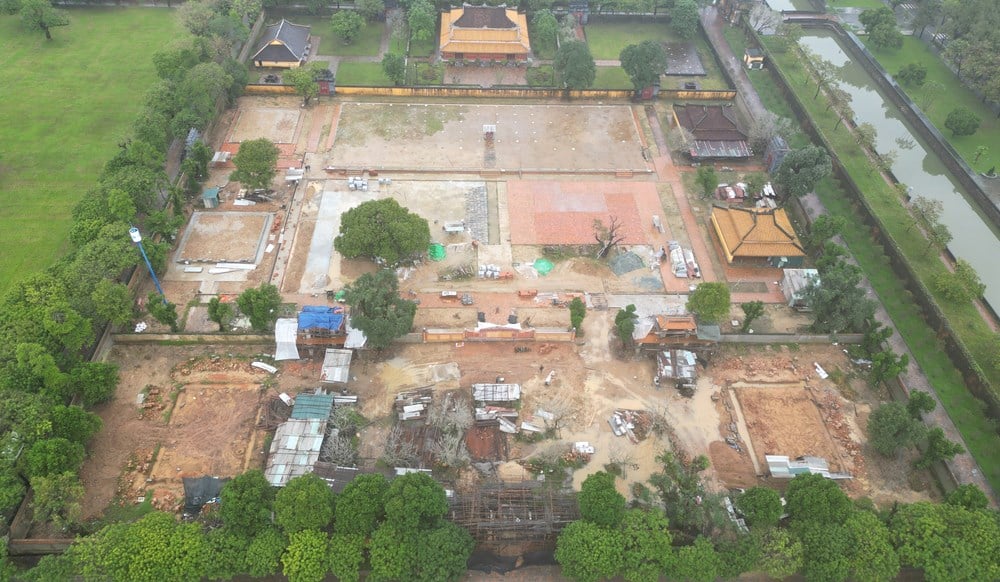
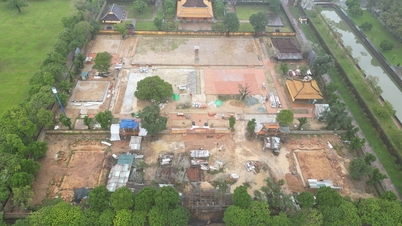
Up to now, the overall restoration project of Thai Mieu relic, phase 1 - phase 1 has completed about 60% of the volume. Photo: VT
At the same time, renovate and restore the yard and walking paths; install electrical systems, water supply and drainage, fire prevention and fighting in the area; plan and arrange the green tree system, lawns, etc.
According to the representative of the Hue Monuments Project Management Board, during the project implementation, many problems arose related to structural features, architectural details, and decorative patterns recorded during the construction process.
The investor has organized to collect opinions from experts and related professional agencies to conduct appraisal and approve design adjustments in accordance with regulations.
In addition, the weather in the last months of 2025, especially with heavy rain and floods from late October to early November, will affect the construction and renovation of technical infrastructure items, roads, and trees in the investment scale of the project.
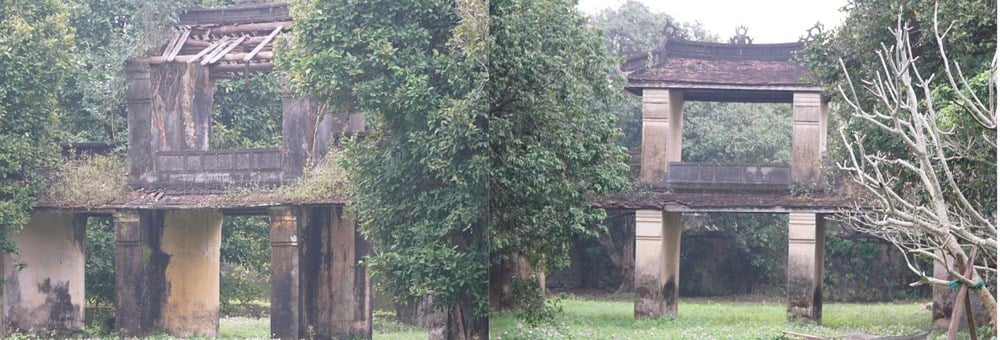
Quan Hy Mon and Dien Hy Mon before being dismantled for restoration. Photo: S. THUY
Currently, the construction volume is estimated to reach 60% of the approved investment scale. Completed work items include: Thai To Temple foundation, screen, Tuy Thanh Cac.
Other items that are completing the main renovation and restoration work include Thai Mieu Mon, Quang Hy Mon, Dien Hy Mon, Hien Thua Mon, Tuc Tuong Mon, the citadel wall, Muc Tu Dien, Tho Cong Tu, Ta/Huu Tung Tu, the yard and walking path... In 2026, the contractor will focus on the remaining work items and complete the acceptance and handover of the project, expected to be 20 months ahead of schedule.
In the next phase, when resources are allocated, the main structure of Thai To Temple - the place to worship 9 Nguyen Lords, from Lord Nguyen Hoang to Lord Nguyen Phuc Thuan - will be renovated and restored. The project is the largest in the Imperial Citadel with a front hall of 15 rooms and 2 wings, and a main hall of 13 rooms and 2 wings.
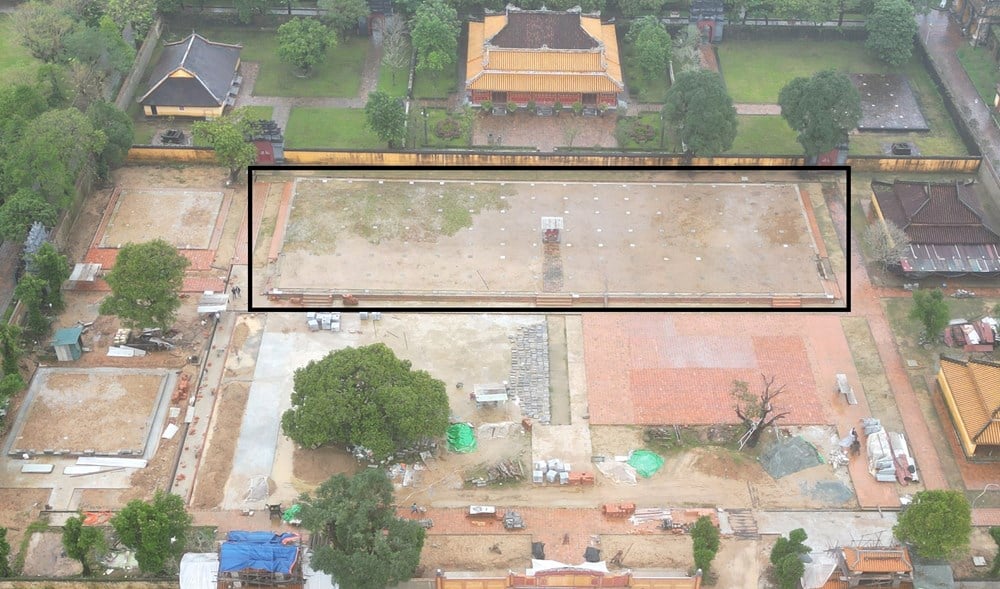
The project has restored the foundation of the main Thai To Temple with an area of 1,917 m2 (black circled area). It is expected that in the next phase, the place to worship the 9 Nguyen Lords will be restored.
In 1947, Thai Mieu was destroyed due to the ravages of war. In 1972, Tu Cung (ie Doan Huy Hoang Thai Hau) and the descendants of Nguyen Phuc clan donated funds and rebuilt Thai To Mieu on a smaller scale right on the foundation of the old building.
However, over time and the impact of natural disasters, the construction has also seriously degraded. The Nguyen Phuc Clan's Board of Trustees has coordinated with the Hue Monuments Conservation Center to temporarily move the altar of the Nguyen Lords to the Trieu Mieu relic (to the north of Thai Mieu).
Previously, in 2021, the People's Council of Thua Thien Hue province (now Hue city) passed a Resolution approving the investment policy of the project "Preservation, renovation, restoration and overall embellishment of Thai Mieu relic, phase 1" with a total cost of 272.7 billion VND, from the central budget and other legal capital sources.
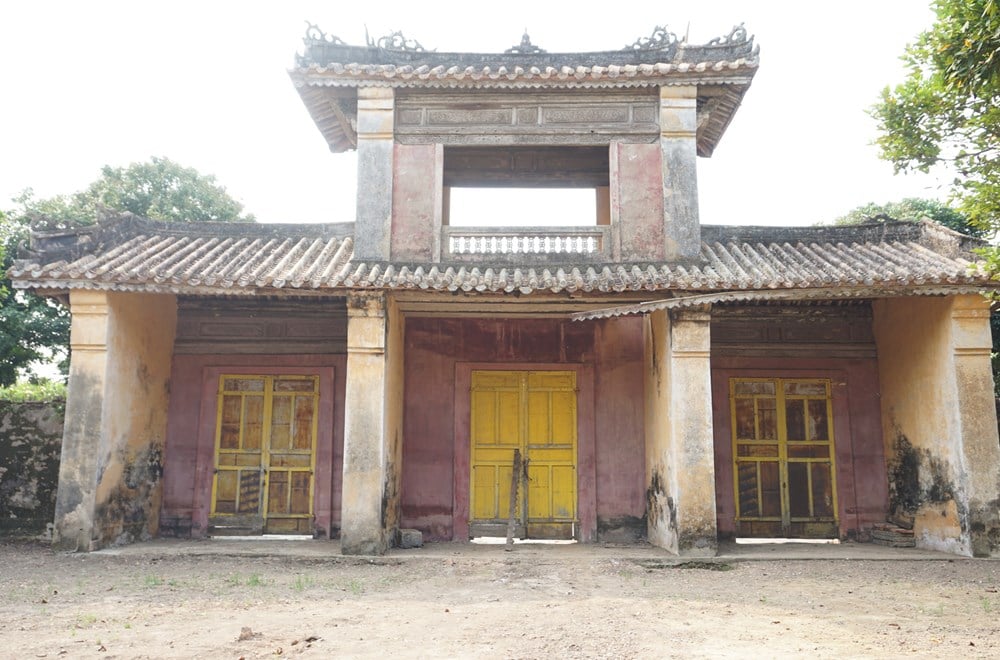
Thai Mieu Mon before restoration. Photo: S. THUY
In the locality's medium-term public investment plan for the 2021-2025 period, this project is allocated 100 billion VND, including 50 billion VND from the central budget reserve and 50 billion VND from the relic site entrance fee revenue.
However, because the project was not approved in time in 2021 and 2022, the central reserve fund was canceled and withdrawn. At the end of 2023, to implement the conservation and restoration of Thai Mieu relic, the People's Council of Thua Thien Hue province issued a Resolution adjusting the capital structure of the project from the provincial budget. In which, the first phase of the project has a budget of 52 billion VND and implements the above items.
Source: https://baovanhoa.vn/van-hoa/noi-tho-cac-chua-nguyen-dang-duoc-trung-tu-nhu-the-nao-186138.html



![[Photo] National Assembly Chairman Tran Thanh Man attends the VinFuture 2025 Award Ceremony](/_next/image?url=https%3A%2F%2Fvphoto.vietnam.vn%2Fthumb%2F1200x675%2Fvietnam%2Fresource%2FIMAGE%2F2025%2F12%2F05%2F1764951162416_2628509768338816493-6995-jpg.webp&w=3840&q=75)
![[Photo] 60th Anniversary of the Founding of the Vietnam Association of Photographic Artists](/_next/image?url=https%3A%2F%2Fvphoto.vietnam.vn%2Fthumb%2F1200x675%2Fvietnam%2Fresource%2FIMAGE%2F2025%2F12%2F05%2F1764935864512_a1-bnd-0841-9740-jpg.webp&w=3840&q=75)






























































Comment (0)