

The book on the history of Dien Bien Phu translated into Arabic is a special project that was launched during Prime Minister Pham Minh Chinh 's visit to Algeria on November 19.
"The unique path" of a San Diu ethnic girl
Ms. Pham Thi Thuy Van (36 years old) is currently the Head of the Department of Arabic Language and Culture at the University of Foreign Languages (Vietnam National University, Hanoi ). She is in charge of teaching and is a professional interpreter in many international events.
In addition, Ms. Van also developed a YouTube channel in Arabic to introduce Vietnam to the international community and share her travels to many countries. Up to now, she has set foot in about 20 countries with many memorable experiences.
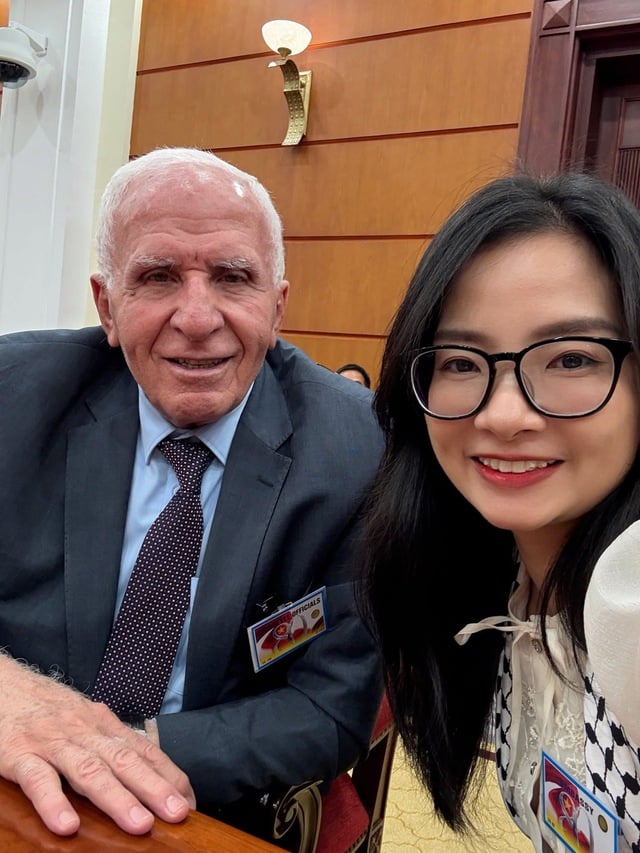
Ms. Pham Thi Thuy Van took on the role of interpreter for General Secretary To Lam to receive Mr. Azzam al-Ahmad, Secretary General of the Executive Committee of the Palestine Liberation Organization.
PHOTO: NVCC
Ms. Van was born into a family of the San Diu ethnic group but grew up in the city. “Since I was little, I felt that I was a little different from my friends. Everyone in my family always encouraged me to pursue something special and Arabic came to me that way,” Ms. Van shared.
According to the head of the department, at the time of choosing her major, information about the Arab world in Vietnamese was very limited, mostly focusing on conflict and instability. "When I said I was studying Arabic, some people asked me questions that made me feel embarrassed. I didn't dare to introduce myself as studying this major," Ms. Van recounted.
The turning point came when she had the opportunity to study abroad in Egypt. Direct contact with Arabic culture helped her gain a comprehensive and sympathetic view. “When I understood correctly, I truly loved the culture and people here. Since then, I am proud to say that I am an Arabic learner.”
Van's YouTube channel was originally in Vietnamese, with the aim of introducing Vietnamese people to her trips to Arab countries. However, her trips were interrupted during the Covid-19 pandemic, so she decided to switch to creating content in Arabic to introduce Vietnam to Arab audiences. She realized that Arabs often only know Malaysia, the Philippines, and Thailand when talking about Southeast Asian tourism, not Vietnam.
“Vietnam is also very beautiful. If the content is told in the language they understand best, Vietnam will be closer and more accessible,” Ms. Van shared.
Pioneering steps of young people
In the journey of bringing Vietnamese culture and history closer to the Arabic-speaking community, the most important milestone for Ms. Pham Thi Thuy Van is the project of translating the book Dien Bien Phu by General Vo Nguyen Giap into Arabic.
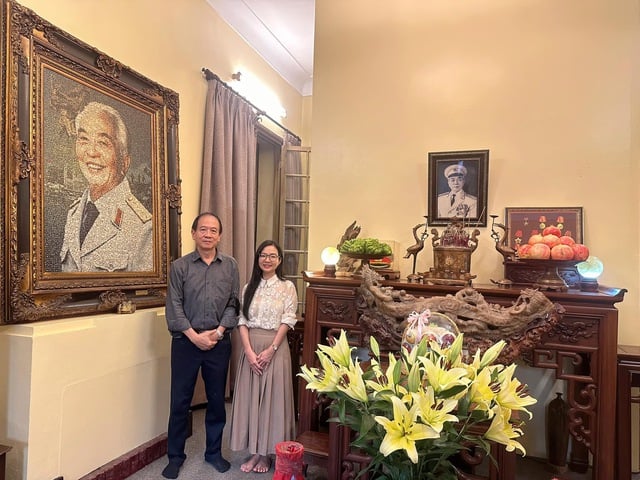
The meeting between Ms. Thuy Van and Mr. Vo Hong Nam, son of General Vo Nguyen Giap, at the General's private home
PHOTO: NVCC
The opportunity began when her group was connected with Mr. Vo Hong Nam, son of General Vo Nguyen Giap. During his visits to Algeria, Mr. Nam noticed the special affection of the people there for the General and wished to have an official translation of the book Dien Bien Phu in Arabic. Because of his promise to the President of Algeria, in September 2025, Mr. Nam contacted Ms. Van's group and offered to complete the translation in just about a month and a half.
“Time was tight and this was my first time translating a history book, so I was very nervous. But I couldn’t miss an opportunity like this,” she recalled.
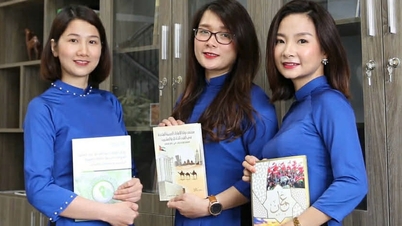
The translation team consisted of three young people: Ms. Van, Ms. Le Thi Khuyen (36 years old, lecturer of the Department of Arabic Language and Culture) and Nguyen Linh Chi (33 years old, Deputy Head of the Department of Arabic Language and Culture). The team faced a series of difficulties due to the tight time schedule, lack of military background, many terms had no equivalent in Arabic, had to do more historical research, consult documents in other languages and asked for support from Palestinian Ambassador Saadi Salama and Arab experts.
Ms. Van shared: “Some terms such as regiment or stronghold group do not exist in Arabic, forcing our group to research English and French to find the closest word. There were times when we were the ones who coined the first Arabic terms for Vietnamese military concepts during the French resistance.”
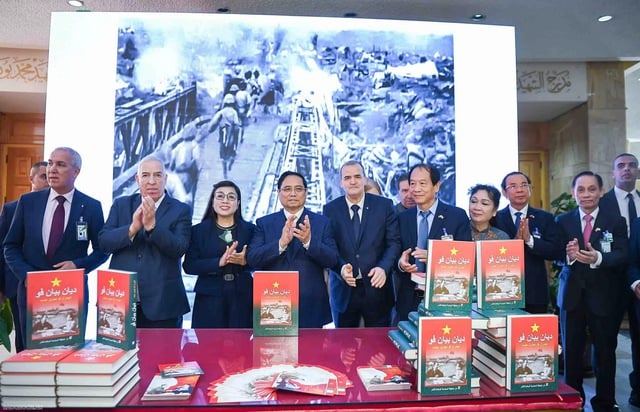
The book was launched during Prime Minister Pham Minh Chinh's visit to Algeria.
PHOTO: NVCC
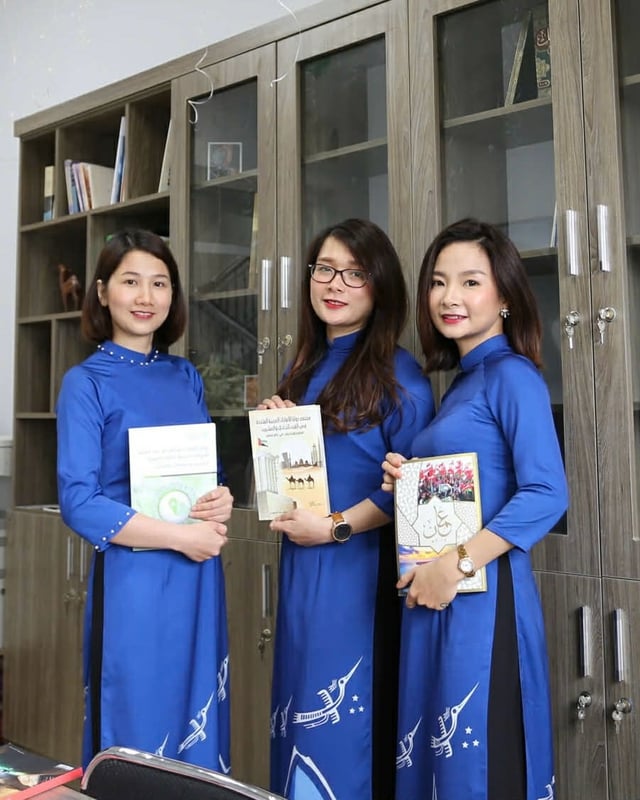
Group of 3 girls translate Dien Bien Phu history book into Arabic
PHOTO: NVCC
On November 19, although she did not attend the launch ceremony because it was part of Prime Minister Pham Minh Chinh’s visit to the Veterans Museum in Algeria, Ms. Van still felt proud when following the event in the press. Immediately after, friends from Algeria and Morocco contacted to buy the book, although the first print was only enough to give to cultural institutions.
“Many people who are researchers or students doing their graduation and master's theses have contacted me and asked me a lot of questions. I think this is a very good start for future projects,” Ms. Van shared proudly.
For Ms. Van, the greatest significance of the project lies in the direct translation from Vietnamese. For a long time, many documents about Vietnamese history in the Arab world have been indirectly translated from French or English, leading to a distorted perspective. “The Arabic translation will be an authentic source of information, especially important in the future when French is no longer popular, people will return to using their mother tongue,” she said.
In addition to Dien Bien Phu , the group has completed the translation of a work by the late General Secretary Nguyen Phu Trong, which is expected to be released in early 2026. “There are very few Vietnamese books translated into Arabic, and very few people learn Arabic to do this job. What we do may not be perfect, but it will be a very valuable resource for international friends,” Ms. Van confided.
While understanding that being a pioneer always comes with debate and risks, the translation team still hopes that this work will be the first brick, inspiring young people to continue bringing Vietnamese culture and history closer to the Arab world.
The role of inspiration for the next generation
In addition to her desire to bring Vietnamese culture and history to the world, Ms. Van also hopes to inspire the younger generation about Arabic. As a lecturer teaching Arabic speaking and interpretation, she sets a very clear principle: if she wants students to be confident, the lecturer must do it first.
She shared: “I cannot hide my love for Arabic and I pass that love on to my students. My youthful and cheerful approach makes them often use my images and good words to include in their presentations."
Ms. Van understands that the biggest fear of students when learning a foreign language is the fear of making mistakes. That is why she proactively opened a YouTube channel, standing in front of the camera talking in Arabic as a way to prove that courage always starts with daring to try.
For students to develop comprehensively, Ms. Van always considers understanding them an important factor. The younger generation is sometimes too confident or easily discouraged when facing difficulties, so lecturers need to keep up with social media trends to accompany and support students better. She always advises: “Just try something. If it is not dangerous for you or for society, just try it. Accept mistakes. The most important thing is to persevere. Don’t give up.”
This approach not only helps students improve their language skills but also inspires them to confidently explore new opportunities, like her own journey of learning Arabic and promoting Vietnamese history to the world.
Source: https://thanhnien.vn/nu-truong-khoa-dua-lich-su-viet-nam-ra-the-gioi-bang-tieng-a-rap-185251205200257835.htm

![[Photo] National Assembly Chairman Tran Thanh Man attends the VinFuture 2025 Award Ceremony](/_next/image?url=https%3A%2F%2Fvphoto.vietnam.vn%2Fthumb%2F1200x675%2Fvietnam%2Fresource%2FIMAGE%2F2025%2F12%2F05%2F1764951162416_2628509768338816493-6995-jpg.webp&w=3840&q=75)


![[Photo] 60th Anniversary of the Founding of the Vietnam Association of Photographic Artists](/_next/image?url=https%3A%2F%2Fvphoto.vietnam.vn%2Fthumb%2F1200x675%2Fvietnam%2Fresource%2FIMAGE%2F2025%2F12%2F05%2F1764935864512_a1-bnd-0841-9740-jpg.webp&w=3840&q=75)
































































Comment (0)