

This policy is assessed by many experts and schools as suitable for the digital transformation trend, contributing to improving digital capacity and early career orientation for students.
Trendy
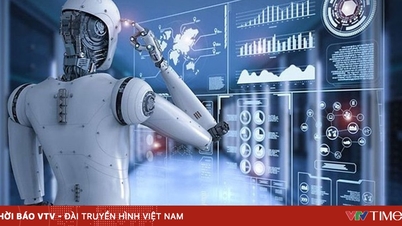
The Ministry of Education and Training has just issued Document No. 7652/BGDĐT-GDPT dated November 21, 2025 to the Departments of Education and Training to seek opinions on the draft Guidelines for piloting AI education content in general education. The draft was developed to implement resolutions, decisions and circulars of the Politburo, the Government and the Ministry of Education and Training related to science and technology development, innovation, digital transformation and improving digital capacity of learners.
According to the draft, the AI education content framework includes 4 knowledge streams corresponding to 4 competency domains: Human-centered thinking; AI ethics; AI techniques and applications; AI system design. The content is implemented in two phases: Basic education (primary, secondary) and career orientation (high school), ensuring suitability with the psychological characteristics of the age group. Primary school students get acquainted with AI through visual activities; secondary school students understand the principles of data and algorithms; high school students can design simple AI models and career orientation.
Educational institutions are allowed to flexibly implement through subjects, topics, projects or clubs. The Ministry of Education and Training recommends that localities make the most of existing resources, avoid spreading investment and increase socialization, especially in disadvantaged areas. The pilot will be implemented from December 2025 to May 2026; in June 2026, it will be summarized for consideration of expansion.
Sharing about the above draft, Mr. Tran Quang Dien - Principal of Vo Van Kiet High School (Phuoc Long, Ca Mau ) said that the Ministry of Education and Training's pilot implementation of AI education in general schools is a step in line with the development trend and educational innovation in the 4.0 era. Mr. Dien said that although located in a remote area, in recent times the school has promoted the application of information technology and digital transformation in teaching and learning, and some teachers of the school have researched and applied AI in teaching.
“Vo Van Kiet High School has prepared human and material resources to meet the requirements of digital transformation. Currently, the school's teaching staff has been given the opportunity to participate in many training courses on AI technology, and about 40 teachers have been certified to be able to apply AI in teaching.
The school's facilities are also fully invested, STEM classrooms meet international standards, basically able to meet the application of AI in teaching and learning. According to the assessment, in the lessons teachers use AI to teach, it creates a high learning effect, students are very excited to participate in the lessons, they also learn quickly, and know how to use AI to improve their learning ability. I believe that if we are allowed to pilot AI education in schools, Vo Van Kiet High School will do well," Mr. Dien affirmed.
Similarly, Mr. Pham Viet Hung - Principal of Dam Doi High School (Dam Doi, Ca Mau), expressed his support for the pilot policy of bringing AI education into general schools. According to Mr. Hung, both students and teachers have been applying AI in teaching and learning very popularly. However, it is still mainly self-study and research without any framework guidance from the authorities.
“Currently, the human and material resources of schools can basically meet the needs of AI education, however, it is necessary to have a consistent policy framework, comprehensive and flexible curriculum and materials. If adequate information is provided and appropriate education methods are used, I believe that the use of AI in schools will achieve the desired results, creating a lever to improve knowledge, promote creativity and contribute to training a generation of brave digital citizens,” Mr. Hung shared.
Opportunities for digital capacity development
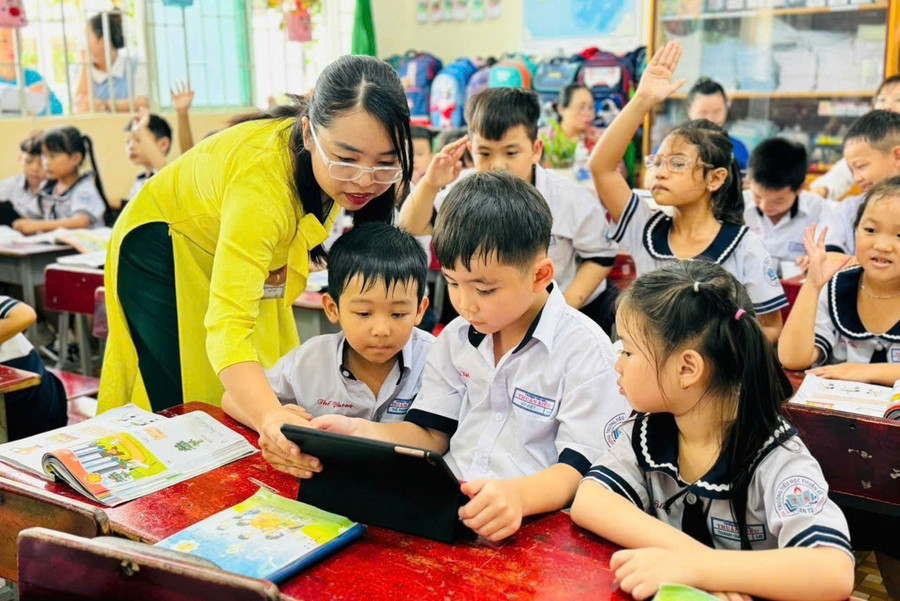
From the 2025-2026 school year, the Experimental School of Educational Sciences (under the Vietnam Institute of Educational Sciences) will organize a separate topic on artificial intelligence for first grade students with 16 lessons. The number of lessons is within the prescribed time limit for the school year, so it does not put pressure on students. The learning content is also calculated according to age.
Ms. Nguyen Thi Huyen Trang - teacher at the Experimental School of Educational Sciences, said: Currently, artificial intelligence is no longer strange to students. Implementing artificial intelligence education is necessary in schools to equip students with necessary knowledge and skills. For first graders, educational content needs to be as close and easy to understand as possible, helping them understand AI and how to use it most effectively.
In response to concerns about students being exposed to technology devices too early, Ms. Huyen Trang explained: “Through the actual implementation of the project, students do not need to be exposed to computers for too long, do not need to test many artificial intelligence applications. They are guided to make their own models, so concerns about negative impacts on health have been resolved.”
In Ho Chi Minh City, Le Hong Phong High School for the Gifted is one of the pioneers in introducing AI into teaching. Principal Pham Thi Be Hien said that the school has implemented the AI subject for 7 years. Initially, the program was divided into two levels: General for 10th graders and advanced for students with a research orientation. After implementation, the program was developed into three levels: General; advanced - application; and advanced - in-depth research for students with an orientation to study AI at university level.
“It is necessary and should be widely applied for students to have systematic access to AI from primary school. However, the biggest difficulty today is the lack of teachers with in-depth training in AI. To overcome this, the school invites lecturers from universities and AI engineers to teach, and at the same time provides in-depth training for IT teachers,” said Ms. Hien.
Prof. Dr. Le Anh Vinh - Director of the Vietnam Institute of Educational Sciences, commented that the potential of AI is huge, therefore, equipping students with essential skills to adapt and develop in the new context is an urgent task of the education sector. To effectively bring AI into schools, it is necessary to rely on three main pillars: a consistent policy framework, comprehensive and flexible teaching programs and materials, and appropriate human and financial resources. Standardizing AI in education is becoming an urgent requirement to ensure that technology is applied effectively, transparently and safely.
In addition to integrating content on AI, digital safety and technology ethics at each level of education, experts emphasized that the Ministry of Education and Training needs to issue a code of conduct for AI in education and build a digital competency framework for teachers and students, including skills to use AI properly. Educational institutions play a key role in implementation and monitoring.
Schools need to specify policies through internal regulations, choose AI tools that are safe, tested and suitable for educational goals. In assessing student capacity, the draft mentions switching to forms such as direct discussion, questions and answers or analytical thinking tests to limit cheating. AI can support personalized learning, grading and error analysis; however, abuse should be avoided.
Mr. Ho Duc Thang - Director of the National Institute of Digital Technology and Digital Transformation, said that bringing AI into primary school requires a clear and feasible action plan. According to him, the goal is not to train "little AI engineers" but to help students understand AI, use it safely and responsibly, and develop creative thinking when interacting with technology. It is only necessary to integrate about 5 - 10 lessons per year into subjects or experiential activities, like the model Singapore will apply from 2025.
At the same time, it is necessary to set up two “safety fences”: Students only use AI through the school system and only access tools in the approved catalog to ensure data security and appropriate content.
The decisive factor for the success of the program is still the team of teachers. Technology cannot replace the role of teachers, so it is necessary to soon build a standardized training program and form a core force of about 1,000 teachers on AI to deploy and spread widely.
Mr. Thang affirmed that there needs to be a pilot roadmap of 18-24 months to prepare learning materials, train teachers, deploy in some localities, and then expand nationwide. Bringing AI into primary schools is timely, but it must be done properly: Putting teachers at the center, using safe tools and deploying step by step with certainty.
“The Ministry of Education and Training needs to issue a code of conduct for AI in education and build a digital competency framework for teachers and students, including skills to use AI properly. On the school side, to avoid widespread and improper use of AI, at the beginning of the school year we also proactively invited experts to propagate and disseminate knowledge on using AI to both teachers and students.
Remind teachers and students about protecting personal data and respecting copyright; not spreading or posting bad or toxic information on social networks; be vigilant against high-tech fraud and information theft...", said Mr. Tran Quang Dien - Principal of Vo Van Kiet High School.
Source: https://giaoducthoidai.vn/thi-diem-tri-tue-nhan-tao-vao-gd-pho-thong-lo-trinh-phu-hop-doi-moi-day-hoc-post759526.html




![[Photo] National Assembly Chairman Tran Thanh Man attends the VinFuture 2025 Award Ceremony](/_next/image?url=https%3A%2F%2Fvphoto.vietnam.vn%2Fthumb%2F1200x675%2Fvietnam%2Fresource%2FIMAGE%2F2025%2F12%2F05%2F1764951162416_2628509768338816493-6995-jpg.webp&w=3840&q=75)
![[Photo] 60th Anniversary of the Founding of the Vietnam Association of Photographic Artists](/_next/image?url=https%3A%2F%2Fvphoto.vietnam.vn%2Fthumb%2F1200x675%2Fvietnam%2Fresource%2FIMAGE%2F2025%2F12%2F05%2F1764935864512_a1-bnd-0841-9740-jpg.webp&w=3840&q=75)










































































Comment (0)