

Lighting up new avenues in detective fiction
At the beginning of the meeting, Mr. Franck Bolgiani - Director of the French Institute in Hanoi praised writer Franck Thilliez. He said: "He is a master of horror detective of contemporary French literature with 25 novels published, translated into more than 20 languages and conquered millions of readers worldwide thanks to his unique style. The writer has applied science , psychology, criminology, human nature, and the hidden dangers of technology to blend together, giving readers a very special, creepy, and attractive feeling."
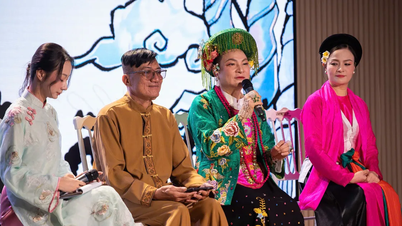
During the exchange, writer and journalist Yen Ba said that Franck Thilliez's works have "shaped" modern French detective literature, with complex and intricate plot programming, the way the plot is controlled to the end. The way of building characters full of psychological trauma to the skillful use of science and technology: genetics, neurology, viruses, bacteria,... All combine to create a very interesting, unique and attractive flow in Thilliez's works.

French writer Franck Thilliez shared that more than fifteen years ago, he was a scientific engineer. He always asked questions and was curious about the laws of nature, people, and stars. After devoting all his time to writing, he still had a passion for science. The writer said: “I delved into these issues during my writing process. I met research experts and doctors. At the Pasteur Institute (France), I met many experts on bacteria, germs, nerves, etc. They supported me during my writing process. I hope that through my detective book, readers will gain more knowledge and love science more.”
Technology cannot replace the hearts of readers
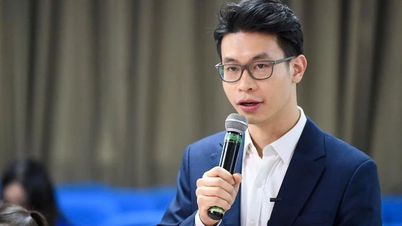
Screenwriter Pham Dinh Hai commented that each work of writer Franck Thilliez exudes a strong cinematic quality. Although exploiting many elements of modern science and technology, Thilliez's literature is not dry; on the contrary, it always brings a strong attraction thanks to the way he leads the story with rhythm and drama.
According to Mr. Hai, the point that makes Thilliez's works lively is that each character has a separate story, a complex inner life, psychological problems and very ordinary feelings. It is this closeness that creates an emotional bridge, helping readers easily sympathize and follow their journey. He also said that exploiting the psychology of the characters, their hidden inhibitions and deep trauma is an area that Vietnamese detective films can apply more in the future, instead of focusing mainly on the crime solving process as in the traditional way.
Writer Franck Thilliez also shared that through the journey of solving the case, I want readers to see the transformation of the character. It can be creating a way out, or it can be a dead end to continue writing the next part. In his work, the character finds his own voice, like Franck Sharko, a veteran police detective, who has to face horrific cases and dark secrets related to his own past. Lucie Henebelle, the policewoman who accompanies Sharko, is a single mother with very ordinary worries.

Regarding the issue of technology affecting literature, especially artificial intelligence (AI), in an interview with a reporter from the Vietnam Law Newspaper, writer Franck Thilliez said that artificial intelligence, science and technology today have great applications in many fields, including literature. However, AI does not have human emotions, for example, the feelings of parents when seeing their children learning to walk, or the thoughts of a child, etc. Artificial intelligence is only used as a framework, which can support writers in finding the necessary materials to serve the process of creating works.
Although AI is increasingly trying to “learn”, this is the challenge for writers in the near future: “However, in my opinion, AI is just a tool, it cannot replace human thinking and creativity. Especially it cannot replace human emotions and creativity”, he said.
On the occasion of the writer Franck Thilliez's visit to Vietnam, the French Institute in Vietnam, in coordination with other units, organized a series of meetings and discussions in Hanoi , Hue, Da Nang and Ho Chi Minh City for the public. The works "Syndrome E", "The Crime Gene" and most recently "The Death Particle" published in Vietnamese will be introduced in the exchanges.
Source: https://baophapluat.vn/khi-khoa-hoc-thoi-hon-vao-van-hoc-trinh-tham.html

![[Photo] 60th Anniversary of the Founding of the Vietnam Association of Photographic Artists](/_next/image?url=https%3A%2F%2Fvphoto.vietnam.vn%2Fthumb%2F1200x675%2Fvietnam%2Fresource%2FIMAGE%2F2025%2F12%2F05%2F1764935864512_a1-bnd-0841-9740-jpg.webp&w=3840&q=75)
![[Photo] National Assembly Chairman Tran Thanh Man attends the VinFuture 2025 Award Ceremony](/_next/image?url=https%3A%2F%2Fvphoto.vietnam.vn%2Fthumb%2F1200x675%2Fvietnam%2Fresource%2FIMAGE%2F2025%2F12%2F05%2F1764951162416_2628509768338816493-6995-jpg.webp&w=3840&q=75)








































































Comment (0)