

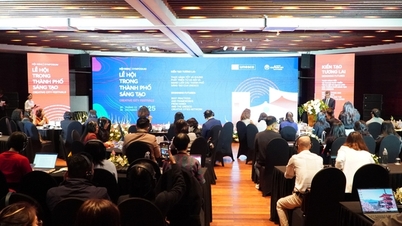
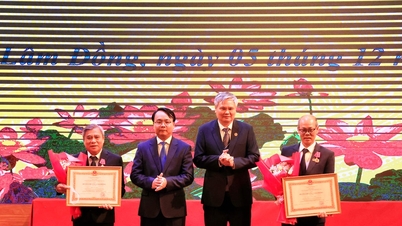
On December 5, in Lam Dong province, the Ministry of Education and Training held a conference to summarize 8 years of implementing the Project on building a culture of behavior in schools (2018-2025). At the same time, it summarized 3 years of implementing Directive 08/CT-TTg on building school culture and the Program on educating revolutionary ideals, ethics, lifestyle and arousing the desire to contribute to youth, adolescents and children (2021-2030).
The conference was held directly at Lam Dong province and online to 33 provinces and cities across the country.
Students and challenges in cyberspace
At the conference, many delegates were interested in building a digital culture of behavior for students in the educational environment.
Many delegates commented that social networks are becoming an indispensable part of school life. Teachers use the network to exchange expertise, parents interact with schools through online groups, and students see it as their main "living space". The convenience of applications is undeniable. However, their downsides are also clear and increasingly complex.

Online challenges are not only fraud and fake information, but also manifestations of behavioral deviation, mental violence, personal attacks, etc. "Virtual world, but real consequences" is a lesson proven through many incidents where a malicious comment or a careless click leads to a media crisis, loss of personal data, and even long-term effects on the psychology and future of young people.
Dr. Mai Thi Thuy Huong, Deputy Director of the Vietnam Institute of Culture, Arts, Sports and Tourism, said that social networks are currently the main communication space for students, but are also a place where inappropriate behavior can easily arise due to their anonymity, rapid spread and ability to create a crowd effect.
Frequent exposure to negative content and “dramatization” trends causes many young people to become emotionally numb, reducing their ability to empathize and respect others. This is an alarming phenomenon because it gradually erodes the fundamental values of school culture.
From a technological perspective, Master Tran Vu Nguyen, Head of the Google Digital Teacher Community, emphasized that the current speed of technology development and deployment is so fast that it creates a complex and acute challenge.
If we focus too much on speed and neglect the standardization of ethics, data security and digital capabilities, the result will be increased risks of academic integrity, technology dependency or even security vulnerabilities. He warns that if a clear digital culture framework is not built in parallel with the digital transformation process, those risks will escalate rapidly.
The concept of “digital school culture” is therefore more urgent than ever. It is not just a set of rigid regulations but a set of norms, attitudes and behaviors of the entire educational community, from administrators, teachers to students, when exploiting and using digital technology and artificial intelligence (AI) in learning and life. This culture must be based on the core values of the country, and also include digital skills, privacy awareness, understanding of information security and ethics related to AI algorithms.
Digital culture education protects students in cyberspace
According to Master Tran Vu Nguyen, Vietnam needs to build an integrated digital school culture framework (VN-DSC) as an essential “protection system” to guide students to become responsible digital citizens. This will be a guideline to help schools deploy technology and AI in a humane and safe way, minimizing unwanted consequences.
Not only stopping at the issue of management, digital culture education also needs to "enter the life" of each student. Associate Professor, Dr. Nguyen Toan Thang, former Director of the Institute of Cultural Development (Ho Chi Minh National Academy of Politics) emphasized three important pillars to form a digital culture of behavior in schools.
Firstly, education on communication and standard behavior in cyberspace. This includes using cultured language, respecting others, and not spreading false information or negative content. In the context of fake news and the increasing trend of verbal violence, this skill becomes indispensable.

Second, ensure network and information security. Students need to be equipped with knowledge to recognize and avoid risks such as online fraud, identity theft, privacy violations, as well as know how to protect personal information. Lack of these skills is the reason why many young people become victims of cyber attacks or data leaks.
Third, use technology responsibly. That means guiding young people to use social media, digital tools and AI for learning, creativity and healthy entertainment, avoiding abuse or misuse.

Building a digital culture is not only the responsibility of schools or families, but also the responsibility of the whole society. In the context of strong digital transformation, every student needs to understand that they are not only users of technology but also shapers of the digital environment. A click, a comment or shared content can create value or cause harm.
To help the young generation become “responsible digital citizens”, we need to nurture in them the ability to think critically, the courage to face the pressure of social networks, the spirit of respect for others and the awareness of obeying the law. Digital culture is the “soft shield” that helps protect children from risks, and at the same time is the “lever” for students to maximize their potential in the digital age.
According to the report of the Ministry of Education and Training, after 8 years of implementing Decision No. 1299, Directive No. 08 and Decision No. 1895, there has been a clear change in students' awareness and behavior, contributing to improving the school cultural environment. Many schools focus on building green spaces, civilized codes of conduct, saying no to violence and discrimination, creating a safe, respectful and inspiring learning environment.
Source: https://giaoducthoidai.vn/xay-dung-van-hoa-ung-xu-so-de-hoc-sinh-tro-thanh-cong-dan-so-co-trach-nhiem-post759473.html


![[Photo] National Assembly Chairman Tran Thanh Man attends the VinFuture 2025 Award Ceremony](/_next/image?url=https%3A%2F%2Fvphoto.vietnam.vn%2Fthumb%2F1200x675%2Fvietnam%2Fresource%2FIMAGE%2F2025%2F12%2F05%2F1764951162416_2628509768338816493-6995-jpg.webp&w=3840&q=75)
![[Photo] 60th Anniversary of the Founding of the Vietnam Association of Photographic Artists](/_next/image?url=https%3A%2F%2Fvphoto.vietnam.vn%2Fthumb%2F1200x675%2Fvietnam%2Fresource%2FIMAGE%2F2025%2F12%2F05%2F1764935864512_a1-bnd-0841-9740-jpg.webp&w=3840&q=75)

























































































Comment (0)