

Currently, compulsory foreign language teaching for grades 3, 4 and 5 according to the 2018 General Education Program is being implemented in localities. According to the Ministry of Education and Training (MOET), 100% of schools have organized compulsory foreign language teaching in grades 3, 4 and 5, most of which are English. Recently, the Project "Making English the second language in schools in the period 2025 - 2035, with a vision to 2045" sets a goal of 100% of general education institutions nationwide teaching English as a compulsory subject from grade 1. This content is attracting attention from schools.
In reality, innovation policies always come with challenges and the biggest "problem" that schools have to face is how to fill the gap of qualified teachers and ensure consistent teaching quality across the board. Sung La Boarding School for Ethnic Minorities (PTDTBT) (Sa Phin commune, Tuyen Quang ) currently has only 1 English teacher for 13 classes. This makes the goal of 100% of students learning English compulsory from grade 1 a big concern. Worried about the difficulties in implementation, Mr. Nguyen Van Loi, Principal of Sung La Boarding School for Ethnic Minorities, said that in order to implement English teaching from grade 1, the school needs at least 3 more teachers. However, the irony is that those teachers have not been recruited for many years. Meanwhile, geographical isolation also makes online teaching difficult when the Internet is weak, teachers often cannot interact with students. "The school currently has 670 students, most of whom are ethnic minorities. Many of them cannot yet write or speak Vietnamese fluently, so learning English from grade 1 is a double challenge," Mr. Loi shared.
Similarly, at Dao San Primary School for Ethnic Minorities (Phong Tho Commune, Lai Chau ), Ms. Pham Thi Xuan, the school's principal, said that the school has begun to develop a plan for this project. To be able to implement it, the school needs 3 English teachers, but currently only has 2 teachers who are both teaching and studying for a second degree. "In the past, there was a time when teachers had to teach online connections between the two schools. But the connection was poor, and students could hardly interact. Although it is difficult, it must be done so that students can have a foundation sooner," Ms. Xuan shared.
Currently, more than 1,000 students of Dao San Primary Boarding School are studying at two schools about 3 km apart. What worries the school's Board of Directors the most is the disadvantage of students in the learning process. "While teachers teach directly at one school, the other school must study online. We are worried that limited learning conditions will affect the quality of knowledge acquisition and the overall results of the program," the female principal added.
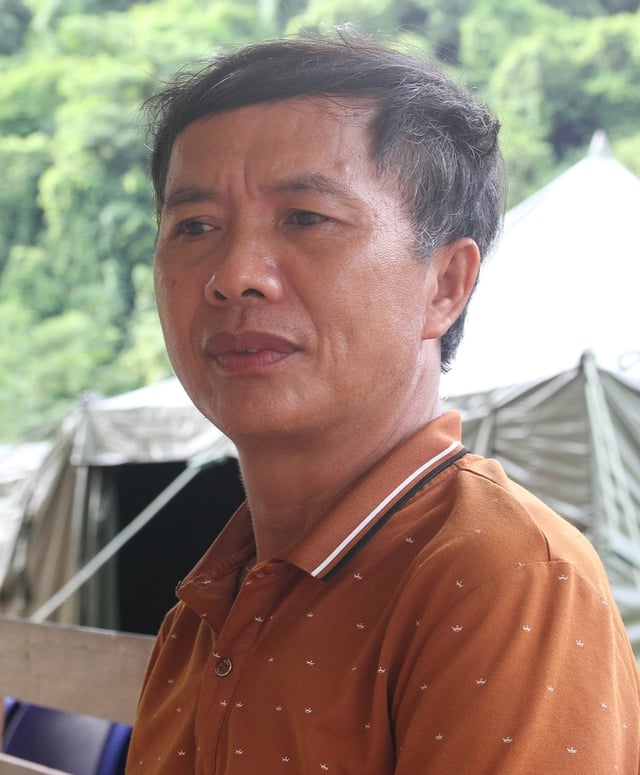
Mr. Tran Sy Ha, Principal of My Ly Primary Boarding School for Ethnic Minorities - Photo: Nguyen Duan
The country currently has about 30,000 English teachers, 88% of whom are qualified, but there is still a shortage in preschool and primary schools. It is estimated that more than 22,000 teachers will need to be added, and at least 200,000 teachers will need to be trained to teach in English by 2030.
"It is almost impossible for us to introduce English into teaching from grade 1," Mr. Tran Sy Ha, Principal of My Ly 2 Primary Boarding School for Ethnic Minorities (Nghe An) shared with PV of PNVN Newspaper. According to Mr. Ha, the historic flood that occurred in early August 2025 completely damaged the entire school's facilities, leading to many difficulties in arranging teaching places for the school. In addition to the difficulties in facilities, ethnic minority students here have difficulty accessing English. For My Ly 2 Primary Boarding School for Ethnic Minorities, the most difficult problem in introducing English into teaching from grade 1 is the problem of teachers. "Currently, the school does not have an English teacher. In previous school years, the school has applied online teaching methods for this subject with the participation of teachers from other schools. In case the school's facilities are guaranteed, to include English in the first grade at the school, it will need 2 more specialized teachers," Mr. Ha shared.
Parents are both happy and worried.
Her daughter is in kindergarten this year and will not enter first grade in 2 years, but every weekend, Ms. Nguyen Linh Chi (28 years old, living in Tu Liem ward, Hanoi) takes her daughter to a high-quality foreign language center to learn English. The goal is for her child to get acquainted and build a language foundation early. "My husband and I both want our child to have early access and be able to communicate in basic English. In the age of technology, we believe that in addition to their mother tongue, children should know a foreign language. This can be very helpful for their future," Ms. Linh Chi shared. With 2 lessons per week, each lesson lasting 60 minutes at the center, Ms. Linh Chi's daughter has access to basic knowledge of English and has the opportunity to interact with native teachers. These early contacts help children not feel confused and increase their confidence when starting with English at school later. Agreeing that English should become a compulsory subject from grade 1, Ms. Linh Chi said that this is a necessary policy in the current open world because starting from grade 3 to learn English is slow.
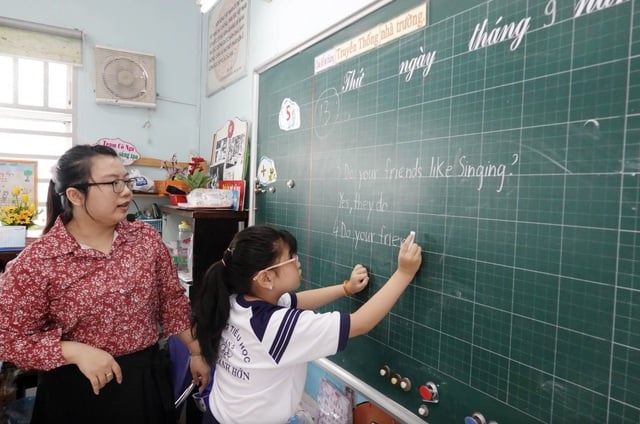
Primary school students in Ho Chi Minh City during an English class - Photo: Dao Ngoc Thach
Ms. Duong Thi Ngoc Anh (32 years old, residing in Xuan Phuong ward, Hanoi) also did not hesitate to register her 3-year-old son to study at a kindergarten that teaches a bilingual program. Ms. Anh explained that giving children access to English from an early age is because she wants to take advantage of the "golden time" for children's language development. "From 2 to 7 years old is the time when children are able to absorb language in the most natural and easy way. Therefore, I hope that my child will meet, contact, and listen to English every day so that he can acquire this language in the most comfortable and easy way," Ms. Anh shared.
Many parents believe that making English a compulsory subject from grade 1 is the right decision. However, the curriculum and the quality of teachers must be ensured so that children are exposed to English without being out of sync. "Teaching English in our country often focuses on teaching grammar while the time spent on communication to practice communication reflexes and pronunciation is still limited. I hope the program will focus on all four skills of listening, speaking, reading and writing, so that children can comfortably use English like their mother tongue," Ms. Anh expressed.
Source: https://phunuvietnam.vn/1-giao-vien-tieng-anh-cong-13-lop-hoc-238251205173101298.htm
![[Photo] Cat Ba - Green island paradise](/_next/image?url=https%3A%2F%2Fvphoto.vietnam.vn%2Fthumb%2F1200x675%2Fvietnam%2Fresource%2FIMAGE%2F2025%2F12%2F04%2F1764821844074_ndo_br_1-dcbthienduongxanh638-jpg.webp&w=3840&q=75)
![[Photo] 60th Anniversary of the Founding of the Vietnam Association of Photographic Artists](/_next/image?url=https%3A%2F%2Fvphoto.vietnam.vn%2Fthumb%2F1200x675%2Fvietnam%2Fresource%2FIMAGE%2F2025%2F12%2F05%2F1764935864512_a1-bnd-0841-9740-jpg.webp&w=3840&q=75)








































































Comment (0)