

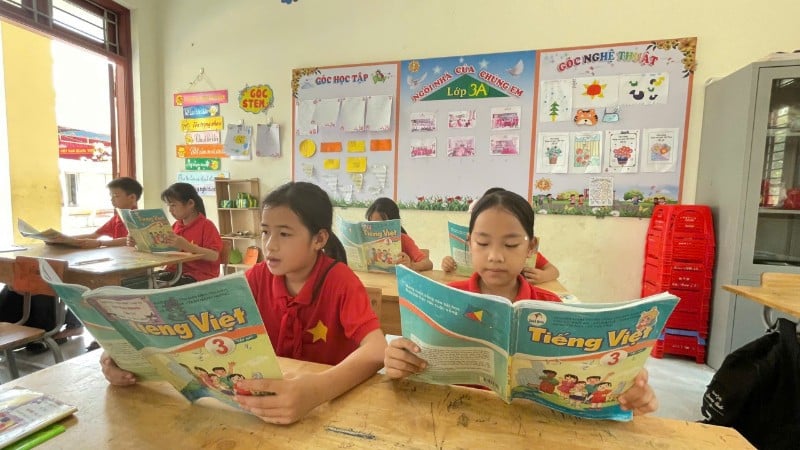
Faced with concerns about the potential for waste, pressure on teachers to choose, and the financial burden on parents, many opinions say that it is time to seriously consider the option of building a common set of textbooks, ensuring stability, science , and suitability for teaching and learning capacity nationwide.
Benefits of a book series
Since the policy of socializing textbook compilation was implemented, the Vietnamese general education system now has many sets of books produced by many different publishing units. This creates diversity, but at the same time also entails significant limitations.
In many localities, teachers are confused in choosing, having to spend a lot of time researching and comparing to find a set of books that are suitable for students' abilities. In addition, the existence of many sets of textbooks makes teaching and learning between localities inconsistent. A teacher from one province moving to another sometimes encounters difficulties because he has to re-familiarize himself with the entire program and knowledge standards according to the new set of books.
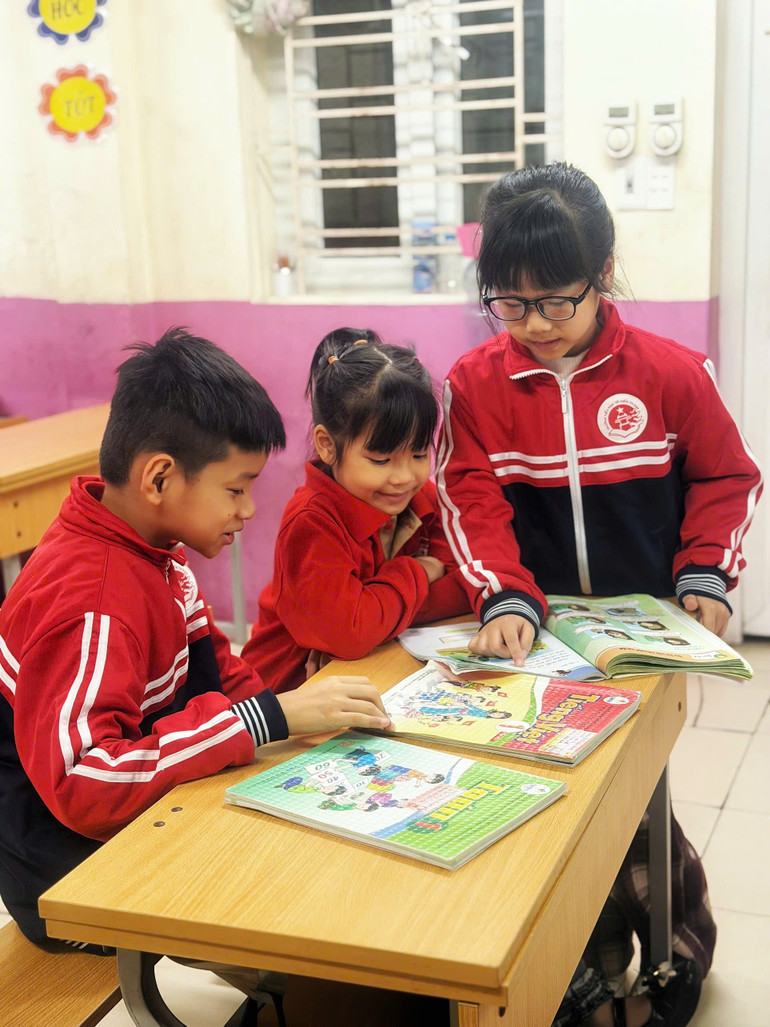
Textbooks are close friends and trusted companions of students.
Experts say that the development of a unified set of textbooks does not mean denying autonomy or creativity in education. On the contrary, a standard set of textbooks will create a common, stable foundation, ensuring the core requirements of knowledge and skills that students across the country need to achieve.
A unified set of books will help reduce the cost burden, limit commercialization in compilation, and create uniformity in testing and evaluation. Teachers will have an advantage in preparing lectures, and students will have access to balanced content that is more appropriate to the reality of psychological development.
In particular, in the context of the new general education program requiring close connectivity between levels of education, a unified set of textbooks will help the process of adjusting and updating knowledge to be carried out more synchronously and effectively.
Concerned about this issue, National Assembly delegate Nguyen Thi Viet Nga (Hai Phong City) said that the Ministry of Education and Training being assigned to develop a unified set of textbooks nationwide is a matter of special public concern because it is related to costs, quality and the risk of monopoly. "I think the current direction of the National Assembly and the Government is very correct: not to return to the textbook monopoly mechanism as before, but also cannot let the situation of too many sets of textbooks cause waste and inconvenience for teachers and students," Ms. Nga emphasized.
What solutions are possible?
Answering the question of Nhan Dan Newspaper reporter about which solution is feasible and economical, the National Assembly delegate of Hai Phong city proposed:
Firstly, the unified set of textbooks should be "selected" from textbooks that are being used effectively. Instead of compiling completely new ones (which is very costly), the Ministry of Education and Training should organize an independent assessment of all current textbooks; select the best books from each set to form a national standard textbook set; and adjust the structure, knowledge framework, and output standards to unify. This method not only saves time and budget, but also takes advantage of the wisdom of many groups of authors that have been tested in practice.
Second, maintain the mechanism of having many sets of textbooks but have a standard set so that schools can be more proactive, the remaining sets act as reference books.
Third, a series of requirements must be set to avoid re-establishing monopolies.
If the Ministry of Education and Training compiles textbooks without a strict monitoring mechanism, it is easy to return to the old model. Therefore, it is necessary to ensure: an independent appraisal council with foreign experts; transparency in the entire selection, appraisal, and pricing process; separation of "state management" and "compilation organization"; unified prices of textbooks by the Ministry must be set by the State to avoid cost overruns.
Ms. Nguyen Thi Viet Nga affirmed: "The most important point is that the unified set of textbooks must truly be for students, not for group interests or convenient management."
Sharing about the solution to build a unified set of textbooks that meet the requirements for application from the 2026-2027 school year, teacher Ly Van Dien, Principal of Yen Trach Primary School (Thai Nguyen) proposed that we should not choose only one set of textbooks out of the 3 sets being implemented from the 2020-2021 school year to now, to avoid monopoly and not taking advantage of the essence of other sets of books. Through many years of teaching and learning, using many sets of textbooks for each subject shows that each current set of textbooks has many advantages and meets the goals, requirements, content, methods, the sets of textbooks have also been assessed and selected at each level, are scientific, highly effective in training, and teachers are fully trained.
"If choosing from these three sets of textbooks, choosing each set for each grade level is a reasonable option, can be applied immediately and saves costs," said Mr. Dien.
Sharing the same view, some teachers also shared concerns that if the plan to compile a new set of books was implemented, it might not be possible to ensure the progress of implementation for the next school year. If we take a whole set of books and leave out the others, it would be a waste of both the brainpower and effort of the Compilation Council and unfair to the books that were not selected, because currently, the books that are being used all have their own advantages.
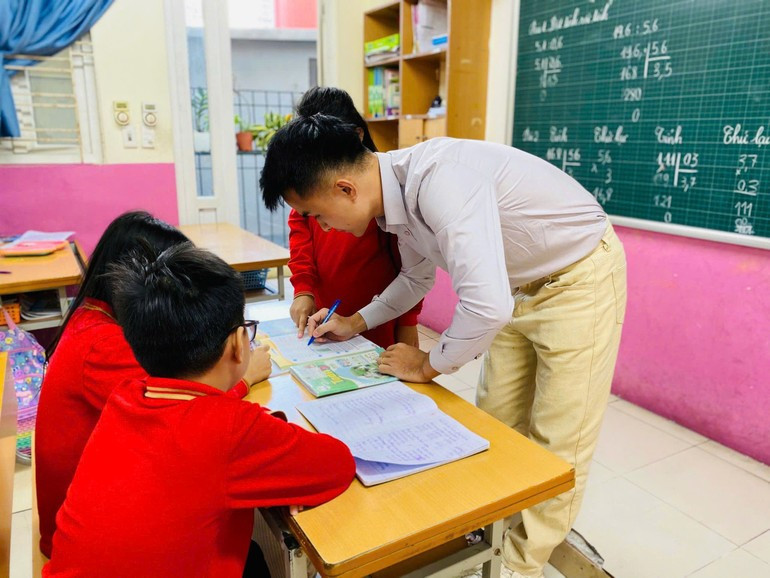
Ms. Dang Ngoc Tram, Principal of Dinh Tien Hoang High School (Hanoi) affirmed that when asked for their opinions, teachers in the school all agreed that each grade level should choose from one of the three current textbook sets, thus ensuring quality and progress, not causing regional disruption, and not having to retrain teachers.
Talking about difficulties, many opinions say that if a new set of textbooks is compiled, it will ensure consistency in content. But to compile a new set of textbooks for 12 grades, it will take about 4-5 years (compilation, editing, trial teaching, appraisal, asking for comments from teachers, experts and training teachers...). Meanwhile, the common set of textbooks must be used in the next school year, which is very difficult to do. If so, the only fastest way is to choose according to the lessons of each individual set of textbooks, then assemble them into a comprehensive subject. If choosing one of the three existing sets of textbooks in their entirety, it is indeed difficult. All three sets of textbooks have been appraised, approved and have been widely used at different levels, choosing like that will not ensure fairness for the other sets of textbooks.
There is also another opinion, proposing a combined model: the State takes the lead in compiling a set of standard textbooks, based on a strict review board, while allowing many supplementary documents and open learning materials so that teachers can flexibly implement them in practice. This approach both ensures a common knowledge base and creates a creative space for teachers.
In addition, a reasonable conversion roadmap is necessary: carefully reviewing current textbooks, absorbing strengths, overcoming limitations; increasing consultation with teachers and scientists before promulgation. In the long term, applying technology will help manage and update textbooks more easily through digital versions, reduce printing costs and ensure equal access across regions.
In short, in the context of general education continuing to innovate strongly, a unified set of textbooks is considered a highly stable solution, meeting the requirements of fairness, quality and efficiency. However, to successfully implement it requires careful, scientific preparation and consensus from teachers, parents and administrators.
Source: https://nhandan.vn/tim-giai-phap-cho-mot-bo-sach-giao-khoa-thong-nhat-post928297.html
![[Photo] Cat Ba - Green island paradise](/_next/image?url=https%3A%2F%2Fvphoto.vietnam.vn%2Fthumb%2F1200x675%2Fvietnam%2Fresource%2FIMAGE%2F2025%2F12%2F04%2F1764821844074_ndo_br_1-dcbthienduongxanh638-jpg.webp&w=3840&q=75)
![[Photo] 60th Anniversary of the Founding of the Vietnam Association of Photographic Artists](/_next/image?url=https%3A%2F%2Fvphoto.vietnam.vn%2Fthumb%2F1200x675%2Fvietnam%2Fresource%2FIMAGE%2F2025%2F12%2F05%2F1764935864512_a1-bnd-0841-9740-jpg.webp&w=3840&q=75)













![[Update] VinFuture 2025 Award Ceremony with total value of 4.5 million USD](https://vphoto.vietnam.vn/thumb/402x226/vietnam/resource/IMAGE/2025/12/05/1764939758366_image-jpg.webp)
























































Comment (0)