

This issue was frankly acknowledged by many experts at the first term Congress of the Ho Chi Minh City Vocational Education Association (2025-2030), in the context that the city's demand for skilled human resources is entering an acceleration phase.
Mr. Truong Anh Dung, Director of the Department of Vocational Education and Continuing Education (Ministry of Education and Training), said that recently, many vocational training institutions have proactively innovated, approached training programs according to international standards, participated in foreign joint training, and participated in ASEAN and world skills competitions.
However, standardization on a large scale is still limited, the standardization level between school groups is not uniform. This causes differences in training quality and ability to meet the labor market. Therefore, the vocational education sector aims to have 80% of facilities upgraded, modernized, and capable of training according to international standards by 2030.
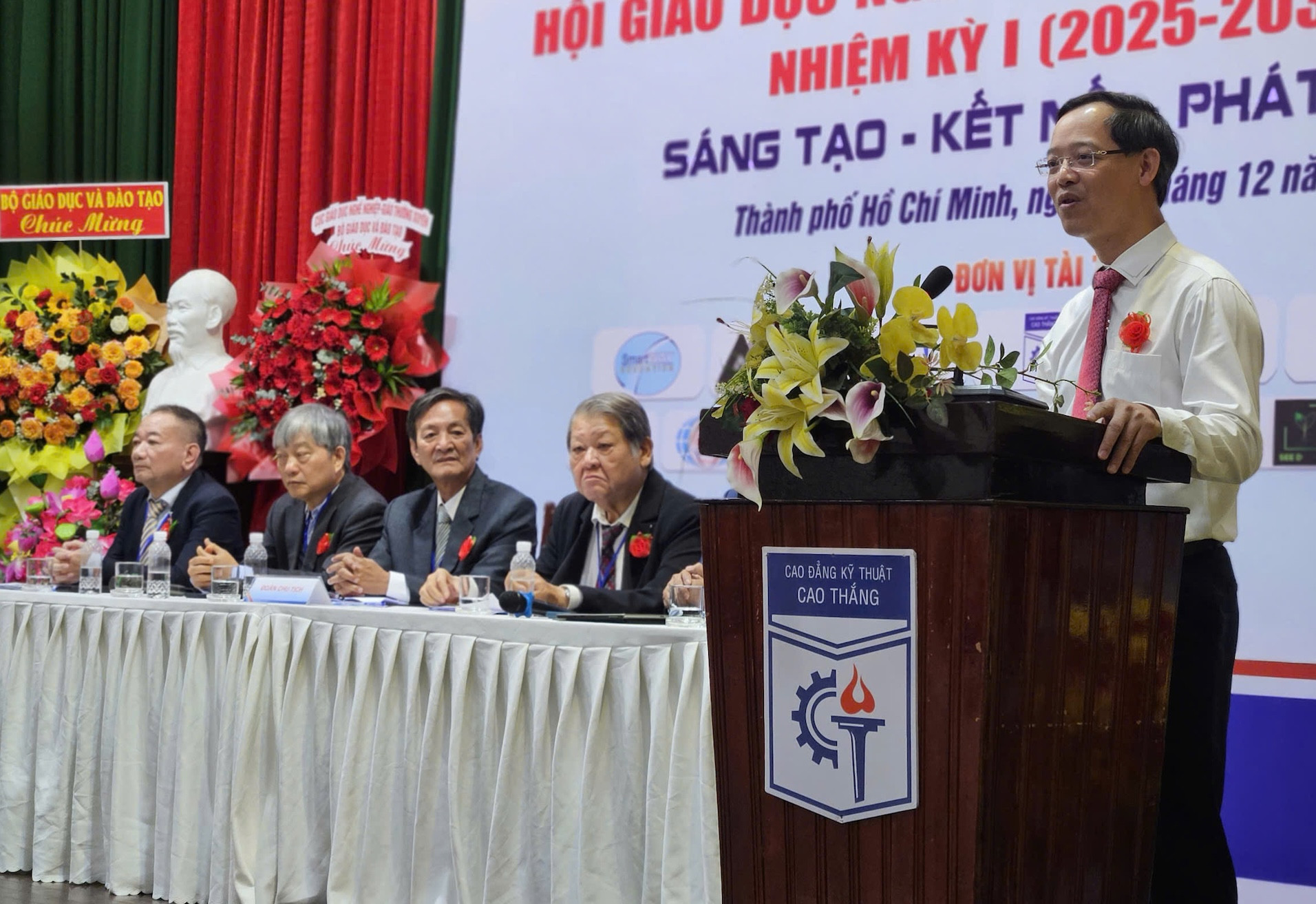
According to Mr. Dung, in the context of strong labor structure transformation, digital transformation and digital skills are no longer an option but a mandatory requirement for vocational training institutions. The Ministry of Education and Training is building a legal framework to synchronize data on learners, teachers and training institutions, connecting directly with the enrollment system and the labor market.
“Vocational training cannot be separated from businesses and employers. The connection should not stop at accepting interns, but businesses need to participate more deeply in program design, teaching, skills assessment and recruitment. Only then can a sustainable vocational skills ecosystem between schools, businesses and professional associations be formed,” said Mr. Dung.
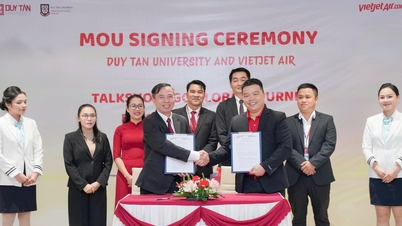
From the perspective of training institutions, Mr. Dang Minh Su, Principal of Global Polytechnic College, said that the current vocational school-enterprise linkage is still heavily formal. Many schools have signed agreements with hundreds of businesses but have almost no specific implementation activities. “We should not sign hundreds of memorandums of understanding without doing anything. The important thing is that each school needs a number of partner businesses that are deep enough and committed enough to jointly build competency standards, co-design learning materials and participate in assessing learners,” Mr. Su stated his opinion.
According to him, instead of chasing after the number of partners, vocational schools need to focus on the quality of cooperation. When businesses truly cooperate, learners will have access to technology, production processes and more realistic career requirements.
From the perspective of the labor market, Mr. Tran Anh Tuan, Vice President of the Ho Chi Minh City Vocational Education Association, said that the city is entering a period of booming demand for human resources, with a forecast of needing from 800,000 to 1 million new workers in the period 2025-2030. The service sector, high-tech industry, logistics, digital economy and green energy will account for about 70% of recruitment demand.
However, a major bottleneck today is that the labor market information system is not fully connected between vocational schools, businesses and employment service centers. Businesses are not yet deeply integrated into the common database, making human resource forecasting and coordination inaccurate.
According to Mr. Tuan, Ho Chi Minh City needs to invest more heavily in digital infrastructure in the field of human resources, building software to manage labor supply and demand data that connects directly with businesses and training facilities.
Many experts believe that, in the context of increasingly fierce competition for human resources, vocational education does not need to shake hands to meet the number, but needs deep and durable enough connections. When businesses really enter the school and the school trains closely to the market needs, students can go straight from the classroom to the job.
Source: https://vietnamnet.vn/truong-cao-dang-trung-cap-khong-nen-ky-voi-hang-tram-doanh-nghiep-lay-so-luong-2470058.html

![[Photo] 60th Anniversary of the Founding of the Vietnam Association of Photographic Artists](/_next/image?url=https%3A%2F%2Fvphoto.vietnam.vn%2Fthumb%2F1200x675%2Fvietnam%2Fresource%2FIMAGE%2F2025%2F12%2F05%2F1764935864512_a1-bnd-0841-9740-jpg.webp&w=3840&q=75)
![[Photo] National Assembly Chairman Tran Thanh Man attends the VinFuture 2025 Award Ceremony](/_next/image?url=https%3A%2F%2Fvphoto.vietnam.vn%2Fthumb%2F1200x675%2Fvietnam%2Fresource%2FIMAGE%2F2025%2F12%2F05%2F1764951162416_2628509768338816493-6995-jpg.webp&w=3840&q=75)

















































































Comment (0)