

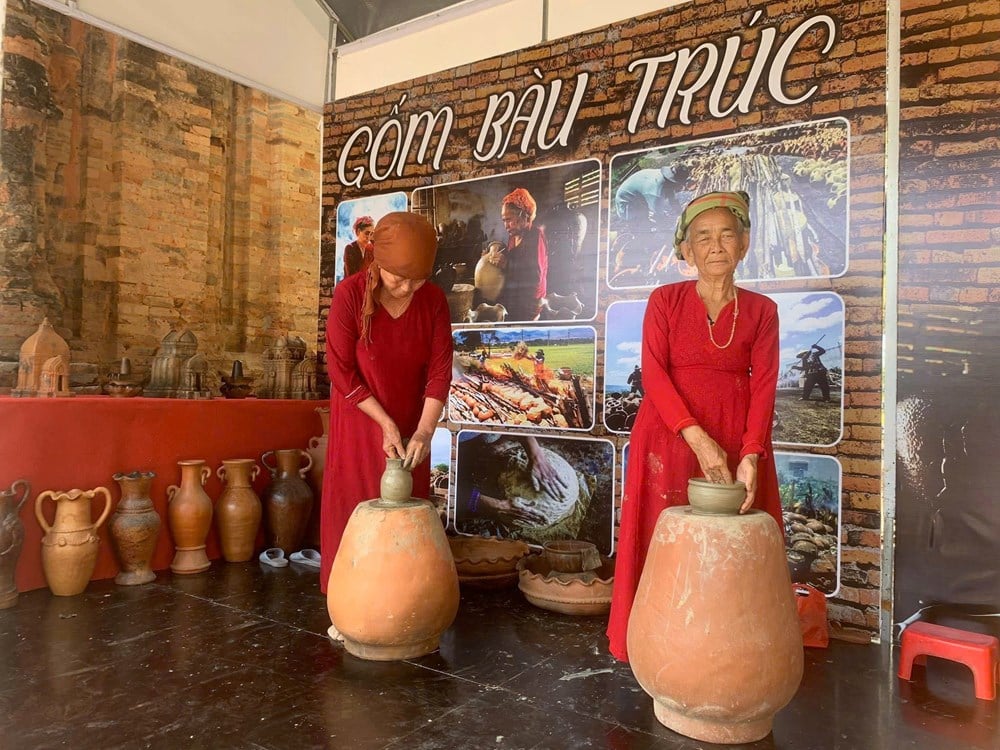
Cham Bau Truc pottery art
With significant investment, the province is aiming to have Cham pottery art inscribed on the list of Representative Intangible Cultural Heritage of Humanity. This is a strategic move, demonstrating a deep concern for preserving cultural identity and elevating the heritage, ensuring that Cham pottery art is preserved and flourishes in the future.
Investing over 205 billion VND in heritage preservation.
Khanh Hoa Provincial People's Committee has just officially approved the Project on Management, Protection and Promotion of the Value of Intangible Cultural Heritage "Cham Pottery Art" for the period 2025-2028 and the following years. This is a strong move, demonstrating the urgency and long-term vision of the province for a heritage in need of urgent protection.
According to the Project, Khanh Hoa province will invest more than 205 billion VND (including 163.5 billion VND from the central and local budgets) to implement important items. This capital will be used to build infrastructure, focus on teaching and training artisans and expanding the market for Cham ceramic products.
UNESCO's inscription of "Traditional Cham Pottery" on the List of Heritage in Need of Urgent Safeguarding (November 29, 2022) is both an honoring of its value and a serious warning about the responsibility to preserve this heritage. Recognizing this challenge, Khanh Hoa province has urgently conducted research and developed a specific action plan.
(Mr. Nguyen Van Hoa, Director of the Department of Culture, Sports and Tourism of Khanh Hoa Province)
The project goes beyond mere protection; it sets specific goals, affirming the position of Cham pottery on the world cultural map. The project aims to remove the heritage site from the list of sites in need of urgent protection by 2026, responding promptly to UNESCO's warning. By 2027, it aims to complete the cultural space planning and community tourism model for the Bau Truc pottery village.
Specifically, the province will develop product quality standards and register the exclusive trademark "Cham Pottery" for the Bau Truc pottery village. From 2028 onwards, the goal is to have "Cham Pottery Making Art" recognized as a representative intangible cultural heritage of humanity, a pinnacle that the heritage is striving for. The project will be implemented in Bau Truc village and village 12 (Ninh Phuoc commune), where Cham women are diligently preserving their craft day and night.
Mr. Nguyen Van Hoa, Director of the Department of Culture, Sports and Tourism of Khanh Hoa province, stated that UNESCO's inscription of "Traditional Cham Pottery" on the List of Heritage in Need of Urgent Safeguarding (November 29, 2022) is both an honoring of its value and a serious warning about the responsibility to preserve this heritage. Recognizing this challenge, Khanh Hoa has promptly conducted research and developed a specific action plan.
After a period of thorough preparation, the Project for the Management, Protection, and Promotion of the Intangible Cultural Heritage of "Cham Pottery Making Art" for the period 2025-2028 and beyond has been completed, submitted to the Provincial People's Committee for consideration, and has now been officially approved by the province. This event marks an important step, demonstrating Khanh Hoa's strong commitment to protecting this valuable "living museum."
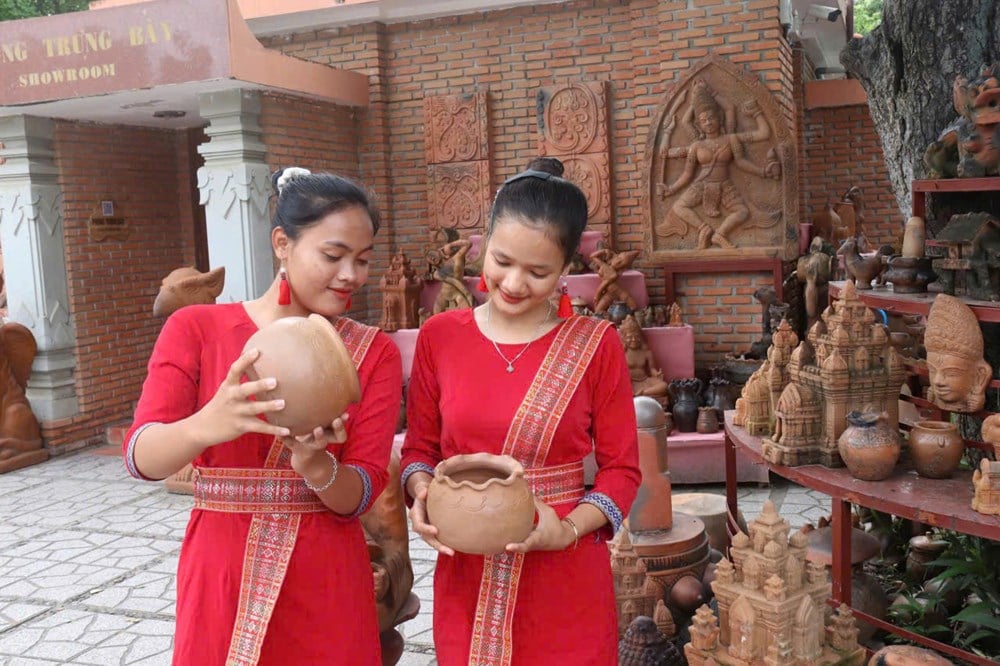
Cham girl with Bau Truc pottery
Bau Truc became a center of Cham pottery creativity.
Cham pottery has a very long history, existing for thousands of years, with similar pottery making techniques found in ancient archaeological relics. Scientists have discovered Cham pottery relics of ancient origin with basic techniques similar to modern Cham pottery, dating back 3000 years. Bau Truc pottery village, one of the oldest pottery villages in Southeast Asia, still retains the primitive production methods of hundreds of years ago. That is the unique and everlasting value of Cham pottery.
What makes Cham pottery unique and gives it its distinctive artistic value is the traditional handcrafted process maintained by Cham artisans for generations. Cham women select yellow clay, knead it skillfully, and place it on large jars to create the final form. The products are entirely handcrafted without a potter's wheel, using the technique of "shaping by hand, rotating with the buttocks."
The craftsman moves back and forth around the workbench, creating unique, straight lines that are completely different from potter's pottery. Each product is therefore a one-of-a-kind work, bearing the imprint, feelings, and mood of the craftsman. Skillful hands engrave patterns on the pottery body depicting rivers, nature, or deities, reflecting deep spiritual beliefs.
The pottery is fired entirely in the open air. The combination of sunlight, wind, and natural coloring techniques (from cashew nut oil, the dông tree, etc.) creates distinctive colors such as yellow-red, pink-red, black-gray, and unusual brown streaks, reflecting the rich culture of ancient Cham pottery. Thanks to the preservation of these skills and secrets passed down through generations, Bau Truc village rightfully deserves the title of "living museum" of Cham pottery.
The traditional pottery village of Bau Truc (Ninh Phuoc commune, Khanh Hoa province) currently has about 400 households involved in the craft, with more than 200 workers directly participating in regular production. The entire village has 12 production and business establishments and two cooperatives operating stably, forming a vibrant craft space that vividly reflects the cultural identity of the Cham community.
Besides the elderly artisans who are "living human treasures" preserving traditional crafting techniques, an increasing number of dynamic, creative young artisans are emerging, proactively learning and innovating product designs. As a result, Bau Truc pottery is not only diverse in style and function, meeting market demands, but also retains the original spirit of handcrafted pottery without a potter's wheel – a unique and rare technique in contemporary pottery.
Mr. Hoa said that every year, the Department organizes basic and advanced vocational training courses for about 60 students, prioritizing children from the village. At the same time, it collaborates with training centers, museums, and vocational schools to form a skilled workforce to ensure the continuity and long-term development of the traditional pottery craft.
The implementation of the Project not only aims to preserve and spread the Cham cultural values, an important part of Vietnam's cultural heritage, but also directly creates sustainable livelihoods for the local community. When the component projects come into operation, it is expected to create stable jobs for about 400 - 500 workers, contributing to increasing income, promoting the development of cultural tourism economy, helping people to be more attached to and proud of the traditional profession of their ancestors.
Source: https://baovanhoa.vn/van-hoa/dua-di-san-gom-cham-ra-khoi-can-bao-ve-khan-cap-187120.html
![[Photo] Explore the US Navy's USS Robert Smalls warship](/_next/image?url=https%3A%2F%2Fvphoto.vietnam.vn%2Fthumb%2F1200x675%2Fvietnam%2Fresource%2FIMAGE%2F2025%2F12%2F10%2F1765341533272_11212121-8303-jpg.webp&w=3840&q=75)






















![[Video] The craft of making Dong Ho folk paintings has been inscribed by UNESCO on the List of Crafts in Need of Urgent Safeguarding.](https://vphoto.vietnam.vn/thumb/402x226/vietnam/resource/IMAGE/2025/12/10/1765350246533_tranh-dong-ho-734-jpg.webp)































































Comment (0)