

>>> Part 2: Historic Train Journeys
>>> Part 1: The wharf of war and development
On July 23, 1975, Saigon Port was renamed Saigon Port, the time when the port began operating to serve the unified national economy .
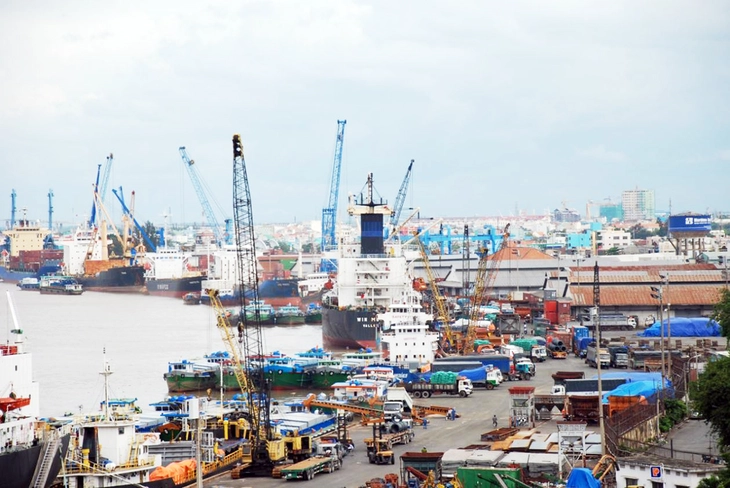
Saigon Port has made an important contribution to the economic development of Ho Chi Minh City and the whole country - Photo: Saigon Port
The brand "Port City"
In 2005, Ho Chi Minh City implemented the Government 's decision on planning to relocate and convert the functions of seaports on the Saigon River out of the city center, including seven ports and Ba Son Shipyard that had to leave.
The reason for the relocation is because the city's urban development is too fast, especially the pressure of increasing population causing heavy traffic jams in the city.
Responding to the press at the time, Mr. Tran Quang Phuong – Director of the Ho Chi Minh City Department of Transportation – confirmed that some ports and shipbuilding and repair factories at Ba Son had to be relocated to other provinces.
However, some ports will be moved to the outskirts of the city and thus the city will not be lost but will still maintain its brand as a seaport city.
According to the transport sector, in 1975 the city's population was 2.5 million people, by 2000 it had increased to more than 5 million people and the population continued to increase.
As a result, many new residential areas were formed, causing the seaports on the Saigon River to gradually be located within the inner city.
This causes increased traffic pressure in the city, while seaports in the city do not have their own connecting routes (in developed countries there are dedicated elevated roads for vehicles from the port to the national highway) but share the public transport system, causing traffic congestion.
In accordance with the port relocation plan, on May 16, 2009, Saigon Port commenced construction of Saigon Port – Hiep Phuoc in Nha Be District, covering an area of 100 hectares, with a total berth length of 1,800 meters, a throughput capacity of approximately 18 million tons of goods per year, and capable of accommodating ships up to 50,000 tons.
For the Nha Rong - Khanh Hoi land in the old District 4, after relocation, the port loading and unloading activities will be converted to a function on an area of nearly 315,000 square meters.
In 2017, the Ho Chi Minh City People's Committee approved a project by a business to develop a complex including residential areas, a shopping center, 3,116 apartments, a school, and a medical station. However, due to legal obstacles and related projects on the land, the project has not been implemented for nearly 10 years.
In a meeting on October 18, 2025, Secretary of the Ho Chi Minh City Party Committee Tran Luu Quang informed that the Standing Committee of the City Party Committee has a policy to stop the housing project in the Nha Rong wharf area to expand the cultural space of Ho Chi Minh City, the remaining area is expected to be used as a park combined with the expansion of Nguyen Tat Thanh Street and the development of services.
Following the City Party Committee's directive, on October 23, 2025, the Department of Construction proposed to the City People's Committee that the Department of Planning and Architecture review the planning and preside over a competition for planning and architectural ideas for the area west of the Saigon River (from Ba Son Bridge to the Vietnam International Container Port), including a multi-functional public park and three inland passenger ports: the Bach Dang Wharf Park area, the international passenger port, etc.
This is the basis for considering local adjustments to related planning projects; reviewing the need for investment and deciding on investment options for projects in the area. Including the construction of Thu Thiem 3 bridge, TOD development, international passenger port, inland waterway port, embankment, and public works along the riverbank.
According to architect Ngo Anh Vu, Director of the Ho Chi Minh City Institute of Construction Planning, the plan to develop the Ho Chi Minh Cultural Space and the park in the Nha Rong - Khanh Hoi port area is a highly anticipated project.
This location is very convenient for expanding the park space on both sides of the Saigon River, in addition to being a green space, it is also a space for performances, festivals, culture, art, and services for residents and tourists.
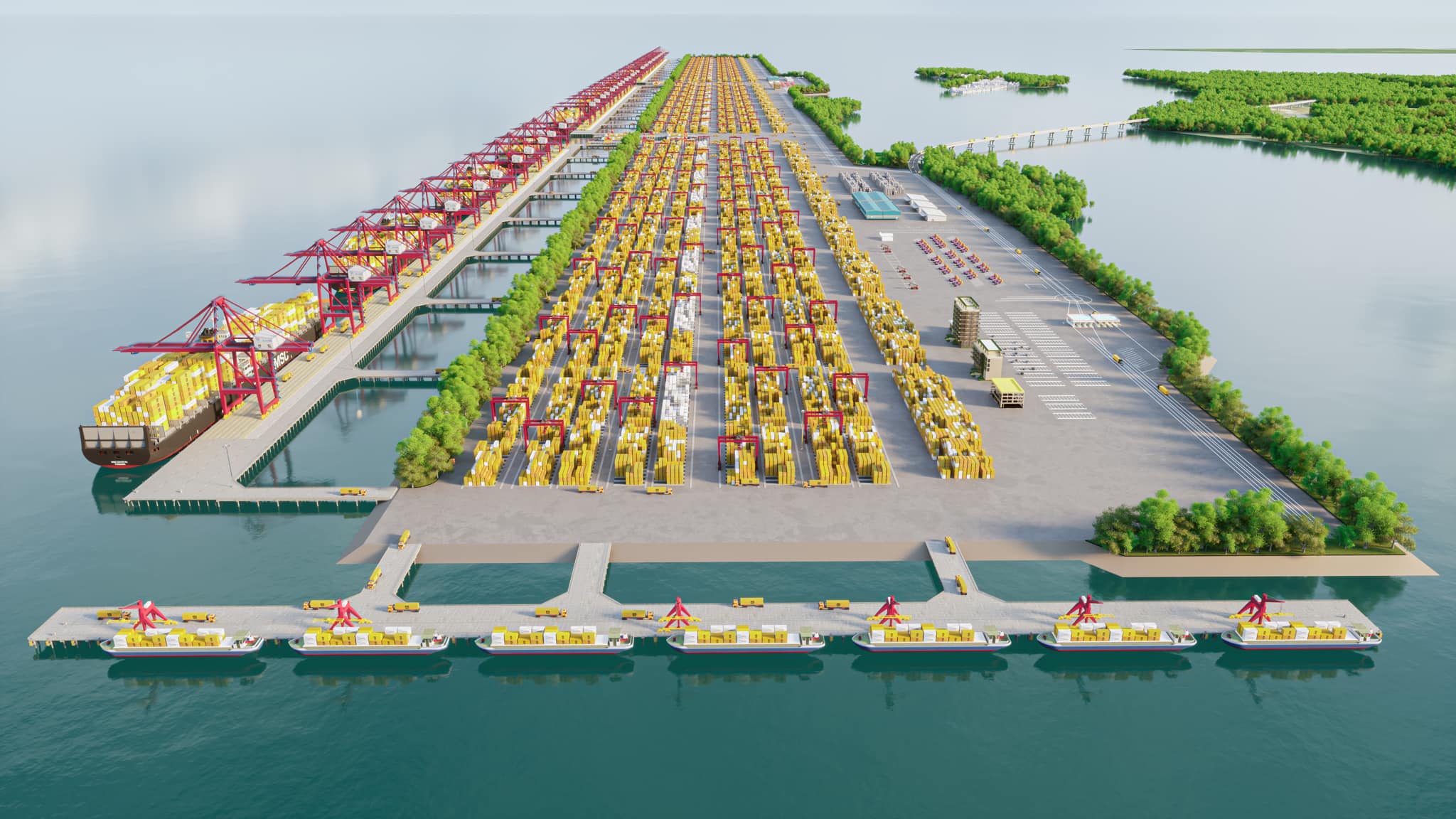
Perspective of Can Gio international transit port in the future
Reaching international seaport level
Since 1975, Saigon Port has been a leading general commercial port in the Vietnamese seaport system, with more than 3,000m of wharf located along the Saigon River and a fairly complete system of warehouses and equipment according to advanced technological processes in the port exploitation industry.
In line with the national strategy for developing the maritime economy, Saigon Port has partnered with leading global shipping corporations such as PSA – Singapore, SSA Marine – USA, and Maersk A/S – Denmark to build and operate three modern ports in the Cai Mep – Thi Vai area of the former Ba Ria – Vung Tau province.
The above ports have a total wharf length of 2,000m, can receive ships with a tonnage of up to 80,000 tons, a loading and unloading capacity of more than 3.5 million TEUs/year, and a total investment of 800 million USD.
At that time, Mr. Le Cong Minh – former General Director of Saigon Port – stated that the port cluster construction projects in Ba Ria - Vung Tau were intended to play a leading role in the entire Southern economic growth region, as the port would receive large ships with a tonnage of 80,000-100,000 tons.
The port has promoted joint ventures with maritime corporations from the US, Singapore, and Denmark to attract investment capital and high technology in the field of port construction and exploitation.
Regarding the Can Gio international transit port project, Saigon port has long been in the idea, planning and throughout the marine economic development strategy and is considered a large-scale project, bringing great benefits to Ho Chi Minh City and the country.
The Can Gio International Transshipment Port project has identified a location at the mouth of the Cai Mep - Thi Vai River, in Ganh Rai Bay, near international shipping routes passing through the East Sea, making it favorable for the development of an international transshipment port.
The project covers an area of 571 hectares, with a main wharf 7.2 km long, capable of receiving the largest container ships currently in operation, up to 250,000 tons, which is equivalent to a 24,000 TEU (1 TEU is equivalent to 1 20-foot container). The total capacity is 16.9 million TEU and the total investment is 5.3 billion USD…
Can Gio Port will add potential and support to turn Cai Mep - Thi Vai Port into a world-class international transit center.
Besides favorable conditions such as strategic location, natural conditions, and cargo flows, a crucial factor in the formation and development of an international transshipment port is the interest of MSC (Mediterranean Shipping Company SA – Switzerland).
According to Saigon Port, MSC has a fleet with a transport capacity of over 23 million TEU/year, accounting for 18% of the total transport capacity of the world's fleet. Service routes connect to more than 500 global seaports.
In Vietnam, the shipping company currently provides services to container ports in Hai Phong, Da Nang, Cai Mep - Thi Vai, etc. Annually, MSC transports more than 1 million TEU of import and export goods from Vietnam, connecting with major markets such as the US, Europe, China, Japan, Australia, and Southeast Asia.
Thus, Saigon Port’s cooperation with MSC is a new step forward in the development of seaport activities. At the same time, it will enhance Saigon Port’s position in international integration.
The above project shows that Saigon Port has a development strategy that aligns with Ho Chi Minh City's need to reach new heights. This is especially true after the city merged with Binh Duong and Ba Ria - Vung Tau, creating a modern port city with an international seaport system comparable to leading seaports in the region and the world…
Experts believe that the success of the project to build a port in Can Gio will mean that Ho Chi Minh City will establish its title as an international transit center port city. Because the port will attract shipping lines, transport companies, cargo owners, logistics service businesses, and participate in the world transport supply chain.
At the same time, attracting major international services, trade, finance, banking, and insurance companies will help Ho Chi Minh City become an international financial center – a title only held by a few countries with strong economies.
This will shape Ho Chi Minh City's important position in the national, regional, and global economies. At that time, the lives of the city's residents will be improved compared to the economies of developed countries.
Saigon Port is increasingly developing and expanding to other places, but the human factor is always the "soul" of the port.
Next: Life of the port, life of people
Tuoi Tre Newspaper
Source: https://vimc.co/165-nam-thuong-cang-sai-gon-ky-4-cang-sai-gon-vuon-ra-bien-lon/


![[Photo] Explore the US Navy's USS Robert Smalls warship](/_next/image?url=https%3A%2F%2Fvphoto.vietnam.vn%2Fthumb%2F1200x675%2Fvietnam%2Fresource%2FIMAGE%2F2025%2F12%2F10%2F1765341533272_11212121-8303-jpg.webp&w=3840&q=75)
![[Photo] The captivating scenery of the fragrant maple forest in Quang Tri](/_next/image?url=https%3A%2F%2Fvphoto.vietnam.vn%2Fthumb%2F1200x675%2Fvietnam%2Fresource%2FIMAGE%2F2025%2F12%2F10%2F1765353233198_lan09046-jpg.webp&w=3840&q=75)
















![[Video] The craft of making Dong Ho folk paintings has been inscribed by UNESCO on the List of Crafts in Need of Urgent Safeguarding.](https://vphoto.vietnam.vn/thumb/402x226/vietnam/resource/IMAGE/2025/12/10/1765350246533_tranh-dong-ho-734-jpg.webp)



















































Comment (0)