

Accordingly, in accordance with the Law on the Promulgation of Legal Documents, the Government has directed the drafting agency to seriously review and incorporate as many valid opinions as possible from National Assembly deputies; the opinions of the National Assembly's presiding body; and the conclusions of the National Assembly Standing Committee to revise and finalize the draft Law on E-commerce. Specific submissions and reports on the incorporation of feedback and explanations have been presented to the National Assembly.
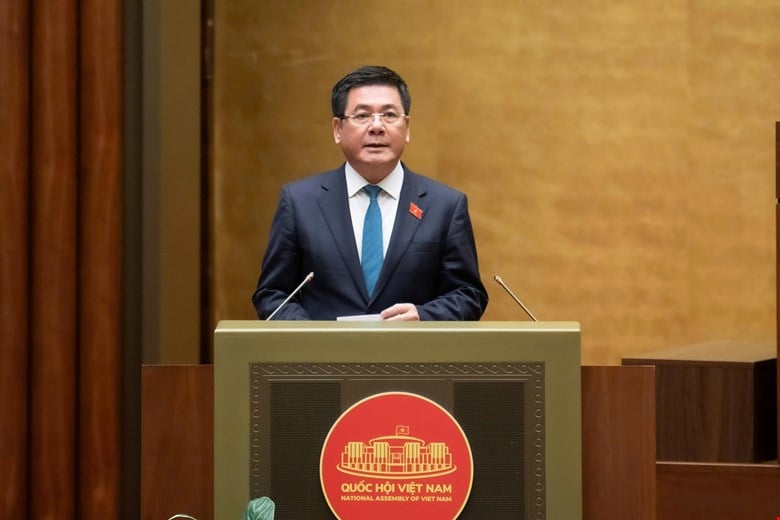
Authorized by the Government, Minister of Industry and Trade Nguyen Hong Dien presented the Report on the acceptance and explanation of feedback to the National Assembly.
Regarding e-commerce activities on social media and livestreaming sales methods.
Taking into account the opinions of many National Assembly deputies, the drafting agency has clearly defined the responsibilities of each entity involved in the livestreaming sales process (including sellers, livestreamers, and platform owners) to enhance information transparency, improve the legal responsibility of all parties, and create a basis for inspection, supervision, and handling of violations.
For social networks engaged in e-commerce activities, the draft Law defines them as a separate, independent type of platform, designed with a system of obligations appropriate to their nature, avoiding the mechanical application of regulations as with intermediary e-commerce platforms, while still ensuring there are no gaps in responsibility, especially in managing business content, coordinating the handling of violations, and protecting consumer rights.
Regarding regulations for identifying sellers on the platform.
Regulations on seller identification on e-commerce platforms are built on the basis of leveraging the national electronic identification and authentication system (VNeID) to contribute to cleaning up the e-commerce market and limiting counterfeit goods and goods infringing intellectual property rights through the ability to trace sellers, while effectively supporting tax management and preventing revenue loss for the state budget.
In drafting this regulation, the Government adhered to the principle of maximizing the use of existing digital infrastructure and data of the State, avoiding the creation of unnecessary administrative procedures for citizens and businesses, while still ensuring an effective management tool for state agencies.
Regarding the responsibilities of the owners of foreign platforms operating in Vietnam.
Taking into account the opinions of National Assembly deputies, the draft Law has been revised based on the operational model and functions of e-commerce platforms. Accordingly, the requirements for appointing authorized representatives, establishing legal entities, or appointing legal entities under authorization will be applied based on the operational model and functions of e-commerce platforms, ensuring compliance with international commitments to which Vietnam is a signatory, while simultaneously enhancing the effectiveness of state management and protecting the legitimate rights of domestic consumers.

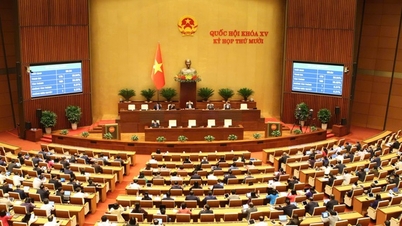
On the morning of December 10th, the National Assembly held a plenary session in the assembly hall. Photo: National Assembly Office.
Regarding the drafting of implementation guidelines.
In response to the opinions of the National Assembly Standing Committee, immediately after the Law is passed, the Government will issue a Plan for its implementation, which will require guiding documents to ensure clear, complete, feasible, and consistent regulations with related laws; not create new burdens for businesses and citizens; and at the same time, strengthen post-audit based on data and risk management; clearly define the responsibilities of each entity in e-commerce activities and ensure that guiding documents take effect simultaneously with the Law.

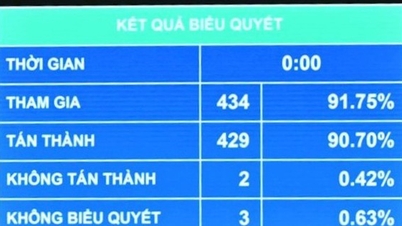
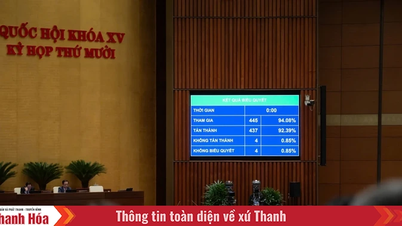
The Law on E-commerce was passed by the National Assembly with a vote of 444 out of 446 attending deputies. Photo: National Assembly Office.
Regarding the detailed comments from National Assembly deputies.
In addition to the major issues mentioned above, many National Assembly deputies have made in-depth and specific comments on the draft Law, such as: (1) Transaction threshold of foreign platforms; (2) Deposit mechanism for some foreign e-commerce platforms to ensure the fulfillment of compensation obligations to consumers in Vietnam and financial obligations to the State; (3) Reporting regime of platforms; (4) Regulations on administrative procedures; (5) Handling violations and e-commerce development policies...
According to Minister Nguyen Hong Dien: These contents have been fully incorporated by the drafting agency and will be further specified in the Decrees detailing the implementation of the Law, ensuring compliance with the spirit of Resolution No. 66 and Resolution No. 68 of the Central Committee and Resolution No. 198/2025 of the National Assembly; thereby minimizing administrative procedures, simplifying regulations, reducing compliance costs for businesses and citizens, and avoiding the creation of new bottlenecks for production and business activities.
“With a serious and receptive attitude towards the opinions of National Assembly deputies, the Standing Committee of the National Assembly, and the agency in charge of verification, the Government recognizes that the draft Law on E-commerce presented at today's session has been refined to be more rigorous and consistent, accurately reflecting the Party and State's policies and meeting the requirements of state management of the e-commerce sector in the context of digital economic development; while also strengthening the protection of the legitimate rights and interests of consumers and creating a transparent and fair business environment for enterprises,” Minister Nguyen Hong Dien said.
The Law on E-commerce consists of 7 Chapters and 41 Articles. The law regulates policies for the development of e-commerce; e-commerce platforms and the responsibilities of organizations and individuals in e-commerce activities; e-commerce with foreign elements; the responsibilities of organizations providing e-commerce support services; and the application of technology in managing and handling violations in e-commerce. The Law on E-commerce applies to domestic and foreign organizations and individuals participating in e-commerce activities in Vietnam and will take effect from July 1, 2026. |
Source: https://moit.gov.vn/tin-tuc/luat-thuong-mai-dien-tu-chinh-thuc-duoc-quoc-hoi-thong-qua.html




![[Photo] Explore the US Navy's USS Robert Smalls warship](/_next/image?url=https%3A%2F%2Fvphoto.vietnam.vn%2Fthumb%2F1200x675%2Fvietnam%2Fresource%2FIMAGE%2F2025%2F12%2F10%2F1765341533272_11212121-8303-jpg.webp&w=3840&q=75)




















![[Video] The craft of making Dong Ho folk paintings has been inscribed by UNESCO on the List of Crafts in Need of Urgent Safeguarding.](https://vphoto.vietnam.vn/thumb/402x226/vietnam/resource/IMAGE/2025/12/10/1765350246533_tranh-dong-ho-734-jpg.webp)
































































Comment (0)