

 |
| VN-Index surges, but the market remains "green on the outside, red on the inside." |
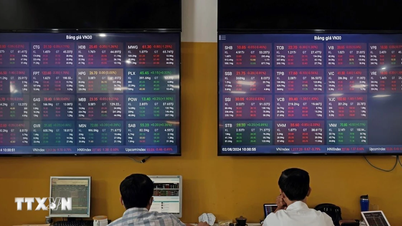
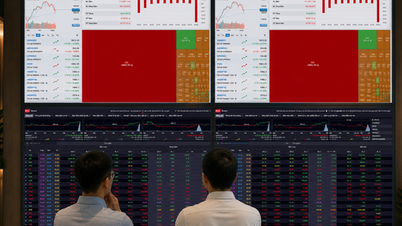
The Vietnamese stock market experienced a notable recovery on June 4th, with the VN-Index rising 12.5 points to close at 1,831.5 points, ending a streak of seven consecutive days of correction. However, behind the index's increase lies a less than positive picture, as the number of declining stocks still significantly outnumbered the number of rising stocks.
Trading activity showed that cautious sentiment still prevailed in the market. The index opened around the reference level, at one point falling nearly 7 points in the first few minutes but quickly recovering. After a period of tug-of-war in the morning, stronger buying pressure emerged in the afternoon, helping the VN-Index continuously extend its gains and successfully test the 1,830 point level before closing.
However, the market remained mixed, with 164 stocks declining on the HoSE exchange, exceeding the 140 stocks that rose. Nevertheless, the gap between the two groups narrowed significantly compared to the morning session, indicating that selling pressure is easing.
The main driving force behind the index's reversal came from large-cap stocks. The VN30-Index ended the session up 0.39%, with 18 gainers and 10 losers. Notably, as many as 23 stocks in the VN30 basket increased in price compared to the morning closing price, reflecting a clear improvement in demand among the leading stocks.
Within the banking sector, STB emerged as the most outstanding bright spot. The stock surged by 6.51%, making it the second-highest performer in the VN30 index, after PLX. In addition, a series of other bank stocks such as VIB, BID, CTG, HDB, LPB,SHB , SSB, TPB, VCB, and VPB also rose simultaneously, providing significant support for the market.
The oil and gas sector continued its positive performance amidst the recovery in global oil prices. PLX surged to its ceiling price of 41,850 VND/share, while BSR increased by 3.8%. OIL, PVC, and PVD also recorded gains of over 2%. However, the strength of the oil and gas sector diminished in the afternoon session as GAS reversed course and narrowed its gains.
Besides banking and oil and gas, the real estate sector also contributed positively to the index's recovery. VIC rose 1.32%, VHM increased 1.08%, while many other stocks such as NVL, GVR, and GEX also recorded favorable performance.
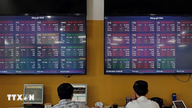
Notably, VIC continued to be the biggest support for the VN-Index, contributing more than 4 points to the index's total increase. However, paradoxically, this very stock was the focus of net selling by foreign investors.
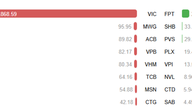
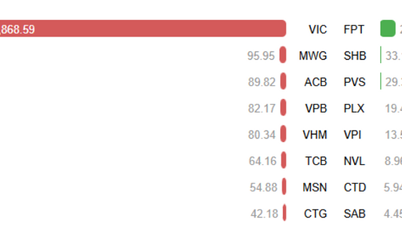
According to statistics, foreign investors continued their net selling streak for the 15th consecutive session, with a net selling value of nearly VND 5,742 billion across the entire market. On the HoSE alone, foreign investors sold a net of over VND 5,755 billion, a sharp increase compared to the previous session.
The focus was on VIC, which saw net selling of 24.64 million shares, equivalent to nearly 4,869 billion VND. This was one of the strongest net selling sessions for this stock in many years. Conversely,FPT continued to attract foreign capital with net buying of approximately 257 billion VND.
The continued large-scale net selling by foreign investors is a factor contributing to the unstable investor sentiment. However, analysts note that the majority of the net selling value comes from block trades in VIC, therefore the actual selling pressure on the market is not as negative as the statistics suggest.
Another noteworthy point is that liquidity remains very low. Although the trading value on the HoSE increased to over 22,100 billion VND, about 1,500 billion VND higher than the previous session, the net matching value only reached about 12,908 billion VND, the lowest in many recent sessions and establishing a new low in liquidity.
Low liquidity indicates that money has not yet truly returned to the market. The recovery of the VN-Index during the session was mainly due to the price-pushing effect of blue-chip stocks rather than a strong spread of capital.
Nevertheless, some positive signs emerged. Market breadth improved significantly towards the end of the session, with the number of rising stocks increasing from 85 in the morning to 136 at closing. Notably, the group of rising stocks accounted for 59% of the total trading value on the HoSE exchange, while the group of falling stocks accounted for only about 31.3%.
The market also received psychological support following news that the State Securities Commission held a dialogue with nearly 100 international investors and worked with MSCI in Singapore to promote solutions for upgrading the market's status. Many international investors assessed that Vietnam possesses outstanding advantages in economic growth, its position in the global supply chain, and its determination to reform the capital market.
According to VPBank Securities' assessment, the 1,800-point level is acting as a crucial support for the VN-Index. If it continues to hold, this area could become a consolidation base for the market to form a new trend in the near future.
The rally on June 4th was therefore significant as it helped the market end its prolonged decline. However, record low liquidity and strong net selling pressure from foreign investors indicate that caution remains. In the short term, the ability of the VN-Index to maintain its recovery momentum will largely depend on the strength of domestic capital flows and the performance of leading stock groups, especially banking and real estate.
Source: https://thoibaonganhang.vn/blue-chips-dan-song-vn-index-hoi-phuc-after-7-session-of-decline-183042.html



























































![[Video] Sunset at Lap An Lagoon – Where the sun sets over the fishing nets](https://vphoto.vietnam.vn/thumb/1200x675/vietnam/resource/IMAGE/2026/05/31/1780192137701_beach-landscape-sea-water-nature-grass-745871-pxhere-com.jpeg)









































Comment (0)