

These devices can help them recover quickly after falls, providing astronauts with extra strength and flexibility in harsh environments.
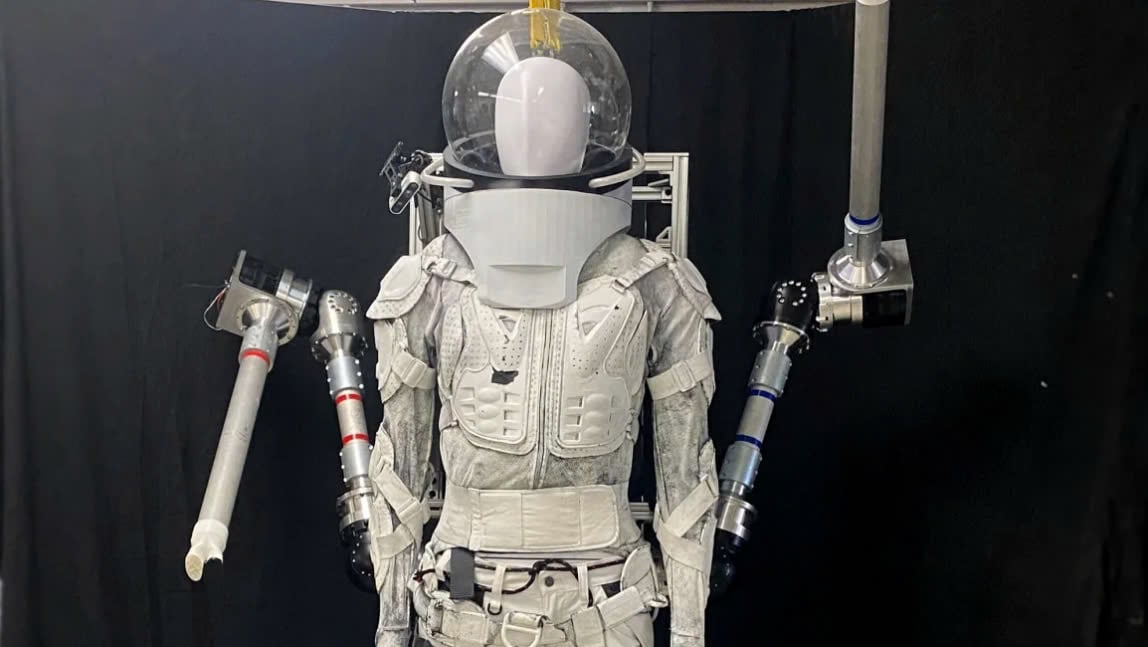
The SuperLimbs project is being developed at MIT. Photo: Kalind Carpenter/Preston Rogers/Mirza Samnani
SuperLimbs – intelligent support technology integrated into the backpack – will be a valuable companion for astronauts. When they fall, the robotic "arms" will automatically extend, helping them get up easily and saving energy for more important tasks.
This is especially important in the gravitational environment of the Moon, where maintaining balance becomes more difficult. According to data from the University of Michigan, the 12 Apollo astronauts fell 27 times and narrowly avoided falling 21 times during their missions.
When astronaut Charlie Duke fell on the Moon in 1972, he had to try three times before he could get back on his feet. Research indicates that falls often occur when astronauts are performing tasks such as collecting samples or using instruments.
In NASA's Artemis program, which aims to return humans to the Moon, astronauts will perform many similar tasks, and assistive technologies like SuperLimbs will help them stand up more easily and enhance safety during lunar exploration missions.
SuperLimbs, a project developed by MIT professor Harry Asada nearly a decade ago, is being adapted for use by astronauts. Erik Ballesteros, a doctoral student at MIT, spent the summer at NASA's Jet Propulsion Laboratory studying the system. He says SuperLimbs needs further refinement, but hopes to demonstrate its ability to help a mannequin stand up from a prone position by January.
X
Video : Astronaut Charlie Duke on the Apollo 16 mission in 1972 attempts to get up after falling. (Source: NASA)
However, developing this technology also faces many challenges, especially in the harsh environment of space. Dr. Jonathan Clark, an expert in space medicine, warns that factors such as temperature, dust, and radiation could increase the cost and time required to approve the technology for use outside of Earth.
Dr. Jonathan Clark emphasized that the pace of innovation in space technology today is impressive, turning science fiction into reality now takes only a few years, whereas previously it could take decades.
Ana Diaz Artiles, an aerospace engineering expert at Texas A&M, noted that they could help reduce energy costs when astronauts stand up, but could also increase weight and consume more energy.
She also emphasized that lunar dust is "extremely toxic," so rolling to stand up could be harmful to astronauts. SuperLimbs could help mitigate this problem, noting that the robot's "arms" are "really amazing and helpful."
The record for the longest moonwalk belongs to the Apollo 17 crew, lasting seven hours and 37 minutes. Meanwhile, the Artemis mission – with astronauts from many countries, including Japan – is expected to last up to a week. Therefore, they must learn to live and work far from Earth, preparing for future expeditions to Mars.
In addition, China also has its own plans to go to the moon by 2030, with the goal of building a research station.
Ha Trang (according to CNN)
Source: https://www.congluan.vn/bo-do-robot-moi-co-the-giup-phi-hanh-gia-dung-day-sau-khi-nga-post316845.html































































































Comment (0)