

Built in late 1964, when the US imperialists began escalating their bombing campaign against North Vietnam, the T1 bunker is the culmination of strategic thinking and the skillful hands of the officers and soldiers of Regiment 259 (Engineering Department). From a distance, the bunker looks like just a mound of earth, but in reality, it is a solid underground fortress, a military "wonder" that is half above and half below ground.
 |
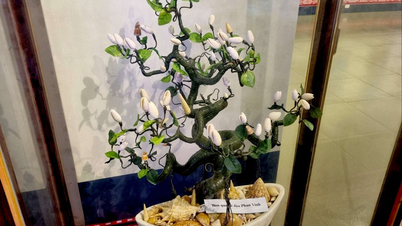
The artifacts are on display at the T1 operational command bunker. |
The bunker's roof is made of thick, monolithic concrete, a double-layered structure sandwiched between layers of sand, providing the perfect "armor" to neutralize the destructive power of bombs and missiles. Two imposing steel doors guard the entrance, capable of withstanding atomic pressure, radiation, and toxic fumes. Inside, the bunker is equipped with a steam-based air conditioning system, ventilation, toxic gas filtration, and electromagnetic interference protection. Every technical detail is geared towards a single goal: ensuring the smooth functioning of the command "lifeline" even when the ground shakes under the destructive force of bombs.
With an area of approximately 64 square meters, the T1 bunker is divided into three rooms: a combat briefing room; a combat duty room; and a room for equipment and engines. The "heart" of the bunker is the combat duty room. Here, duty shifts take turns working 24/7, their eyes never leaving the map display, their ears strained to listen to every signal from the dense radar network.
 |
| These phones are used to transmit orders. |
The communication system was organized with absolute precision. More than 20 telephones, housed in four small rooms, acted like "blood vessels" connecting the T1 bunker to the Politburo, the Ministry of National Defense , the military regions and branches, and the A9 Post Office switchboard. Notably, the bunker had a dedicated telephone exclusively for receiving and responding to President Ho Chi Minh; along with a system for reporting directly to the highest-ranking leaders of the Army.
Few people know that whenever Hanoi was shaken by the sound of air raid sirens, the signal originated from a small siren in this very bunker. The signal was transmitted to the roof of Ba Dinh Hall and then spread to all 15 sirens throughout the city, urging the capital's soldiers and civilians to take up combat positions.
 |
| Tourists visit the T1 command and control bunker. |
During the historic 12 days and nights at the end of 1972, the T1 bunker became the direct command center for the life-or-death confrontation. Colonel, Associate Professor, and Doctor Tran Ngoc Long, former Deputy Director of the Institute of Military History, stated: "The T1 bunker simultaneously performed three coordinated tasks: commanding the shooting down of American aircraft, ensuring the supply lines to the battlefield, and organizing the people's air defense system."
Today, the T1 bunker is not just a silent historical site. With the support of 3D mapping technology, the glorious pages of history seem to come alive again. Visitors descending into the bunker can witness firsthand the moment the first B-52 was shot down on the night of December 18, 1972, or the image of the plotters diligently drawing the enemy's flight paths amidst the screeching of radar interference.
The preservation of Tunnel T1 is carried out annually by the Thang Long-Hanoi Heritage Conservation Center, striving to restore it to its original state. Simultaneously, research, collection, and display of documents and artifacts are being expanded to best explain its historical value, enhance its educational value, and inspire pride among locals and tourists.
Source: https://www.qdnd.vn/van-hoa/doi-song/bo-nao-thep-duoi-long-dat-1019903

![[Photo] General Secretary and President To Lam receives Amazon's Senior Vice President David Zapolsky](https://vphoto.vietnam.vn/thumb/1200x675/vietnam/resource/IMAGE/2026/05/22/1779466547770_a1-bnd-3513-6601-jpg.webp)




























































































Comment (0)