

In recent years, the application of technology to the healthcare sector has brought about positive changes, particularly in the implementation of electronic medical record systems.
This model not only helps improve the quality of healthcare but also reduces time and costs, bringing many benefits to patients, doctors, and healthcare facilities.
Many advantages
Electronic medical records help patients avoid having to bring any documents when seeking medical treatment, including diagnosis results, test results, or medication lists.
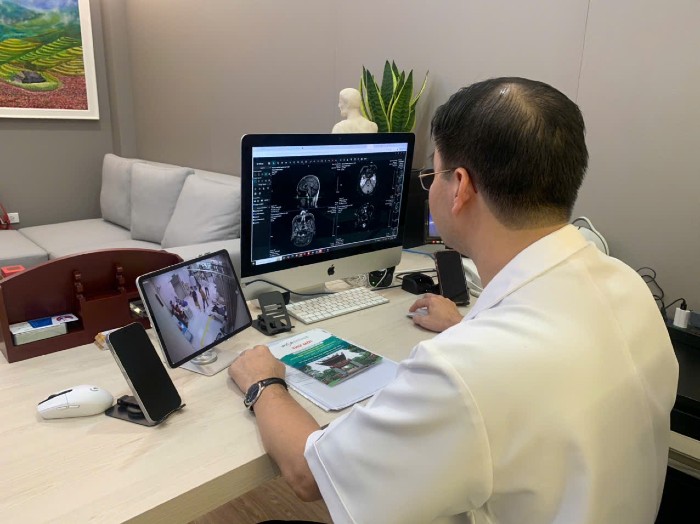 |
| In recent years, the application of technology to the healthcare sector has brought about positive changes, particularly in the implementation of electronic medical record systems. |
This eliminates patient concerns about losing test results or difficulties in reading doctors' handwriting. Furthermore, electronic medical records allow patients to easily track and compare test results and routine health check-up findings.
Combined with electronic health records, e-medical records facilitate patients in managing their health information throughout their lives, from family history and medical conditions to drug allergies. This helps patients proactively prevent diseases and take care of their personal health.
At Bach Mai Hospital, the electronic medical record system has been implemented since November 2024. Both patients and doctors are satisfied with the convenience and speed that this system provides.
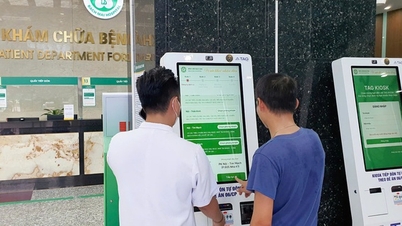
Accordingly, patients only need to scan their citizen identification card, and their basic personal information and medical history will be displayed, allowing them to be quickly directed to the appropriate examination area and conveniently receive treatment.
Before going to the hospital, some people had mentally prepared themselves for long waits and lengthy examination and treatment procedures, sometimes even a whole day, but the reality exceeded their expectations. Everything was very quick and convenient, taking only about 2 hours from the initial procedures to the order of tests, scans, and finally, the results were complete. Almost all stages were done through digital technology .
Pay your fees at the clinic, eliminating the need to travel to different locations to make payments. After procedures, return to the clinic where doctors can read the results on the computer. This minimizes travel and the risk of losing paperwork.
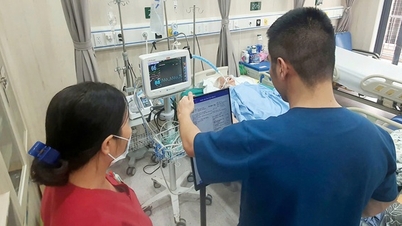
While caring for a family member receiving inpatient treatment at the A9 Emergency Center, Bach Mai Hospital, a resident of Quang Ninh also expressed satisfaction with the experience of using electronic medical records.
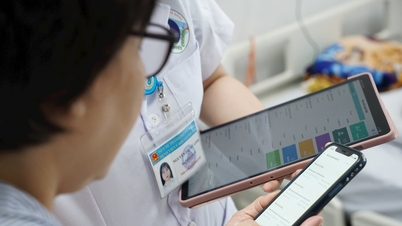
According to him, all procedures, as well as instructions, treatment protocols, and prescriptions, can be verified and viewed on a tablet or personal phone. Initially, I was unfamiliar with it, but with guidance from the doctors and nurses, I found it easy to use and quite convenient. Not only I, but my children can also view and monitor my treatment progress.
Electronic medical record systems not only help doctors quickly access patient information but also enhance communication and interaction between departments within the hospital.
This creates a favorable working environment, minimizes waiting times and reduces duplication in tests, leading to more accurate and timely diagnosis and treatment.
Associate Professor Dr. Nguyen Anh Tuan, Director of the A9 Emergency Center at Bach Mai Hospital, said that with the application of digital transformation and electronic medical records, administrative procedures are not time-consuming, and doctors can quickly conduct examinations.
All instructions are given via software. After the order is completed, the relevant departments receive the information, and the patient simply needs to move to the designated locations for treatment. The results are also returned to A9 very quickly, even before the patient returns to the clinic.
Whatever cross-sectional image a patient has taken, we immediately receive that image on the Center's computer and can make a diagnosis right away. For difficult cases, we can immediately discuss and consult with other departments, promptly addressing pathological situations in a race against time.
If patients need to be transferred to other treatment departments, they can be immediately admitted with complete information simply by using the software, instead of having to wait for hundreds of pages of paper medical records to be handed over.
It can be said that the digital transformation and electronic medical record system at Bach Mai Hospital has been comprehensively implemented, from receiving and processing patient history information, patient triage, to ordering examinations, carrying out orders, reading results, processing and treating patients, payment, and procedures for admission, discharge, and transfer to other hospitals.
At Hoai Nhai General Hospital, the implementation of electronic medical records has helped the hospital save significant time and costs. Dr. Ly Viet Hai, Head of the Intensive Care and Toxicology Department, said that applying electronic medical records allows them to easily access test results and diagnostic images without printing films or paper documents. This significantly reduces waiting times and errors.
According to Dr. Nguyen Thi Huyen Nga, Head of the Pediatrics Department, electronic medical records allow doctors to quickly find patient information and update new data. This saves time for both doctors and patients, while minimizing medical errors.
Expedite the implementation process at healthcare facilities.
Electronic medical records offer numerous benefits to healthcare facilities. Storing medical information digitally saves storage space and reduces the cost of maintaining paper records.
Electronic medical records represent a significant step forward in healthcare reform and digital transformation in Vietnam. This system not only saves time and costs but also improves the quality of diagnosis and treatment, creating convenience for both patients and doctors.
When widely and consistently implemented, electronic medical records will help the Vietnamese healthcare sector become more professional, save resources, and contribute to the sustainable development of the national healthcare system.
Vietnam has approximately 1,300 medical examination and treatment facilities, including about 135 hospitals of level I or higher. However, the pace of transitioning from paper medical records and files to electronic data in hospitals is still slow.
Regarding electronic medical records, according to Circular 46/2018, the Ministry of Health requires all hospitals of grade I and above to implement electronic medical records by the end of 2023. From 2024-2028, the Ministry of Health requires all medical examination and treatment facilities to implement electronic medical records.
According to an expert, the implementation of electronic medical records currently faces many difficulties, both financially and in terms of implementation guidelines. Currently, hospitals have implemented hospital management information systems such as HIS software for patient management, and software for social insurance integration, etc.
However, implementing electronic medical records requires additional software such as software for sharing diagnostic imaging results and blood test results.
To accelerate the implementation of electronic medical records, Minister of Health Dao Hong Lan recently signed and issued a document on promoting digital transformation and implementing Project 06 in agencies and units within the health sector.
Following the directive of Minister Dao Hong Lan, digital transformation is a political task. The entire sector must promote cashless payment for medical services; and continue to fully implement the contents of Directive No. 12 of 2019 issued by the Minister of Health on promoting cashless payment for medical services.
In addition, agencies and units within the healthcare sector must prioritize funding for activities related to the application of information technology and digital transformation;
At the same time, at least 1% of the agency's or unit's budget should be allocated to information technology applications, in accordance with Directive No. 02 of 2009 issued by the Minister of Health on promoting the application and development of information technology in the health sector.
For medical examination and treatment facilities, the head of the health sector urgently requested the implementation of electronic medical records, eliminating the use of paper medical records as stipulated in Circular No. 46 of 2018 of the Ministry of Health; the implementation of telemedicine as stipulated in Circular No. 49 of 2017; and the implementation of electronic prescriptions according to the issued guidelines.
In addition, it is necessary to implement online appointment scheduling for medical examinations and treatments; focus on solutions to support citizens and patients, and utilize chip-embedded citizen identity cards and biometric identification during registration and medical examinations and treatments.
The implementation of electronic medical record software will bring significant benefits to management agencies and hospital directors. At the same time, it will help people access services more quickly, reduce administrative procedures, and improve the quality of healthcare services and medical treatment.
Source: https://baodautu.vn/benh-an-dien-tu-buoc-tien-moi-trong-cai-cach-y-te-d229906.html
![[Photo] General Secretary and President To Lam meets with National Assembly delegates from ethnic minorities.](https://vphoto.vietnam.vn/thumb/1200x675/vietnam/resource/IMAGE/2026/04/20/1776696701056_a1-bnd-8331-3342-jpg.webp)



![[Image] National Assembly discusses the implementation of the socio-economic development plan.](https://vphoto.vietnam.vn/thumb/1200x675/vietnam/resource/IMAGE/2026/04/20/1776696707422_ndo_br_img-20260420-185419-jpg.webp)



























































































Comment (0)