

Flying fish come in many varieties, such as open-water flying fish, offshore flying fish, green flying fish, large flying fish, and reef flying fish… According to the taste of those who enjoy casual dining, reef flying fish are very delicious, hence the slightly higher price. One kilogram of reef flying fish, containing 7-10 fish depending on size, costs around 150,000 VND. Reef flying fish are favored probably because they live in clean waters at the foot of rocky reefs extending into the sea, resulting in firm and delicious flesh. This area has abundant coral, algae, and food (plankton), so reef flying fish are much more robust than flying fish of other varieties.
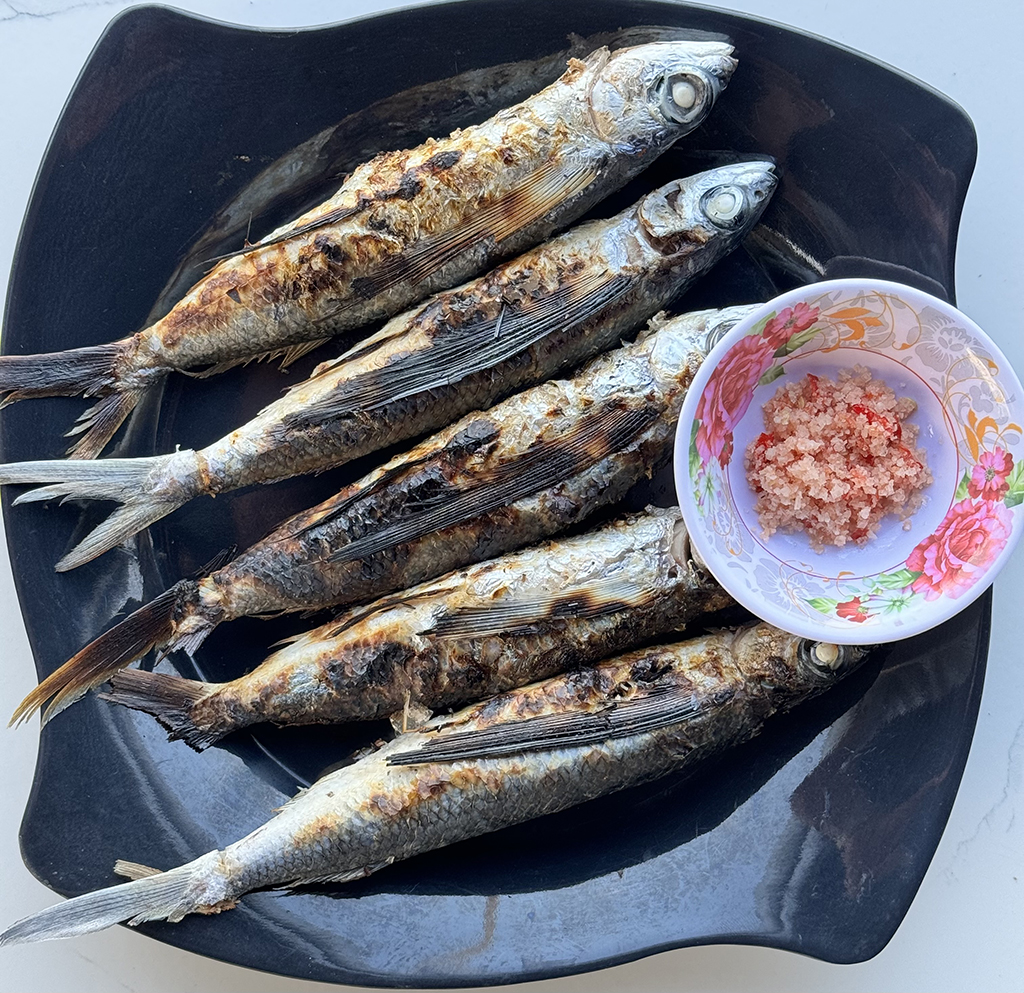
On summer afternoons, grilled flying fish is always a favorite dish among the people of the seaside village.
The migratory sea cucumbers, foraging in the shallow waters, provide a source of income for fishermen lacking capital, operating on a small scale, and fishing near the shore. Just two people in a motorboat can travel from the sea to the fishing grounds in less than half a day before returning. The catch may be small, but it still brings in nearly a million dong. Their wives wait at the dock with baskets…
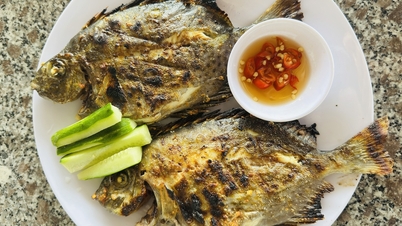
As the afternoon sun began to fade, scattered charcoal stoves in the alleyways started to blaze. Grilled flying fish, simple and unpretentious. Fresh fish, with bright black eyes, shiny green scales, and smooth bellies, were simply placed on the grill as they were.
Don't think that grilling is just a matter of throwing the fish on the fire and turning it over and over. It's not that easy! If you grill it carelessly, leaving it barely cooked, it will still have a lingering fishy smell in your belly. If you overcook it, almost to the point of being overcooked, the skin will turn black, the flesh will be dry and tough, and much of the sweetness will be lost. Eating like this with such food is very boring. Delicious food is what makes a good conversation complete.
Proper grilling requires a charcoal fire that's blazing but not too intense; too much heat will cause the fish to cook unevenly. The fish scales should turn a dark yellowish-brown with a speckled appearance. A keen sense of smell is also essential to determine when the fish is ready to be served.
Furthermore, what you dip grilled flying fish in is also very important. Don't copy restaurants or eateries by making a thick, sticky dipping sauce; it will diminish the deliciousness of the fish. The fish meat is already sweet and fragrant, so dipping it in dry chili salt is absolutely amazing. But the salt shouldn't be cooked salt, but raw salt, and even better if it's fine salt. This is the layer of salt that has just crystallized on the surface of the rice fields, with large, pure white, porous grains and a very "sweet" taste. Grind this salt with a few ripe red chili peppers.
Set up a simple table on the porch, under the coconut trees rustling in the southerly breeze, the "buddies" gathered around. The feast of salted fish from the rocky shore continued with lively chatter. One of the "experts" in making salted fish, in a moment of inspiration, slowly uttered a profound philosophical remark. He said that sea fish in general, and salted fish in particular, live in saltwater. Even on shore, they are not far from salt crystals. Salted fish – salted fish, forever salty.
People living by the sea have a somewhat wild way of eating grilled fish. They break the fish in half with their hands, causing the guts and roe to burst out. This is the hottest part, with the most unique flavor, so it should be enjoyed immediately because it loses its deliciousness when it cools down.
Peeling off the crispy dried scales reveals the pristine white flesh, rich in flavor and aroma, paired with a touch of salty, sweet, and spicy chili salt. You'll either savor it in your mouth or exclaim, "Oh my goodness, it's so delicious... I'll never forget it!"
Source: https://thanhnien.vn/ca-chuon-nuong-moi-185240617191912278.htm
![[Photo] The General Secretary, President and his wife meet with Vietnamese-Chinese friendship leaders.](https://vphoto.vietnam.vn/thumb/1200x675/vietnam/resource/IMAGE/2026/04/15/1776264829725_vna-potal-tong-bi-thu-chu-tich-nuoc-to-lam-gap-mat-nhan-sy-huu-nghi-viet-nam-trung-quoc-8703641-3130-jpg.webp)
![[Photo] Mrs. Ngo Phuong Ly meets and exchanges views with Mrs. Peng Li Yuan](https://vphoto.vietnam.vn/thumb/1200x675/vietnam/resource/IMAGE/2026/04/16/1776277858080_phu-nhan-1-jpg.webp)
![[Photo] National Assembly Chairman Tran Thanh Man attends the opening session of IPU-152](https://vphoto.vietnam.vn/thumb/1200x675/vietnam/resource/IMAGE/2026/04/16/1776277863731_ctqh5-jpg.webp)
![[Photo] My Son at night: A thousand-year-old heritage site amidst the Milky Way](https://vphoto.vietnam.vn/thumb/1200x675/vietnam/resource/IMAGE/2026/04/15/1776261039184_ndo_br_chon6-jpg.webp)






































































Comment (0)