

 |
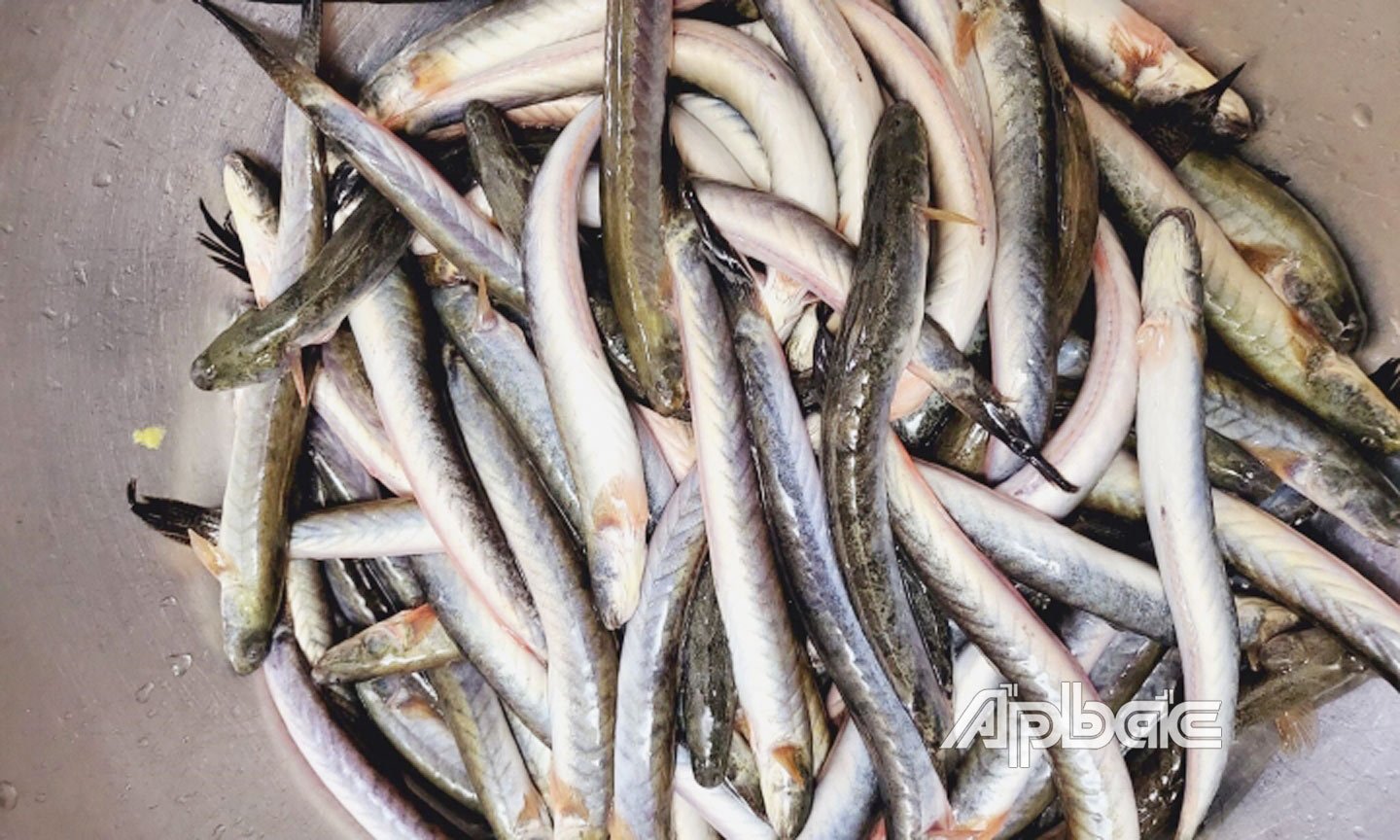
| Goby fish is a specialty of the Go Cong region. |
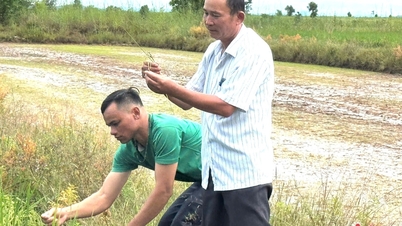
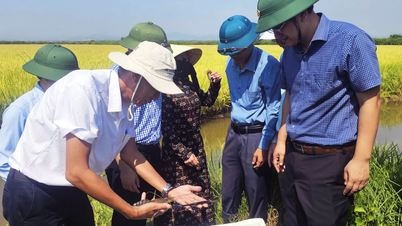
Mudskippers live in burrows in rice paddies. These burrows have a main tunnel leading down into the deep mud, called the "deep burrow," which serves as their refuge when they have no other escape route. Besides the main burrow, mudskippers also dig many side burrows, or secondary burrows connecting the main burrow to the surface of the rice paddies, to escape when being caught. Experienced mudskipper fishermen can use their feet to block the deep burrow, reach into the main burrow with one hand, and use the other hand to catch the fish in the side burrows.
Without experience in blocking the muddy burrows from the start, if the mudskippers burrow into the mud, the only way to catch them is to use both hands to dig deep into the mud until you reach the burrow, which can sometimes take half an hour. Mudskippers are usually brown with black stripes and live in freshwater.
They make burrows in the rice paddies to hide during the day, and at night the mudskippers crawl up to the burrow openings to feed. Normally, mudskipper burrows only contain male or female fish living alone, but when breeding, they form pairs and live together in the same burrow. Mudskipper burrows during breeding are easy to distinguish; the burrow opening is very large, always located in a low-lying area, and the opening is covered with mud from the deep rice paddies that the mudskipper couple has piled up.
Although called "sea goby," it's actually a river goby, as they make burrows in the mud on riverbanks and can survive in both freshwater and saltwater seasons. Sea goby has off-white skin, thick scales, a large, fan-shaped tail with markings, and firm flesh that isn't as tasty as field goby. Nowadays, most rural markets sell farmed goby, which is much larger and cheaper than wild-caught goby, but inexperienced people find it difficult to distinguish between farmed and wild goby.
In the past, people in Go Cong used to say that these mudskippers were born from the land. During the dry season, the fields would crack, but after a few rain showers, the fields would fill with water and mudskippers would appear. Back then, neither mudskippers from the fields nor those from the sea were considered valuable. In poor families, women or children would take baskets to the fields and plantations to catch mudskippers from the burrows to stew with peppers and eat to get through the meal.
During the rice flowering season, following the tides and the flow of water, people set traps on the mouths of the drainage channels from the rice fields down to the canals, or set bottom nets in a section of a canal or ditch, and they catch countless catfish. The locals dry them and use them as fertilizer for watermelons and custard apples.
Back then, the Go Cong theater always had troupes from Saigon performing. Although I wanted to go see the show, I didn't have enough money to buy "low-class" tickets, meaning tickets to stand at the back of the theater, peering up at the stage to watch the Cai Luong (Vietnamese traditional opera), like fish in a rice field always craning their necks out of the water to breathe.
When the rice is almost ripe, the fields of Tang Hoa village are teeming with mudskippers. Standing on the bank and looking down at the water, you can see countless mudskipper heads. That's how it is with mudskippers; there are no seats, and even behind the last row of seats, you can find plenty of people's heads.
Around the 1950s and 60s, snakehead fish was a common fish in rural areas, but with the skillful hands of home cooks, it was transformed into many delicious and inexpensive dishes. In Go Cong, during the chilly days of the northeast monsoon, the wind brings with it the blossoms of the Sophora japonica tree and the fruit of the winged bean plant, both of which only appear in late autumn.
A bowl of sour soup with water spinach and winged beans, cooked with snakehead fish, seasoned with thick-leaved perilla, a single dish on the table, yet you can eat it repeatedly, feeling full but still wanting more. Alternatively, using the same snakehead fish, people can grill it and combine it with a dipping sauce of fish sauce, lime juice, sugar, garlic, chili, thinly sliced white radish, pickled radish in a bowl of vinegar mixed with a little sugar and salt, and finely chopped basil, creating a wonderfully delicious dish.
In addition, braised catfish with fermented fish sauce is equally delicious. In the old kitchens, which were often open-plan, the aroma of fermented fish sauce still wafted through the air, stirring up a rumbling stomach. As dusk fell, the oil lamp flickered high, the steaming hot rice from Nàng Hoa rice pot filled the family dinner table by the lamplight, with all family members present – simple yet overflowing with happiness.
And for those who enjoy drinking, there's no forgetting grilled dried snakehead fish marinated in tamarind fish sauce. The dried snakehead fish, grilled until tender, has a sweet and fragrant flavor. The tamarind fish sauce with chili peppers, the sweet and sour taste of the fish sauce, combined with the sweet and aromatic flavor of the dried fish, makes you want to keep refilling your glass.
When the rice paddies are teeming with snakehead fish, the people of Tang Hoa often treat guests from afar to snakehead fish porridge. While porridge is usually made with rice, snakehead fish porridge only contains broth and snakehead fish meat, yet it's still called porridge. Only after tasting a bowl of snakehead fish porridge can one truly appreciate this delicious and unique dish from the South.
With live snakehead fish, a whole basket of live fish is dropped into a pot of boiling water. The heat is increased until the fish is tender, then stirred a few times with chopsticks to break up the flesh. The bones are then strained through a sieve, and the broth is simmered over low heat, skimming off any foam. Seasonings include fish sauce, finely chopped onions, and lightly crushed peppercorns… The spiciness of the peppercorns, the aroma of the onions, and the perfectly balanced sweet and sour flavors of "snakehead fish porridge" are simply indescribable.
"Meeting mudskipper with fermented shrimp paste is like meeting an old friend in a foreign land" - this folk verse, passed down from our ancestors, evokes nostalgic memories of home when mentioning mudskipper, a simple, rustic dish that has become ingrained in the memories of those from Go Cong living far from home.
LE HONG QUAN
Source: https://baoapbac.vn/van-hoa-nghe-thuat/202505/ca-keo-ma-gap-mam-ruoi-1042267/


![[Photo] General Secretary and President To Lam presides over a meeting on assessing national development resources.](https://vphoto.vietnam.vn/thumb/1200x675/vietnam/resource/IMAGE/2026/05/20/1779253785852_a1-bnd-2943-8519-jpg.webp)
![[Photo] National Assembly Chairman Tran Thanh Man working with the Standing Committee of the Economic and Financial Committee](https://vphoto.vietnam.vn/thumb/1200x675/vietnam/resource/IMAGE/2026/05/20/1779249584387_ndo_br_1-jpg.webp)









































































Comment (0)