

In the US, a female shark at Brookfield Zoo in Illinois gave birth to a baby shark despite not having been in contact with a male shark for the past four years.
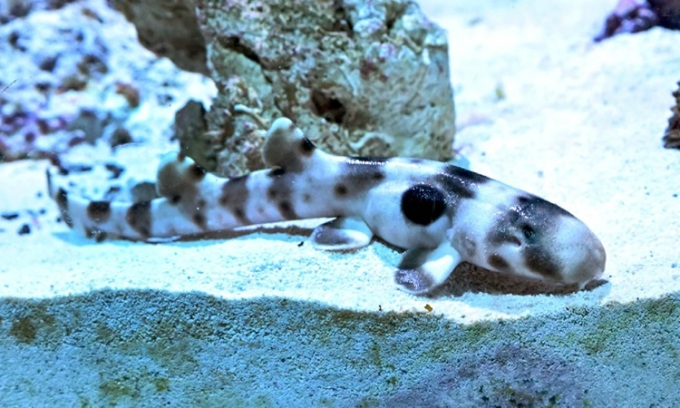
The young epaulette shark appears healthy and is eating well. Photo: Brookfield Zoo.
The birth took place on August 23rd after a five-month pregnancy and is the second recorded non-fertilized birth in a captive epaulette shark ( Hemiscyllium ocellatum ), Live Science reported on November 9th. Animal caretakers kept the young shark separately for two months for observation. The 13-15 cm long pup will now be displayed in the "Living Coasts" area of the zoo.
Parthenogenesis is a form of asexual reproduction in sexually reproducing species under normal conditions. This phenomenon has been observed in birds, sharks, lizards, and snakes in captivity. In June 2023, scientists witnessed parthenogenesis in crocodiles for the first time. Females of species capable of parthenogenesis lay eggs containing all the necessary genetic information. Mammals cannot reproduce asexually because they require genes from sperm.
The mother shark arrived at Brookfield Zoo in 2019 from the New England Aquarium. Since then, she has not lived with any males. The shark matured last year at the age of 7 and began laying 2-4 eggs per month. One of those eggs develops into an embryo without fertilization, thanks to the male's genetic material.
According to Mike Masellis, an animal care specialist at Brookfield Zoo, baby sharks born through parthenogenesis can be very fragile. However, the newly hatched epaulette shark appears to be quite healthy. It eats finely chopped fish roe, chopped squid tentacles, and various other fine foods.
Epaulette sharks are primarily nocturnal and can grow up to 1.1 meters in length, according to the Australian Museum. They live in the Great Barrier Reef off the coast of Queensland, Australia, from the northern tip of Cape York Peninsula to the Capricorn Islands and Bunker Group. This elongated shark is named after the large eye-spot above its pectoral fins, which makes it appear larger. Epaulette sharks can walk short distances on the sandy seabed, using their strong pectoral fins for locomotion.
An Khang (According to Live Science )
Source link





![[Photo] Prime Minister Pham Minh Chinh receives the Chinese Ambassador to Vietnam](https://vphoto.vietnam.vn/thumb/1200x675/vietnam/resource/IMAGE/2026/04/05/1775397481797_ndo_br_dsc-5512-jpg.webp)


































































































Comment (0)