

30 provinces and cities are implementing ethnic minority language teaching.
According to statistics from the Department of Ethnic Education , Ministry of Education and Training, currently over 30 provinces and cities nationwide are implementing the teaching of ethnic minority languages in general schools and organizing training for officials, civil servants, and soldiers in the armed forces.
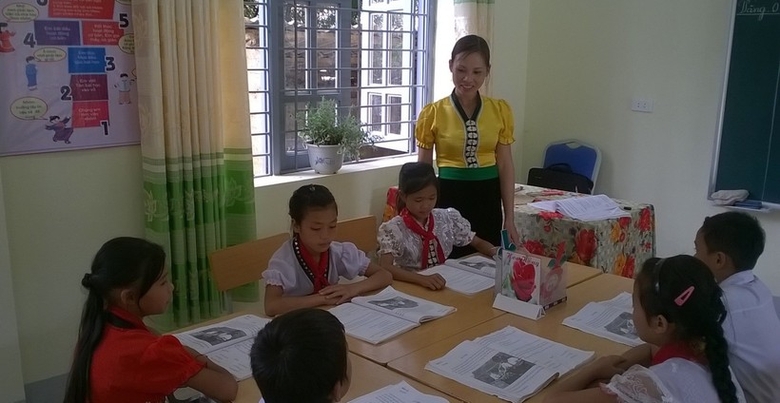
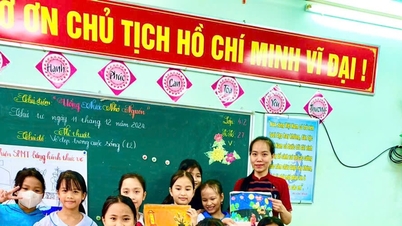
A lesson at Vo Nguyen Giap Primary School, Dien Bien District.
Many provinces/cities have issued projects and plans to implement policies aimed at preserving the spoken and written languages of ethnic minorities, notably Soc Trang, Tra Vinh, Lao Cai , Yen Bai, Hoa Binh, Dien Bien, Thanh Hoa, Nghe An, Ninh Thuan, Binh Thuan, etc.
In the 2022-2023 school year, the whole country had 535 schools teaching ethnic minority languages with 4,176 classes and 117,699 students. Among the seven ethnic minority languages taught in general education schools, Khmer had the largest scale, accounting for 55.7% of the total number of schools, 65.6% of the total number of classes, and 69.01% of the total number of students.
Cham, Jrai, Bahnar, and Thai languages are taught at the primary school level; Ede and Hmong languages are taught at the primary and lower secondary levels; and Khmer is taught at all three levels: primary, lower secondary, and upper secondary. In addition, some ethnic minority languages are taught experimentally, such as Cham Arabic, Ta Oi, Co Tu, Pa Co, and Bru Van Kieu.
According to Mr. Thach Song, Head of the Department of Ethnic Education and Continuing Education, Soc Trang Department of Education and Training, all 11 districts, towns, and cities in Soc Trang province organize Khmer language classes for students in general education institutions and continuing education centers.
In addition, 85 out of 93 Theravada Buddhist temples participate in teaching Khmer to students during the summer. The Southern Vietnam Intermediate Pali Cultural Supplementary School teaches both Khmer and Pali to its monastic students.
Every year, the Department of Education and Training of Soc Trang province directs and guides educational institutions in the area to effectively teach the Khmer language, while also maintaining good Khmer language competitions such as the provincial-level Khmer calligraphy competition and the provincial-level Khmer language excellence competition for 9th and 12th grade students.
“Through the aforementioned exams, the movement to learn Khmer has been spread throughout secondary schools in the province. The Department of Education and Training also coordinated with the Provincial Radio and Television Station to produce and broadcast the program “Learning Khmer Together” on Soc Trang Radio and Television Station to preserve and protect the ethnic minority script and promote the cultural values of the Khmer people in Southern Vietnam,” Mr. Thach Song said.
Similarly, Dien Bien province pays special attention to teaching the Thai and Hmong languages to students. Since 2012, the Provincial People's Committee has issued Decision No. 969/QD-UBND dated October 25, 2012, approving the Thai alphabet for use in teaching ethnic languages in Dien Bien province.
Accordingly, the Department of Education and Training advised the People's Committee of Dien Bien province to issue Decision No. 895/QD-UBND dated September 8, 2011, on the implementation of the Project to teach Thai and Hmong languages to primary and secondary school students in Dien Bien province for the period 2011-2015, with a vision to 2020.
From 2021-2022 to the present, a total of 351 classes have been opened in Dien Bien province, with 9603 students learning Thai and Hmong languages at primary schools.
Mr. Dao Thai Lai, Head of the Primary Education Department of the Dien Bien Department of Education and Training, shared: “Through the process of teaching the spoken and written languages of the Thai and Mong ethnic groups, students are provided with basic knowledge about the language and culture of the Thai and Mong ethnic groups, contributing to developing their thinking skills and supporting them to learn Vietnamese and other subjects well.”
Through learning their ethnic language and writing system, children gain a deeper understanding of society, nature, people, customs, traditions, and culture; they develop a love for their mother tongue; and this creates conditions for preserving and promoting the spoken and written heritage of their ethnic group.
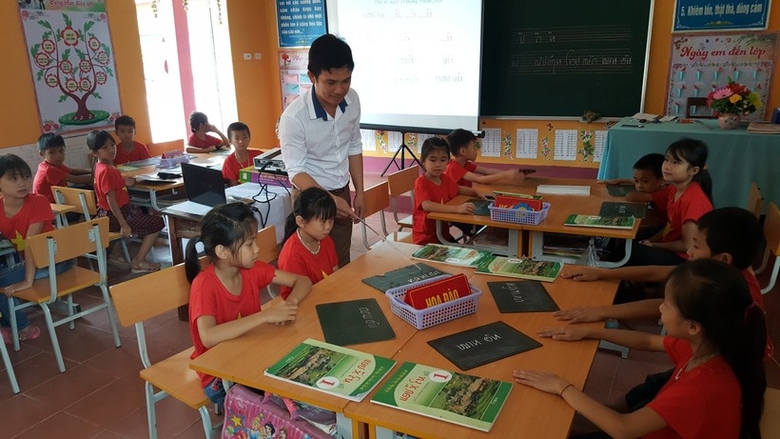
100% of ethnic minority language teachers in Gia Lai province meet the required qualifications.
Since 2011, Gia Lai province has issued Decision No. 30/2011/QD-UBND dated October 28, 2011, on the promulgation of the alphabet and phonetic system of the Jrai and Bahnar languages, and Decision No. 780/QD-UBND dated November 22, 2011, on allowing the teaching of Bahnar and Jrai languages at the primary school level in Gia Lai province.
Currently, in implementing Decision No. 142/QD-TTg of the Prime Minister, Gia Lai province has issued Plan No. 99/KH-UBND dated January 11, 2023, of the People's Committee of Gia Lai province on the implementation of the Program "Improving the quality of teaching ethnic minority languages in the general education program giai đoạn 2023-2030". The Department of Education and Training has implemented and guided units to develop teaching plans and lesson plans that are consistent with the program and ensure a time allocation of 2 lessons/week and are suitable to the actual conditions of each school.
Accordingly, 100% of ethnic minority language teachers in Gia Lai province have met the required qualifications, received certificates for completing the training program on teaching ethnic minority languages, and actively participate in professional development activities, learning, observing classes, and making teaching aids.
Ms. R'Com H'Phai – a Jrai language teacher at Ngo May Primary School, Ia Grai District, Gia Lai Province – shared : “The Provincial People's Committee and the Department of Education and Training pay attention to the teaching of ethnic minority languages. The school principal has directed ethnic minority language teachers to use the existing facilities and equipment of other subjects and to collect and utilize objects such as trees, flowers, roots, fruits, and readily available materials in the locality to make teaching aids; using pictures from other subjects and applying them flexibly to serve the teaching and learning of Jrai and Bahnar languages.”
During Jrai language lessons, students are enthusiastic and enjoy the subject. Teaching ethnic minority languages helps them understand their ethnic culture and further appreciate their mother tongue.”
According to Ms. R'Com H'Phai, in the era of international integration, paying attention to teaching ethnic languages in schools is very important, contributing to raising social awareness, protecting national defense and security, developing the economy, alleviating poverty, and preserving the linguistic heritage of ethnic groups, contributing to building an advanced Vietnamese culture rich in national cultural identity.
Source




![[Photo] Prime Minister Pham Minh Chinh receives the Chinese Ambassador to Vietnam](https://vphoto.vietnam.vn/thumb/1200x675/vietnam/resource/IMAGE/2026/04/05/1775397481797_ndo_br_dsc-5512-jpg.webp)



































































Comment (0)