Vietnamese music fans welcomed two virtual singers, Michau and Damsan, at the 2nd Ho Chi Minh City International Music Festival - Ho Do 2022. Michau and Damsan performed alongside names like Vu Cat Tuong, Ngot, Dinh Huong, Tung Duong, Soobin Hoang Son, and the foreign band Leonid & Friends.
Venturing into multiple artistic fields.
At Ho Do 2022, Michau and Damsan appeared on the main screen, surrounded by a band and dancers. While Michau showcased her powerful vocals in "Losing You," Damsan took the audience on a journey to find the sun goddess in "Don't Look Back."
According to Mr. Nguyen Tien Huy, General Director of Pencil Group (the company that created Michau and Damsan), the images of the two virtual singers are inspired by Vietnamese folk tales: the legend of Trong Thuy and My Chau and the epic of Dam San. Both are created using hologram projection technology. The voices are processed from recordings of real singers and then converted into virtual sound. The singers who recorded for Michau and Damsan must remain anonymous and their identities cannot be revealed.
After performing at Ho Do 2022, Michau and Damsan have yet to release any music as previously advertised. However, Vietnamese music fans have welcomed another virtual singer: Ann. According to the creators, Ann is a combination of AI algorithms and real sounds. Thanks to this, the female singer has a unique voice and timbre. Nevertheless, viewers commented: "Ann is only at the level of a 'virtual singer' and cannot yet be considered a professional singer because her song interpretation is quite simple, lacking subtlety and emotion. Ann's expressions in the music video are also monotonous, with a cold, emotionless face in every scene."
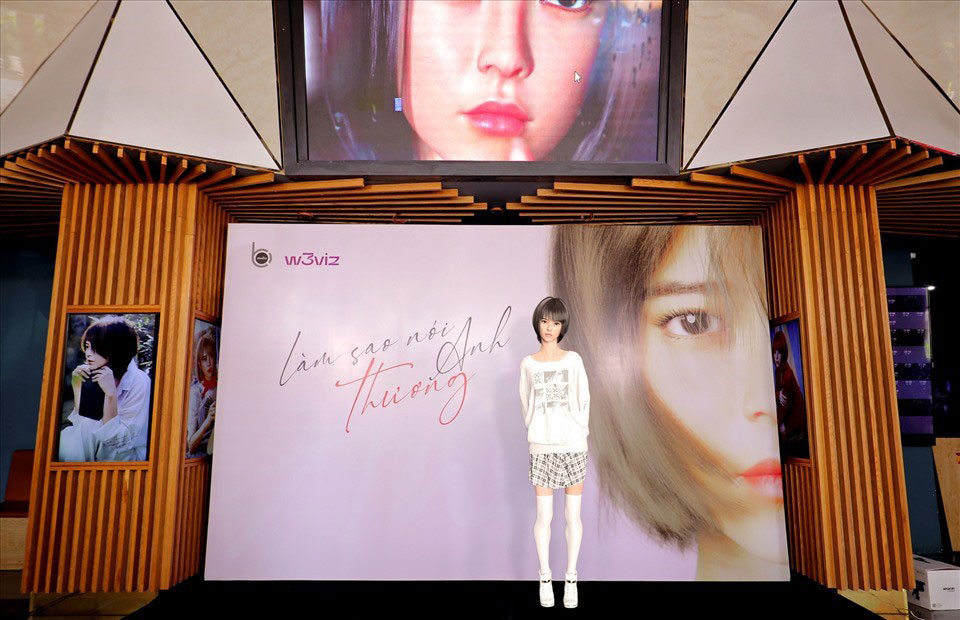
Ann, the virtual singer, makes her debut with the music video "How Can I Say I Love You?" (Photo: MINH HANH)
Around the world , many virtual singers have become idols, attracting a large fan base, such as Hatsune Miku (Japan), Luo Tianyi (China), and Apoki (Japan). Among them, Apoki (Japan), launched in 2019, is the first virtual idol of the graphic design company Afun Interactive. Apoki is presented as a singer, dancer, YouTuber, and influencer, and has released music videos such as "Get it out," "Coming back," and "Shut up kiss me." Apoki currently has 290,000 subscribers and 3.8 million followers on TikTok. In China, in June 2022, a virtual singer, Luo Tianyi, also created a new idol trend among young people. Tianyi is depicted as a 15-year-old girl with gray braids and green eyes, and currently has over 5 million followers on Weibo.
Data from Emergen Research, a research and consulting firm, shows that the global digital human market reached $10 billion in 2020 and is projected to reach $528 billion by 2030. Following this global trend, representatives from the virtual singer's publisher revealed that they expect Ann to be further refined and expand into other artistic fields such as acting, fashion modeling, and participating in entertainment shows.
The real singer cannot be replaced.
The biggest advantage of virtual singers is that their voices and appearances can be programmed. Investors believe that virtual singers offer a safer option for management companies, especially given the current hot topics in the entertainment industry regarding scandals and "blacklisting." With a virtual singer, management companies don't have to worry about their artists getting involved in personal controversies. Furthermore, virtual singers can perform continuously without being affected by health, age, or skill limitations.
According to musician Nguyen Ngoc Thien, virtual singers are an inevitable development in the modern entertainment industry. Ultimately, however, they are simply a new form of entertainment that enriches audience choices. Because virtual singers are a product of technology, we can only listen for enjoyment; we cannot experience the emotions that real singers infuse into their songs. "I believe that virtual singers or virtual artists are a unique development for the entertainment industry, but they cannot replace real artists or singers," musician Nguyen Ngoc Thien asserted.
Composer Nguyen Van Chung said he was excited about virtual voices and that virtual singers would avoid personal scandals and controversies. However, virtual singers cannot compete with real singers due to many limitations. For example, virtual singers cannot perform live or interact with the audience. Singer-songwriter Anh Tuan (a member of the MTV group) added: "Virtual singers cannot bring genuine emotions and feelings to the audience, so they cannot replace real singers."
Insiders argue that virtual singers are simply machines capable of performing. Virtual idol singers like Hatsune Miku (Japan), Luo Tianyi (China), Adam (Korea)... initially garnered attention but quickly faded into obscurity.
Source: https://nld.com.vn/van-nghe/ca-si-ao-kho-lam-nen-chuyen-20231116213659137.htm







































































































Comment (0)