

And the question that arose after the debate, which was judged to have leaned somewhat in favor of Harris, was: Are presidential debates really that important, and do they change voters' minds and decisions about the candidates?
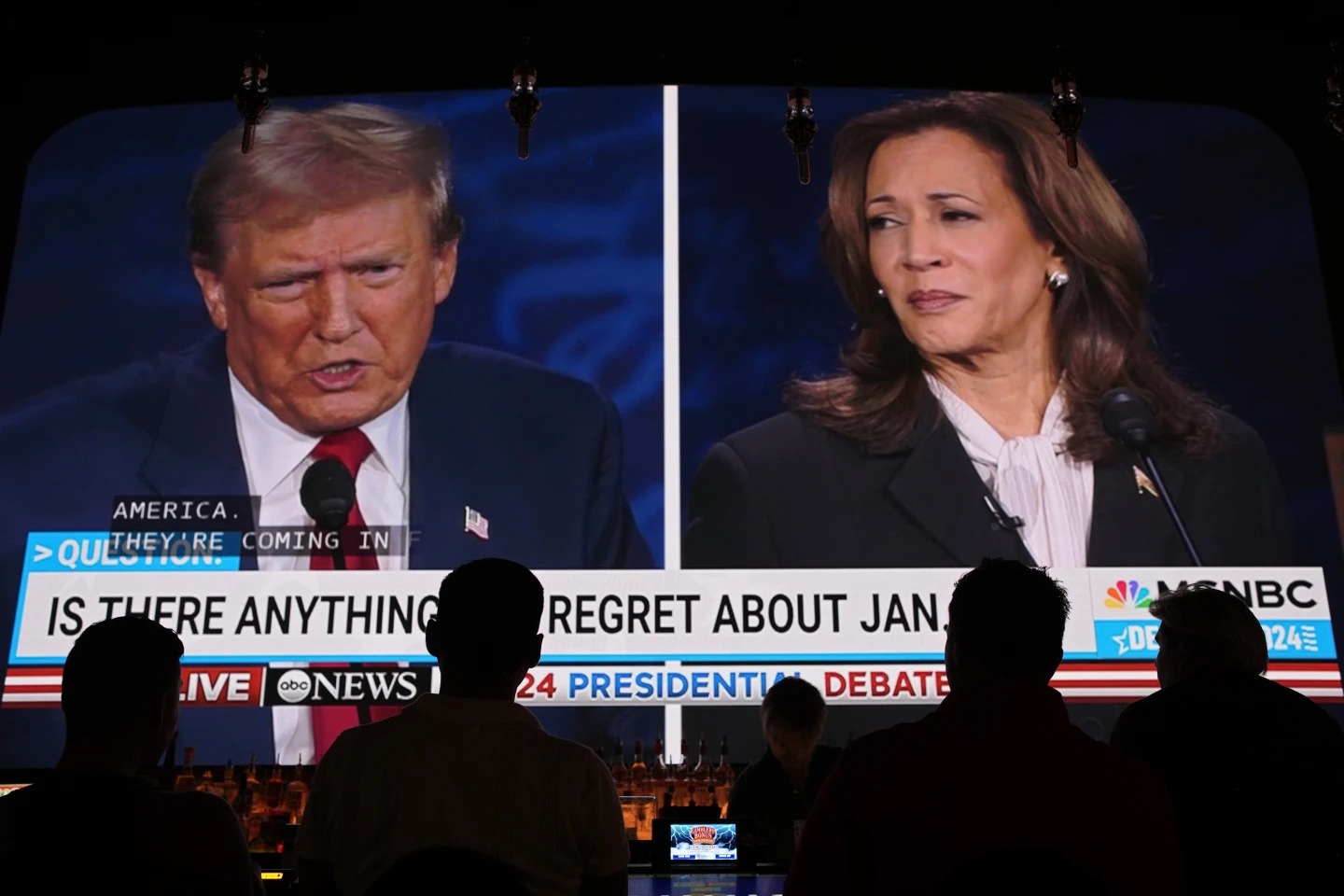
People watch the debate between former President Donald Trump of the Republican Party and Vice President Kamala Harris of the Democratic Party on the evening of September 10. Photo: AP
Will presidential debates change the outcome of the election?
Overall, research shows that the answer is mostly no.
Associate Professor Vincent Pons of Harvard Business School evaluated pre- and post-election surveys in 10 countries, including the US, the UK, Germany, and Canada, from 1952 (the year of the first televised presidential debate in the US) to 2017.
The results showed that televised debates did not significantly influence voters' choices. "Debates are where voters can learn what the candidates represent and how good they really are, but the debates have no impact on any particular voter group," Pons said.
Another analysis published in 2013 by University of Missouri communications professors Mitchell McKinney and Benjamin Warner examined survey responses from college students at universities across the U.S. from 2000 to 2012.
In their survey, they also found that presidential debates have little impact on voter choices. 86.3% of respondents maintained their choice before and after watching the debate, 7% were undecided, and only 3.5% switched to a different candidate. Professor Daron Shaw of the University of Texas at Austin stated that by the time the debates take place, most voters have already chosen a party.
Meanwhile, in the two debates between Trump and Biden in 2020, 87% of voters surveyed said the debates did not affect their votes, according to a Monmouth University poll.
The FiveThirtyEight polling analytics platform showed that on September 28, 2020, Biden had 50.1% and Trump had 43.2%. By September 30, after the debate, Biden had 50.5% and Trump had 42.9%.
Similarly, the poll numbers for the two candidates remained largely unchanged before and after the second debate. Biden won the 2020 election with 51.3% of the national popular vote and 306 Electoral College votes.
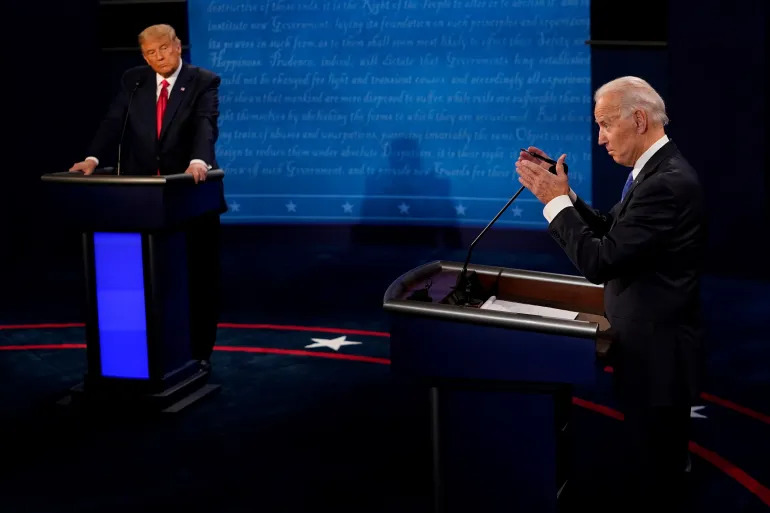
The final US presidential debate of 2020 took place at the Curb Event Center at Belmont University in Nashville, Tennessee, on October 22, 2020. Photo: Pool
Democratic candidate Hillary Rodham Clinton and Donald Trump had three heated debates eight years ago.
The first debate took place on September 26, 2016. The two candidates clashed over everything from racial discrimination in America to Trump's derogatory comments about the beauty pageant winner. Clinton was seen as being on the offensive, while Trump was on the defensive.
Most news reports the following day suggested that Clinton had gained the upper hand in the debate. However, according to a 2016 FiveThirtyEight poll, support for both candidates hadn't changed much, and had even slightly favored Trump. Specifically, Clinton had 42.4% and Trump 40.5% on September 25th. By September 27th, Clinton's was at 42.5% compared to Trump's 41%.
The second debate took place on October 9th, but neither that nor the third debate on October 19th had much impact on the polls.
On election day, November 8th, Clinton won 48% of the popular vote compared to Trump's 46%, but Trump won more votes in the Electoral College, thus winning under the indirect presidential election system in the United States.
A large body of research suggests that the primary reason presidential debates often fail to influence voters significantly is because most voters who watch these televised performances already support one candidate.
But there are exceptions.
However, there are instances where debates increase the chances of certain candidates, such as the case of former President Barack Obama.
In the 2008 presidential race, Obama gained a significant advantage a few days after the first debate, which took place on September 26, 2008.
From September 9th to 14th, the two candidates, Obama of the Democratic Party and John McCain of the Republican Party, had roughly equal support in the polls. Obama garnered 46%, compared to McCain's 44%.
But after the debate on September 26th, from September 27th to 29th, Obama's approval rating soared to 49%, while McCain's dropped to 42%.
Furthermore, the debate between Biden and Trump last June is another example. According to the average of a poll compiled by FiveThirtyEight, before that debate, President Joe Biden was only slightly behind former President Donald Trump.
However, Biden had a forgettable performance in the debate, lacking focus, speaking unclearly, and at times incoherently. As a result, from June 27th to July 9th, Trump widened his lead by another 2%, reaching 42.1% support compared to Biden's 39.9%.
"That debate had a dramatic impact, essentially creating momentum to eliminate Biden from the race. It was a significant and highly unusual event," Shaw said.
Furthermore, debates can help undecided voters make a choice. This is especially true for relatively unknown candidates, such as Barack Obama in 2008 or John F. Kennedy in 1960, where debates can be crucial in helping them win later on.
Hoai Phuong (according to Al Jazeera)
Source: https://www.congluan.vn/bau-cu-my-2024-cac-cuoc-tranh-luan-co-lam-thay-doi-quyet-dinh-cua-cu-tri-khong-post312026.html





























































![[Video] Sunset at Lap An Lagoon – Where the sun sets over the fishing nets](https://vphoto.vietnam.vn/thumb/1200x675/vietnam/resource/IMAGE/2026/05/31/1780192137701_beach-landscape-sea-water-nature-grass-745871-pxhere-com.jpeg)







































Comment (0)