

Besides tuition and room and board, international students in the US need to pay for many other expenses such as insurance, books, and transportation.
Nguyen Ngoc Khuong, an independent study abroad consultant in the US, analyzes the expenses students have to pay during their four years of study there:
Cost of Attendance (COA) is the total cost of studying abroad, including tuition, room and board, books, insurance, transportation, and personal expenses. Typically, American universities divide these costs into two main categories: direct costs and indirect costs .
If you want to find out more, you can go to Google and type in the name of the school you want to attend, then add "COA" or "Cost of Attendance" after it. For example, you can search for "Duke University COA", then go directly to the school's website to see the most accurate figures. You will see that Duke lists the costs for the 2023-2024 school year as follows: Tuition, housing and food, books, personal expenses, and transportation. The total is $90,366 USD (over two billion Vietnamese dong) per year.
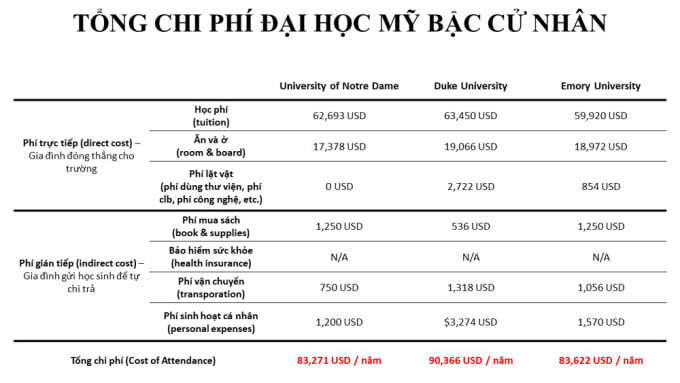
This table shows the undergraduate tuition fees for three universities: Notre Dame University, Duke University, and Emory University.
Direct cost
Direct costs include tuition, room and board. These are the three largest expenses, often accounting for over 95% of the total amount a family has to pay for their children each year. This amount must be paid directly to the school; therefore, families can negotiate with the admissions office or financial aid office to reduce costs.
I want to emphasize that when studying in the US or anywhere else, you need to consider the cost of living. For example, at one of the most expensive universities in Vietnam, the cost of living is only $2,400 USD (approximately 57 million VND) per year, but in the US, this can be 6 or 7 times higher, ranging from $11,000 USD to $20,000 USD, depending on the location of the university. For instance, the University of Notre Dame charges $17,378 USD (approximately 412 million VND) per year for living expenses despite being located in a small city.
Regarding housing costs, most American universities require students to live on campus for the first two years. If you move out, you can save approximately $5,000 - $6,000 (118-142 million VND) per year.

Duke University students move their belongings to campus. Photo: Duke University
Indirect costs
These are expenses for books, health insurance, transportation, and personal living costs. These expenses are usually not fixed, and students can manage their spending flexibly.
For example, Emory University estimates textbook costs at $1,250 per year, but that's when students buy new, latest editions. However, you can buy used books, rent books on Amazon, borrow books from the library, and download books online to reduce this cost.
Thanks to that, when I was a student, I never spent more than $200 (4.7 million VND) a year on books. As for health insurance, if you choose the best option, you can spend more than $2,000 (47 million VND) a year, but if you use the basic option, the cost is only $300 (over 7 million VND).
Regarding transportation, students typically need to cover international and domestic airfare. If students fly back to Vietnam once a year and only use public transport, this cost will be low. However, if international students return home three times a year and own a private car, they may have to spend around $40,000 USD (over 947 million VND) annually on this type of expense.
In fact, many universities in the US charge very high direct fees but are among the most generous in providing scholarships to international students. For example, last year, 45% of international students at Notre Dame received scholarships and financial aid, allowing them to pay an average of over $19,600 per year, significantly less than the school's stated cost of over $83,000. Meanwhile, many schools charge $50,000 but offer fewer scholarships.
Therefore, when submitting applications, families and students should do thorough research to make the right choice.
Nguyen Ngoc Khuong
Source link
![[Photo] Da Nang: Mountainous commune adorned with flags and flowers, ready for election day.](https://vphoto.vietnam.vn/thumb/1200x675/vietnam/resource/IMAGE/2026/03/10/1773113803384_ndo_br_9-jpg.webp)





























![[Photo] Meeting of the Standing Committee of the National Assembly Party Committee with the Standing Committee of the Government Party Committee on the First Session of the 16th National Assembly](https://vphoto.vietnam.vn/thumb/1200x675/vietnam/resource/IMAGE/2026/03/10/1773107502031_ndo_br_thu-tuong-pham-minh-chinh-va-chu-tich-qh-tran-thanh-man-dong-chu-tri-hoi-nghijpg-jpg.webp)



































































Comment (0)