

The current disparity in garbage collection fees across different localities is causing resentment and comparisons among various parties.
Ho Chi Minh City has not yet issued service fees for the collection, transportation, and treatment of household waste in accordance with the 2020 Environmental Protection Law. Local authorities have compared prices with current regulations, resulting in discrepancies.
People compare themselves to others.
Ms. Le Ngoc Huong (Linh Trung Ward, Thu Duc City) said that since 2023, she has been paying an average of 70,000 VND per month for garbage collection and transportation to two sources: the collection unit and the neighborhood leader. In 2024, the amount increased to 76,000 VND. This includes a 26,000 VND monthly transportation fee paid directly to the collection unit (paid every six months).
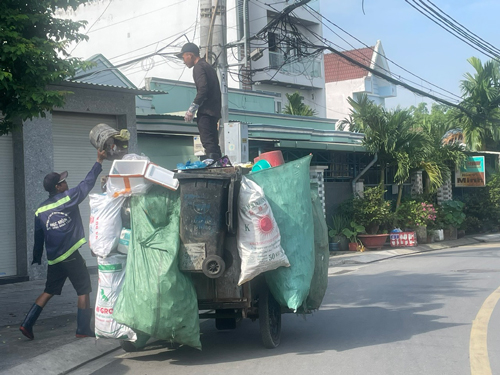
Many waste collection units are waiting for new regulations that are more in line with reality. (Photo: QUOC ANH)
Despite paying extra, the homeowner was still not satisfied with the service, as garbage often accumulated for 2-3 days, emitting a foul odor.
Meanwhile, in Binh Tan District, Ms. Nguyen Thi Tanh recounted that her family pays 88,000 VND per month for garbage collection and transportation. Although the amount of waste generated is not large, as all three family members work from morning to evening and rarely cook, the amount they pay is equivalent to that of a neighboring family of 10 who cook two meals a day.
Ms. Tanh believes that the single waste collection fee is unfair and does not encourage people to reduce waste disposal and recycle. "In my opinion, the city should guide localities to issue waste collection rates based on the amount of household waste generated, aiming to encourage people to reduce waste disposal," Ms. Tanh stated.
Coal collection unit
Currently, the pricing for garbage collection and transportation is not standardized across localities, leading to comparisons and resentment among residents. Not only do residents want change, but many privately run garbage collection cooperatives also hope the city will establish new standards to better reflect reality.
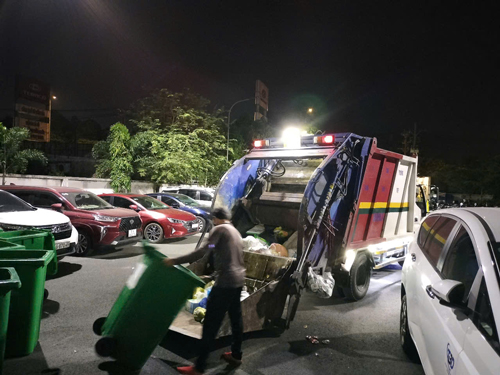
The majority of people do not sort their waste, and the waste collection team has to take on this responsibility. Photo: THU HONG
The Binh Tan Environmental Cooperative is the unit responsible for garbage collection in Binh Tan District. Mr. Trieu Kim Bang, the cooperative's director, stated that each household currently pays 88,000 VND per month for garbage collection, including 42,000 VND for transportation and the remainder for collection fees. This figure is significantly lower than in other areas such as District 3 and District 10, affecting the income of garbage collectors. Furthermore, there are approximately 1,000 households in the district that do not have a garbage collection contract and instead dispose of their waste elsewhere. Some households, when questioned, claim that they pay the same fee as those who generate less garbage, arguing that it is unfair.
Mr. Pham Van Khanh, General Director of Dong Tam Environmental Cooperative, analyzed that the current garbage collection and transportation fees are based on a decision issued by the city a long time ago and are no longer suitable for the current situation due to significant inflation.
The current garbage collection fee in District 5 is 61,000 VND per household. Most collectors use handcarts and manual labor, so this fee is insufficient to make a living. They have to supplement their income by selling recyclable materials and receiving "extra tips for good service." "Therefore, we earnestly hope the city will issue a new garbage collection fee with an increase to make it easier for collectors and create an incentive to switch to alternative means of transportation," Mr. Khanh said.
Still waiting for the new prices to be announced.
An investigation by a reporter from Nguoi Lao Dong Newspaper in Phu Nhuan District revealed that, according to Decision No. 924/2021 of the District People's Committee, the price for garbage collection and transportation from 2021 to 2025 ranges from 56,500 VND to 83,500 VND per month per household. In Go Vap District, the price for garbage collection and transportation in 2024 is 77,000 VND per month per household, with transportation costing 27,000 VND; it is projected to increase to 84,000 VND in 2025, with transportation costing 34,000 VND. Meanwhile, in Thu Duc City, the price for garbage collection and transportation increased from 67,500 VND in 2023 to 80,600 VND per household per month in 2025.
In Binh Chanh district, the cost of collecting and transporting household waste is divided into two groups: manual collection and mechanized collection at the source, each with different price levels.
According to the Ho Chi Minh City Department of Natural Resources and Environment, during this period, before new regulations on the price of household waste collection, transportation, and treatment services are issued under the 2020 Environmental Protection Law, the department recommends that the city continue to implement the current regulations of the Ho Chi Minh City People's Committee. Specifically, Decision 38 of 2018 on the maximum price for household waste collection and transportation services using state budget funds and the maximum price for household solid waste treatment services using state budget funds; and Decision 20 of 2021 amending and supplementing some articles of Decision 38.
The Department of Natural Resources and Environment explained that localities use different means of transportation, distances, and routes; and the processing technology varies between plants, leading to differences in service fees when collected correctly and fully from waste generators, and different fees paid by residents for waste collection and transportation...
Not much has changed yet.
Besides the issues of garbage collection and transportation costs, the implementation of waste sorting at source, as mandated by the 2020 Environmental Protection Law, is also considered inadequate. Observations show that people tend to "outsource" the task to garbage collection and transportation workers, assuming that these workers will sort the waste once it's loaded onto the trucks by picking up recyclable materials.
Mr. Le Minh Ngoc (Thu Duc City) said his family usually separates waste into two categories: recyclable items like beer cans, soft drink cans, and paper are put into one large bag, and the rest goes into another. When the recyclable bag is full, he gives it to the garbage collectors to help them earn extra income and reduce the effort of sorting. In addition, for large, heavy waste items like potting soil, chairs, and glass, he doesn't know how to properly dispose of them, so he mainly relies on the collectors to handle them and gives them extra money.
The lack of proper waste sorting seems to be common among the population. Following Mr. Nguyen Van Vui (a garbage collector in Xuan Thoi Thuong commune, Hoc Mon district), the reporter observed that most people do not sort their waste at the source. When loading trash cans onto the truck, Mr. Vui and two other employees perform an additional step of identifying and picking up plastic items and cardboard boxes, separating them into individual bags hanging on the side of the truck.
Mr. Vui said that some households sort their waste, setting aside recyclable items to sell to scrap dealers. Non-recyclable waste, including batteries, light bulbs, and plastic bags, is collected in one place…
According to the 2020 Environmental Protection Law, household solid waste generated by households and individuals is classified into three categories: reusable and recyclable solid waste; food waste; and other household solid waste. The law also clearly stipulates that waste sorting must be completed no later than December 31, 2024.
(To be continued)
(*) See Nguoi Lao Dong Newspaper, issue dated December 10th.
"According to many garbage collectors, by sorting through unsorted waste, they are considered to be doing the 'double' job of collecting recyclable materials. The money from selling these recyclable materials sometimes accounts for 40%-50% of their income..."
3 options
More than a year ago, Vice Chairman of the Ho Chi Minh City People's Committee Bui Xuan Cuong assigned the Department of Natural Resources and Environment to gather feedback from units and organizations to select the optimal plan regarding the unit price for collecting and transporting household waste.
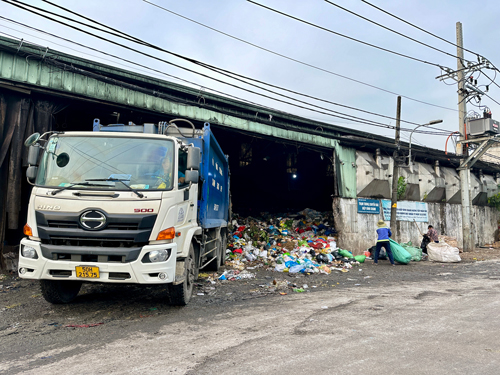
A waste transfer station in Thu Duc City. Photo: NGOC QUY
Accordingly, the Department of Natural Resources and Environment is tasked with researching and finalizing the implementation of service prices according to three options. Firstly, the Ho Chi Minh City People's Committee issues specific service prices based on the average price across the city for localities to apply, or develops and submits specific local prices to the Ho Chi Minh City People's Committee for issuance. Secondly, localities independently develop and submit specific service prices to the Ho Chi Minh City People's Committee for issuance. Thirdly, the Ho Chi Minh City People's Committee issues specific prices based on the average price, categorized by region, to be applied to areas with similar characteristics...
Source: https://nld.com.vn/dap-so-cho-rac-thai-cach-lam-phai-cong-bang-196241210211350885.htm
![[Photo] Announcement Ceremony of the Art Program “Light Concert – Welcoming the New Year 2026”](/_next/image?url=https%3A%2F%2Fvphoto.vietnam.vn%2Fthumb%2F1200x675%2Fvietnam%2Fresource%2FIMAGE%2F2026%2F01%2F27%2F1769514762857_le-cong-bo-ct-hoa-nhac-anh-sang-1772-9042-jpg.webp&w=3840&q=75)


![[Photo] Commemorating the unwavering friendship between Vietnam and Laos](/_next/image?url=https%3A%2F%2Fvphoto.vietnam.vn%2Fthumb%2F1200x675%2Fvietnam%2Fresource%2FIMAGE%2F2026%2F01%2F27%2F1769518372051_ndo_br_1-jpg.webp&w=3840&q=75)


![[Hightling] Conference on the Implementation of Tasks for 2026](/_next/image?url=https%3A%2F%2Fvphoto.vietnam.vn%2Fthumb%2F402x226%2Fvietnam%2Fresource%2FIMAGE%2F2026%2F01%2F27%2F1769477856197_dsc01637.jpeg&w=3840&q=75)


![OCOP during Tet season: [Part 2] Hoa Thanh incense village glows red.](/_next/image?url=https%3A%2F%2Fvphoto.vietnam.vn%2Fthumb%2F402x226%2Fvietnam%2Fresource%2FIMAGE%2F2026%2F01%2F27%2F1769480573807_505139049_683408031333867_2820052735775418136_n-180643_808-092229.jpeg&w=3840&q=75)
![OCOP during Tet season: [Part 1] Ba Den custard apples in their 'golden season'](/_next/image?url=https%3A%2F%2Fvphoto.vietnam.vn%2Fthumb%2F402x226%2Fvietnam%2Fresource%2FIMAGE%2F2026%2F01%2F26%2F1769417540049_03-174213_554-154843.jpeg&w=3840&q=75)




Comment (0)