


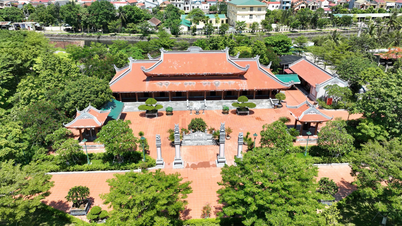
The former residence of General Thận - a testament to the August Revolution (located in what is now Long An ward)
According to Vo Hoang Khai, former Head of the Propaganda Department of the Tay Ninh Provincial Party Committee (before the merger): Vietnam in the 20th century had three characteristics: Firstly, the successful August Revolution of 1945, establishing the Democratic Republic of Vietnam. Secondly, defeating wars of aggression to protect the achievements of the August Revolution. And thirdly, carrying out the reform process to advance the country towards socialism. Without the August Revolution, we would not have had the Dien Bien Phu Victory with its "Nine years of struggle culminated in Dien Bien Phu, creating a red wreath of victory and a golden epic"; after the Dien Bien Phu Victory, the French withdrew and the Americans arrived, leading to the liberation war of the South with the Ho Chi Minh Campaign, achieving victory on April 30, 1975, followed by border wars.
Eighty years ago, the victory of the August Revolution ushered in an era of independence and freedom for the entire nation. After eighty years, the entire nation is once again brimming with enthusiasm, entering a new era – an era of progress. In this era, Tay Ninh has also been deeply immersed in the flow of national history.
Tan An was at the forefront of the August General Uprising in Southern Vietnam.
The successful August Revolution led to the birth of the Democratic Republic of Vietnam – the first workers' and peasants' state in Southeast Asia, ending the feudal monarchy in Vietnam and concluding over 80 years of colonial and fascist domination. From this point on, the country, society, nation, and people of Vietnam entered a new era – an era of national independence linked with socialism.
During that great revolution, Long An (before the merger), formerly Tan An, proudly stood as the "pioneering locality in the August General Uprising in Southern Vietnam," as former Secretary of the Southern Vietnam Party Committee Tran Van Giau remarked.
Following the Southern Uprising, the Tan An Party Committee proactively restored its forces. By the end of 1943, it had a regional committee member; in early 1945, it established District Committees A, B, C, and D to organize its forces. In 1945, many party branches developed, especially the Youth Party Branch. In mid-1945, the Party established the Vanguard Youth organization in 46 out of 62 villages to launch the uprising. In early July 1945, the Party Committee had established an internal network within the military and deployed secret self-defense forces to the inner city; notably, the provincial capital organized two weapons forging workshops. Because Tan An had a strong party member base and a mass base, it was chosen by the Southern Regional Committee as the first place for the uprising and achieved victory on August 21, 1945.
The book "History of the Long An Provincial Party Committee (1930-2000)" records: On the morning of August 22, 1945, 4,000 people, armed with bamboo poles and spears, carrying red flags with yellow stars, flocked to the provincial capital's football field to participate in a rally celebrating the successful revolution. As they marched, the crowd chanted the slogan "Long live independent Vietnam!". The representative of the Provisional Administrative Committee of Tan An province, Chairman Nguyen Van Trong, declared: "The government of Tan An has returned to the hands of the people!"
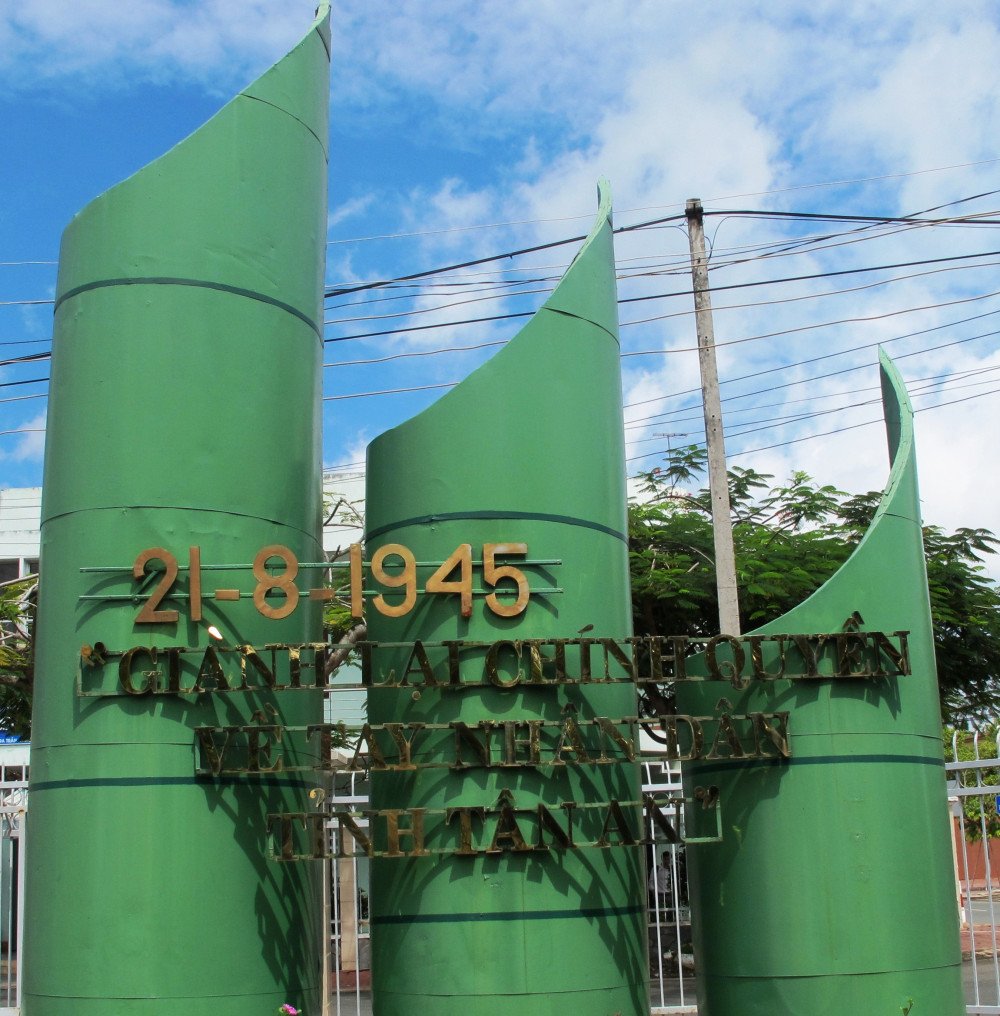
The symbol of the August Revolution in the former Tan An province.
After 15 years of persistent and tenacious struggle, the people of Tan An, under the leadership of the Provincial Party Committee, successfully carried out the General Uprising, exceeding the expectations of the Regional Party Committee. This momentous event is closely associated with the General Than Palace – a symbol of the August Revolution in this area. The General Than Palace was repurposed by the Tan An Provincial Party Committee as its headquarters. This was the first publicly accessible headquarters of the revolutionary government in Southern Vietnam after the August Revolution. At the General Than Palace, the Tan An Provincial Party Committee held three important conferences to discuss and decide on issues related to building, consolidating, and protecting the newly established revolutionary government.
Cho Lon Province (formerly Can Duoc, Can Giuoc, Duc Hoa, and Trung Quan districts), with its special location closely linked to Saigon, saw its uprising to seize power launched on the same day as Saigon, in accordance with the Regional Party Committee's plan. The uprising to seize power in Tan An Province was a resounding success, exceeding the Regional Party Committee's plan by one day. This had a strong impact on surrounding areas such as Trung Quan, Can Duoc, and Duc Hoa (Cho Lon Province) and Cho Gao and Chau Thanh (My Tho Province),...
That victory marked a new chapter in the revolutionary struggle history of the people of Tan An and Cho Lon provinces. From this point on, along with the rest of the country, the people of the two provinces escaped the yoke of colonial and feudal rule, took control of their own destiny, and built a new life.
Tay Ninh (before the merger) creatively applied the Party's guidelines and policies to seize power.
On August 23, 1945, upon receiving news that Saigon was urgently preparing for an uprising to seize power, the Provincial Party Committee sent comrades Tran Kim Tan and Truong My Lan to contact the Regional Party Committee to request guidance on action. That same day, comrade Truong My Lan returned to Tay Ninh to report on the situation, while comrade Tran Kim Tan remained in Saigon to attend the rally.
Following instructions from the Provincial Party Committee, Comrade Huynh Van Thanh, Head of the Provincial Party Committee, convened a meeting attended by Party members and core cadres. The meeting discussed organizing a rally with a large number of participants to enable the Provincial Viet Minh Front to operate openly, and to call on the people to support the Viet Minh.
Following the conference's directives, on the night of August 23, 1945, the leadership sent people to various locations to mobilize the people, the Vanguard Youth, and students to attend a rally in the town. Banners, flags, and slogans for the rallies were provided by the Viet Minh base at Thanh Dien Sugar Factory, which used fabric from the factory to dye red and sew for the groups. Everything was done with utmost urgency and care.
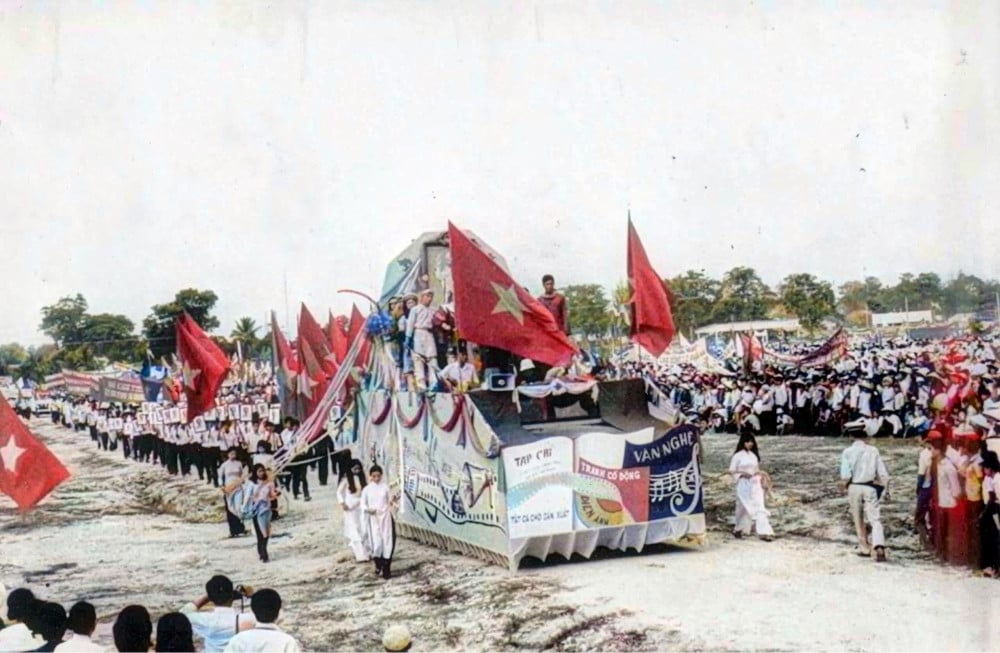
A rally celebrating the liberation of Tay Ninh (before the merger) was held at the town's stadium (now Tan Ninh ward) in May 1975. This is also the location of the rally that seized power on August 25, 1945 (Archival photo).
Early in the morning of August 25, 1945, from Thanh Dien, Xom Vinh, and Quan Com, the masses, waving red flags with yellow stars, everyone wearing white armbands with red Viet Minh inscriptions or red armbands, led by Party members carrying pistols, marched into the town's stadium. At the same time, the Vanguard Youth, armed with guns and bamboo spears, marched from Hiep Ninh communal house to the stadium. Cao Dai followers, carrying their religious flags and marching in orderly ranks, also arrived at the town stadium from the Holy See to participate in the rally. Thus, an unprecedented large-scale rally took place in Tay Ninh.
At the rally, Comrade Huynh Van Thanh delivered a speech stating that the Japanese army had surrendered to the Allied forces, the government in Hanoi and throughout North and Central Vietnam belonged to the Viet Minh, and called on the people of Tay Ninh to rise up and be ready to seize power. The masses attending the rally were extremely enthusiastic, chanting slogans in support of the Viet Minh Front. The mass rally turned into a demonstration marching past the governor's residence, around the market, and the main streets of the town. Faced with the revolutionary spirit of the masses, the puppet government dared not react. By noon, the demonstration returned to the town.

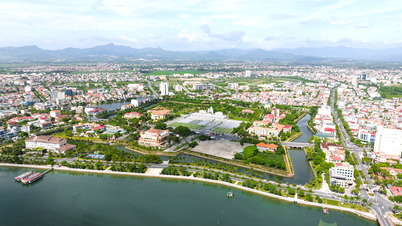
The center of Tan Ninh ward today is the site of the rally and uprising to seize power 80 years ago (Photo: Tam Giang)
At approximately 2 PM on August 25, 1945, a delegation of cadres from Saigon arrived in Tay Ninh with the Regional Party Committee's directive to seize power. The provincial leadership committee convened an expanded meeting of members of the action leadership and several key cadres to plan the seizure of power. Provincial Governor Le Van Thanh was summoned and asked to submit his books and documents and hand over the government. The transfer of provincial power was completed that same night, August 25, 1945.
Subsequently, the revolutionary forces only arrested Governor Le Van Thanh and a number of high-ranking officials, and took over key agencies immediately after the puppet provincial government's apparatus collapsed. The uprising to seize power took place not only in the provincial capital but also in Trang Bang district and Phuoc Chi area the following day.
Thus, along with the rest of the country, the August 1945 uprising to seize power in Tay Ninh (before the merger) was a resounding victory. This victory was due to the Provincial Party Committee's keen ability to absorb and creatively apply the Party's guidelines and policies, especially the policy of building forces in preparation for the uprising, and particularly the leadership role of Party members and Party organizations.
Nhu Nguyet - Ngo Tuyet
Source: https://baolongan.vn/cach-manh-thang-tam-dau-son-lich-su-a200893.html


![[Image] A brilliant symphony and explosive power in the skies of Da Nang.](https://vphoto.vietnam.vn/thumb/1200x675/vietnam/resource/IMAGE/2026/05/31/1780196945787_anh-man-hinh-2026-05-31-luc-10-08-51.png)















![[Video] Sunset at Lap An Lagoon – Where the sun sets over the fishing nets](https://vphoto.vietnam.vn/thumb/340x192/vietnam/resource/IMAGE/2026/05/31/1780192137701_beach-landscape-sea-water-nature-grass-745871-pxhere-com.jpeg)




































































Comment (0)