A smooth handshake between the CDU/CSU and the SPD.
 Báo Quốc Tế•14/03/2025
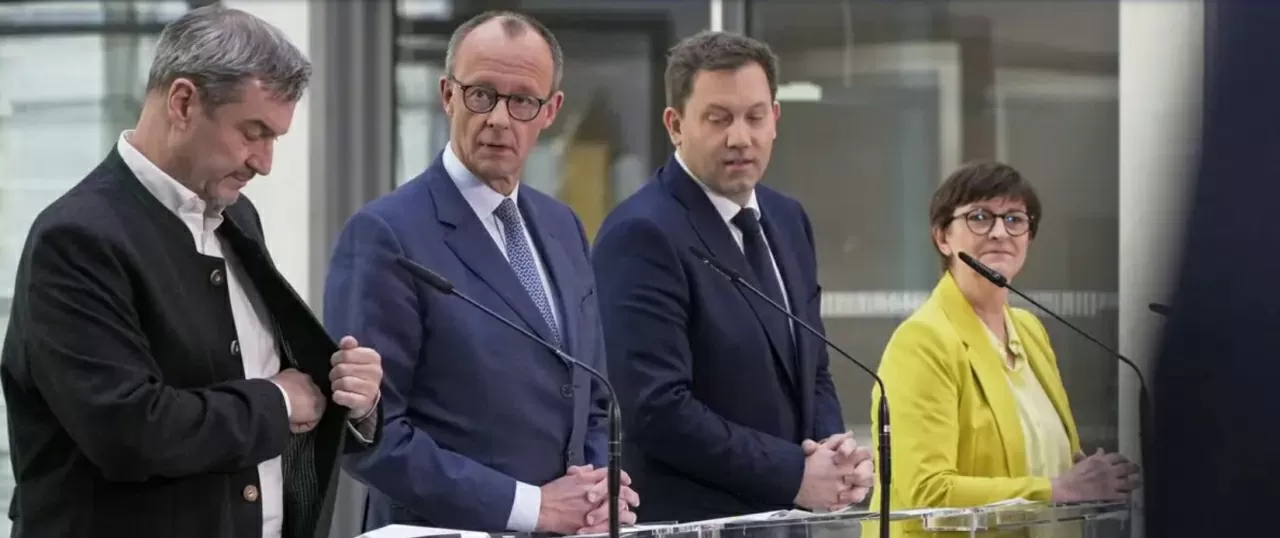 |
| Leaders of the CSU, CDU, and SPD parties hold a press conference following exploratory talks between the CDU/CSU and the SPD at the German Parliament in Berlin on March 8. (Source: AP) |
Having been closely associated in the past, most recently under former Chancellor Angela Merkel until 2021, the CDU/CSU and SPD joining forces is understandable, especially given that their rival, the far-right Alternative for Germany (AfD), came in second place in the elections at the end of February 2025 with over 20% of the vote.
You may also like

The EU is experiencing internal conflict over dialogue with Russia.The European Union (EU) summit in Brussels, Belgium, revealed growing disagreements among member states on how to approach Russia and Europe's role in efforts to find a solution to the conflict in Ukraine.
Russian Ministry of Defense: Effective combat UAVs have tripled in number.Russian UAV forces are demonstrating superior combat effectiveness in the field. According to the latest assessments, the performance of this specialized force is now three times higher than that of conventionally operated units. At the same time, the application of artificial intelligence (AI) in the military is also being accelerated.
It seems things are going smoothly. In preliminary negotiations, the CDU/CSU and the SPD reached an agreement on a comprehensive financial package, including a special fund of €500 billion over the next 10 years to invest in infrastructure. The two parties also found common ground on the need to revise the rules limiting national debt to free up more resources to help Germany emerge from recession.
Turning to the economic sphere, tax-related obstacles were resolved when both sides agreed on a plan to reduce the burden on middle-class households, cut electricity bills, and permanently eliminate value-added tax (VAT) on food in restaurants. An agreement on a minimum wage of 15 euros per hour and a stable pension scheme was also reached.
Even on the divisive issue of immigration, the two sides found a compromise. While the CDU/CSU accepted the SPD's view that the processing time for German citizenship should be shortened for eligible applicants, the SPD no longer opposed the CDU/CSU's hardline stance on preventing illegal immigration.

Vietnam encourages US businesses to expand investment in high technology.On the morning of June 26th, at the Government Headquarters, Deputy Prime Minister Ho Quoc Dung received Mr. Jeff Place, Supply Chain Director of Coherent Group (USA). During the meeting, the Deputy Prime Minister affirmed that Vietnam encourages US businesses to expand investment, especially in high-tech, innovation, and semiconductor industries.

Encourage U.S. businesses to expand investment in high-tech sectors.Deputy Prime Minister Ho Quoc Dung said that Vietnam welcomes US businesses to continue expanding their operations in Vietnam, especially in high-tech industries and sectors with high added value.

Vietnam and the United States strengthen cooperation in addressing the consequences of war.VTV.vn - On June 22, General Secretary and President To Lam received Acting Secretary of the US Navy Hung Cao.
With such a smooth handshake, Germany anticipates a new government by Easter, April 20th, with Friedrich Mersey, leader of the CDU, as Chancellor. The only remaining issue is how to appropriately divide the seats among the parties in the coalition government.
Source: https://baoquocte.vn/chinh-truo-ng-duc-cai-bat-tay-suon-se-giua-cducsu-va-spd-307410.html

![[Photo] General Secretary and President To Lam works with the Party Committee of the Government on the work of preventing and combating storms, floods, extreme natural disasters and climate change.](https://vphoto.vietnam.vn/thumb/1200x675/vietnam/resource/IMAGE/2026/06/29/1782729441945_a1-bnd-0385-9454-jpg.webp)

![[Photo] National Assembly Chairman Tran Thanh Man attends the Conference to announce the Master Plan for Hanoi Capital City with a 100-year vision.](https://vphoto.vietnam.vn/thumb/1200x675/vietnam/resource/IMAGE/2026/06/29/1782709639728_ndo_br_1-jpg.webp)
Trending by Category







Most Read






Google Trends











Same author


























![[Image] Building an elevated road through the Ma Da forest.](https://vphoto.vietnam.vn/thumb/402x226/vietnam/resource/IMAGE/2026/06/29/1782724737750_anh-man-hinh-2026-06-29-luc-16-18-43.png)