

According to the new regulations, vehicle inspection centers under the Department of Transport will have to undergo privatization. Without the "privileges" granted to state-owned inspection units, these centers will be forced to improve the quality of their services in order to survive.
Increase investment to remain competitive.
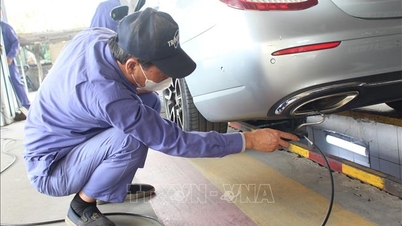
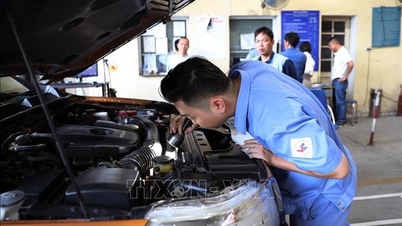
On the morning of November 1st, at the 2401D Motor Vehicle Inspection Center ( Lao Cai ), vehicle inspections proceeded normally. Inside the waiting area, customers relaxed, enjoying drinks and monitoring the inspection process via surveillance cameras.
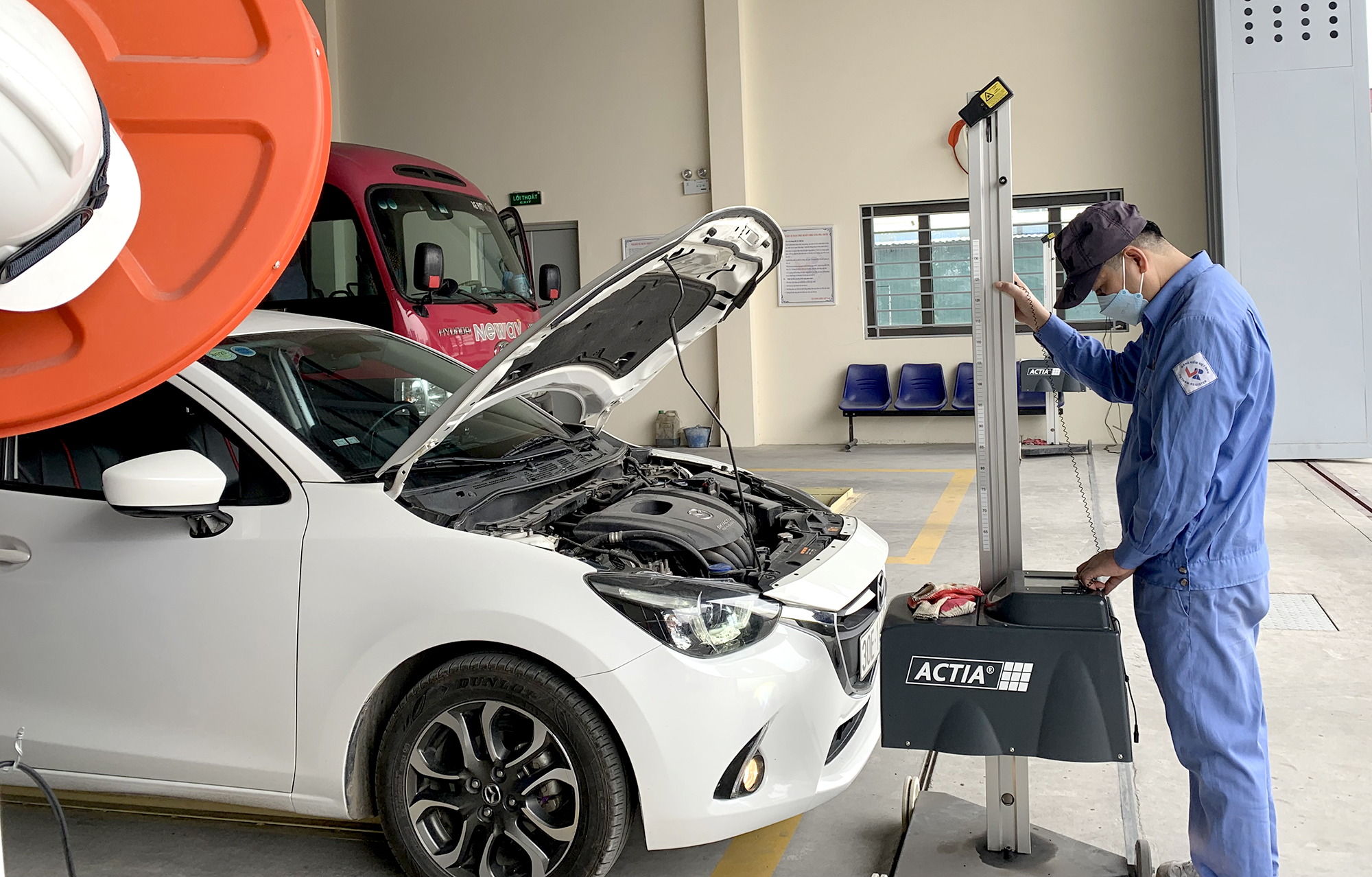
Privatizing vehicle inspection centers helps improve service quality, but there are still many concerns about its effective implementation.
According to the center's leadership, in 2016, the unit underwent equitization, transitioning to operating as a 100% privately-owned joint-stock company.
"Although we faced many difficulties in the initial stages, the equitization process has helped the center become self-reliant in investment and operation. We have focused on investing in equipment and improving service quality to meet people's needs, increase competitiveness, and attract customers," he said.
Similarly, in Son La , Mr. Pham Tuan Anh, Director of Son La Marine and Land Motor Vehicle Inspection Joint Stock Company (2602D), said that after privatization, the unit's operations have changed in a more dynamic direction to compete with other private centers in the area.
The focus has been on improving service quality, and the restructured operational system is no longer as cumbersome as before, minimizing procedures. Each employee has to handle different tasks but always serves with enthusiasm and dedication.
However, according to Mr. Tuan Anh, because it is no longer a public service unit, the cost of land for business, electricity, water, etc., is higher than before, while the number of vehicles is decreasing due to the emergence of many other centers in the area. In addition, after the regulations on exemption from initial vehicle inspection and extended inspection cycles for some types of vehicles came into effect, the inspection service price has not increased in the past 10 years, causing the unit to fall into difficulties.
"Salary for vehicle inspectors and technical staff have been reduced and are no longer attractive enough, making it increasingly difficult to recruit more personnel," Mr. Tuan Anh shared.
Similarly, the leader of the 2401D Vehicle Inspection Center stated that, despite being privatized for eight years, the unit still faces financial difficulties, with revenue not covering expenses. Currently, the income of vehicle inspectors and technical staff is only slightly above the minimum wage.
Separation of management and service delivery.
According to Decision 17/2024 of the Prime Minister (effective from December 10, 2024), public service units in the field of technical inspection of road motor vehicles and inland waterway vessels (excluding the field of ship and offshore structure registration) will be converted into joint-stock companies, with the State holding more than 50% of the charter capital.
Deputy Prime Minister Ho Duc Phoc has just signed Decision No. 17/2024 amending and supplementing a number of articles of Decision No. 26/2021 on the list of sectors and fields for converting public non-business units into joint-stock companies, effective from December 10, 2024.
The decision added three more sectors and fields of public service units to be converted into joint-stock companies with the State holding over 50% of the charter capital, including: Occupational safety technical inspection; Construction inspection; and Technical inspection of road motor vehicles and inland waterway vessels (excluding the field of ship and offshore structure registration).
In fact, in many localities, since 2016, in addition to private vehicle inspection centers, many inspection centers that were previously units under the Department of Transport have also undergone privatization.
Thus, unlike the previous period when vehicle inspection centers were public service units that could be 100% privately owned, now they can only be 19% privately owned, with the State still holding over 50% of the charter capital.
According to a representative from the Department of Enterprise Management, Ministry of Transport, under the current model, vehicle inspection centers in Group V (under the Ministry of Transport) are not subject to Decision 17/2024 for conversion to a joint-stock model.
For local vehicle inspection centers (under the Provincial People's Committee) which are public service units, implementation according to Decision 17/2024 will be required when conditions are met.
In addition, the Vietnam Registering and Inspection Department is currently developing and finalizing the "Innovation in State Management in the Field of Vehicle Registration and Inspection" project, which aims to separate the functions of state management from the provision of public services.
This includes establishing public service centers to manage vehicle inspection units. Once the plan is approved and these public service centers become operational, a review and assessment will be conducted over three years to determine whether privatization is necessary, as well as to develop a plan and roadmap for privatization.
Only profitable operations qualify.
According to an expert in the vehicle inspection field, Decree 150/2020 stipulates that the conditions for converting a public non-business unit into a joint-stock company are that the unit must have capital and assets, be an independent legal entity, have financial statements for three years, and be self-sufficient in covering recurrent expenditures and investments, or be self-sufficient in covering recurrent expenditures in the year closest to the conversion (i.e., operating at a profit).
Once the unit meets these criteria, the owner plans the privatization process and roadmap, reports it to the Prime Minister, and only after approval can it be implemented.
Applying the above conditions to the field of motor vehicle inspection, the inspection centers under Group V (Ministry of Transport) currently do not fall under this category as they do not have assigned assets (their main assets are personnel), they rent premises, and their financial resources are still dependent on the owning entity.
For vehicle inspection centers that are public service units at the local level (Group S), the Provincial/City People's Committee will be responsible for reviewing the conditions of each unit to plan for privatization and report to the Prime Minister before implementation.
What do vehicle inspection centers want?
According to an investigation by reporters from Giao Thong Newspaper, during the period of conversion to a joint-stock company from 2017-2020, in 2018-2019, the 2201S Vehicle Inspection Center (Tuyen Quang) also proceeded with the procedures for asset valuation and the equitization plan.
However, according to a representative of this center, when the Provincial People's Committee sent a letter to the Ministry of Planning and Investment to report to the Government, the Ministry of Planning and Investment stated that the equitization of the public service unit operating in the field of motor vehicle inspection would not be continued until before 2025.
"Therefore, although ready, the center is currently still a public service unit. If the province reviews and decides to re-privatize it, the unit will have to reassess its assets and re-develop the privatization plan from scratch," this person said.
In Hoa Binh province, the 2801S Vehicle Inspection Center was approved for privatization seven years ago, but it has yet to be implemented. A representative from the center stated that it has recently relocated, invested in new equipment, and has a long depreciation period. Privatization would likely fail to attract investors due to high costs, while the number of vehicles undergoing inspection has decreased.
According to the leaders of Vehicle Inspection Center 2903V (Hanoi), although there has been no plan for privatization, the number of vehicles inspected has decreased significantly due to the impact of policies on inspection cycles. The unit has proactively restructured its personnel and streamlined its work to optimize cost structure and efficiency. Currently, the inspection center has only 21 staff members, compared to 25-30 previously.
"If there is a policy and conditions for equitization, it will be implemented according to the roadmap. However, equitization means the center will have to pay salaries and bonuses to its employees itself, while for many months the unit has still had to request support from the Vietnam Register."
Never before has the number of vehicles coming for inspection at the beginning of October been as low as it is now. If the price of vehicle inspection services doesn't increase, most inspection centers will have to bear losses every month. In this context, it's difficult to attract investors to buy shares," this person observed.
Sharing the same view, the leader of the 2201S Vehicle Inspection Center stated that, during the period 2025-2027, the number of vehicles requiring inspection is unlikely to grow. Furthermore, the transition to a business model means that costs for land rent and electricity will also increase, and they will no longer benefit from the same pricing as public service units.
While the number of vehicle inspection centers is increasing, for effective privatization, new inspection service fees need to be issued soon. The increase must ensure sufficient revenue for the centers to cover expenses and pay appropriate salaries to employees. On the other hand, hazardous work allowances for inspectors should be implemented soon, given the harsh working environment, thereby attracting more personnel to this field.
According to statistics, the country currently has 292 vehicle inspection centers with 542 inspection lines, including 69 units in the S sector and 13 units in the V sector, with the remainder being private inspection centers.
Ten localities have recently privatized their vehicle inspection centers, including: Quang Ninh, Thai Binh, Ha Tinh, Lao Cai, Son La, Ben Tre, Hau Giang, Quang Nam, Bac Kan, and Hai Duong.
Source: https://www.baogiaothong.vn/can-gi-de-co-phan-hoa-dang-kiem-thanh-cong-192241105001126426.htm






























































































Comment (0)