

Despite receiving support, the model of teaching IELTS in schools still has many limitations. Should it be widely adopted? Based on his experience training teachers and teaching in both public and private sectors, Mr. Khuu Hoang Nhat Minh, Director of Academic Development at Origins Language Academy, believes that careful consideration is needed before deciding to offer IELTS courses, especially in curriculum preparation and teacher coordination.
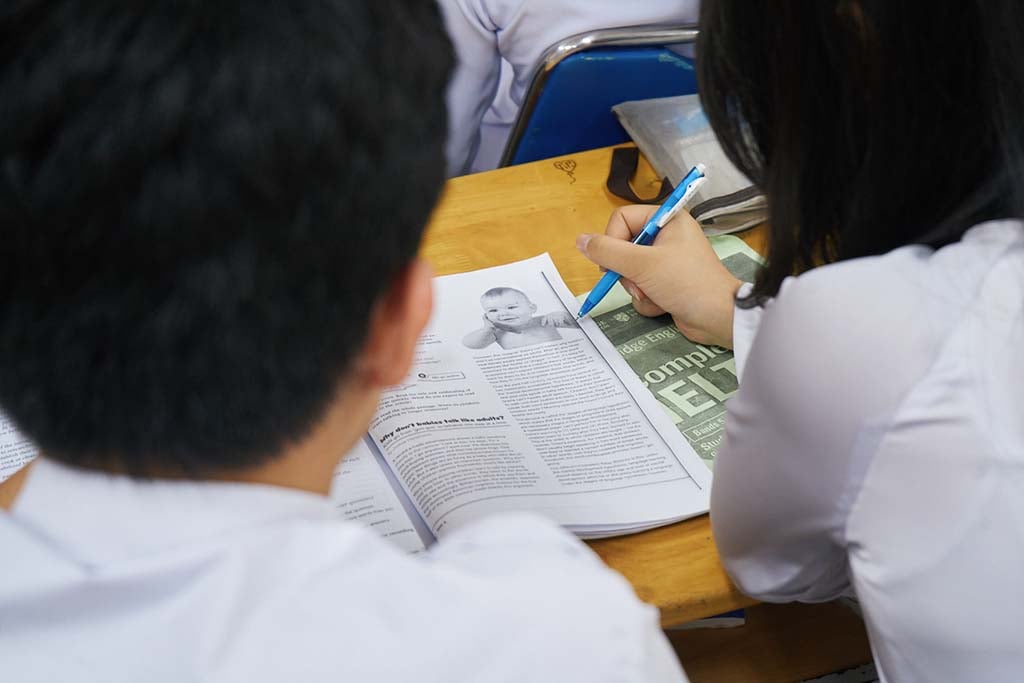
To effectively prepare students for the IELTS exam, teachers need to meet three criteria: language proficiency, pedagogical skills, and knowledge of the exam.
Specifically, to effectively prepare students for the IELTS exam, teachers need to meet three criteria: language proficiency, pedagogical skills, and most importantly, knowledge of the exam. "Good test-taking techniques can help candidates increase their score by one point. However, it would be very dangerous if teachers did not understand IELTS well, neglecting to build students' language skills and only focusing on test-taking techniques throughout their three years of high school," Mr. Minh noted.
Regarding native-speaking teachers, schools need to make appropriate arrangements instead of completely entrusting them with IELTS preparation. This is because few native-speaking teachers in Vietnam possess strong pedagogical skills, and it's even more difficult to find someone who truly understands IELTS since they don't need to take the exam themselves. "Teaching multicultural thinking, correcting pronunciation, or guiding students to speak naturally like native speakers are some suitable positions for them," suggested Master Minh.
Regarding the coordination of IELTS classes in high schools, Mr. Minh suggested that it is necessary to assess students' abilities and differentiate them into groups with similar proficiency levels, instead of teaching the entire class in a uniform manner. At the same time, schools need to arrange a suitable ratio between the number of general English lessons and exam preparation English lessons, such as 70:30 in grade 10 and vice versa in grade 12, when students have a solid foundation and are beginning to "compete" for the certificate exam.
Master Vo Dao Phu Si, a lecturer at a public university in Ho Chi Minh City, believes that diverse resources are needed to support teachers so they can effectively teach IELTS in schools, alongside teaching the main curriculum. This is because teachers lacking strong pedagogical skills will struggle when teaching large classes with students of varying foreign language proficiency levels.
According to Mr. Si, teachers need to be trained by experts knowledgeable about the IELTS test to fully understand the content and structure of the exam, and then convey this knowledge to students instead of just teaching tips or tricks.

A diverse range of resources is needed to support teachers so they can effectively teach IELTS in schools, alongside teaching the main curriculum.
Dr. Nguyen Vinh Quang, a specialist in educational management at the University of Hertfordshire (UK) and currently the Director of Mr.Q International Career Education Organization, also noted that teachers are a crucial link determining the success or failure of IELTS teaching in schools, as not many high school teachers have had prior experience with this exam.
Regarding program management, Dr. Quang recommends that schools clearly explain to parents at the beginning of the school year the reasons for teaching foreign language certificates, and why IELTS is being taught. In addition, schools should investigate and coordinate with English teachers who are currently teaching IELTS outside of school to avoid conflicts in teaching methods.
Another noteworthy issue is that schools need to consider diversifying their options, instead of focusing solely on preparing students for a single certificate. Specifically, Dr. Quang suggested offering a maximum of three popular options, such as IELTS, TOEFL, or Cambridge. "Avoid recognizing and teaching too many certificates as this will lead to operational chaos and conflicts between testing organizations," Dr. Quang noted.
Source link
![[Photo] Prime Minister Pham Minh Chinh presides over a dialogue with Japanese businesses.](https://vphoto.vietnam.vn/thumb/1200x675/vietnam/resource/IMAGE/2026/03/21/1774097547316_ndo_br_dsc-0448-jpg.webp)



























































































Comment (0)