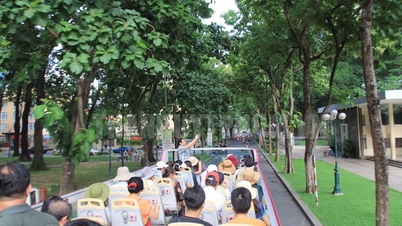
These are just two of the many challenges educators are facing as short-form social media and AI permeate the lives of young people today, from Gen Z students to Alpha-generation schoolchildren, shortening their attention spans, according to experts.
TEACHERS ARE THE "GUIDES"
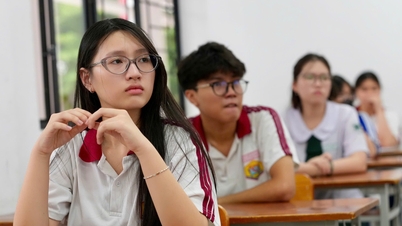
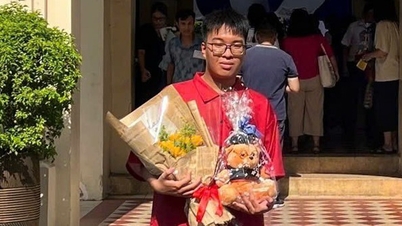
Truong Uyen Nhi, a high school student in Ho Chi Minh City, confided that because she often "browses the internet," she finds it difficult to concentrate for long periods during lectures. She even tends to skim through content she thinks she already knows, leading to laziness in reading carefully. This affects her learning, as she only remembers about 60% of the core knowledge, "while the extended parts or accompanying details are easily missed because the brain is used to 'quickly filtering' information," Nhi explained.
That is one of the reasons why female students are particularly interested in highly practical lessons that allow for teamwork or projects to create real products from the knowledge they have learned.
AI is also a prominent issue, as students are overusing it quite a lot, from asking them to write essays, solve science problems, or create products instead of contributing their own creativity. Furthermore, Nhi said she only sees teachers asking students to create products using AI, but has never encountered a teacher who guides students on how to use AI to support effective learning. "When teachers ask students to create products using AI, it's like they're being 'taught' how to become dependent on AI," the female student lamented.
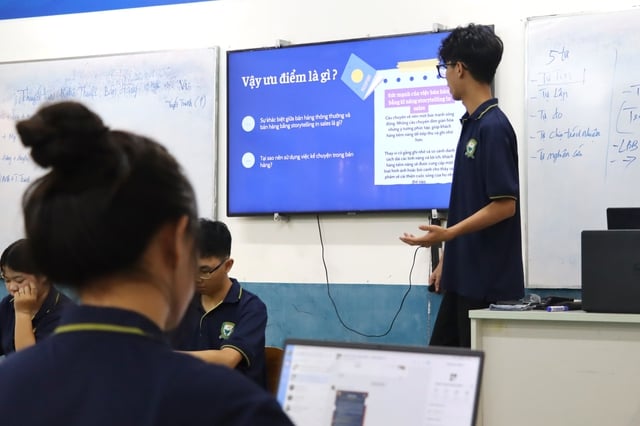
Students use AI to deliver presentations.
PHOTO: NGOC LONG
Nhi added that she also uses AI, but only to take notes on lectures and plan her studies, viewing it as a supporting tool. "I hope that teachers will not let AI completely replace students' thinking processes, nor will they assign tasks that can be easily completed using AI," Nhi shared.
Dieu Hoang Cat Tien, a student at a university in Ho Chi Minh City, believes that as AI develops, traditional teaching methods become increasingly boring because AI can synthesize and explain everything comprehensively. Therefore, what she expects from her teachers is the ability to enhance the learning experience and "guide" her. "This is something no technology can do," Tien said.
According to Cat Tien, "guiding" is about being present on the path to the final destination, leaving the space for exploration to the students rather than directly "putting signposts" telling them where to go or what to do. This allows students to form their own personal experiences and feel genuinely excited when they reach their goal.
"In my opinion, today's high school and university students would be more interested in being proactive in learning and exploring knowledge. Because AI, at best, can only provide methods and theoretical knowledge, like the teaching methods of some teachers nowadays, without the emotion or real-world experience to share," the female student added.
C. FOR CO-CREATIVE LEARNING



In light of the changing generation of learners, educators should understand the characteristics of students and adjust their teaching methods accordingly, rather than clinging to outdated pedagogical approaches and considering them as absolute truths, according to Dr. Nguyen Nam, a lecturer at Fulbright University Vietnam (Ho Chi Minh City). An effective approach is to find a "connection" between the lesson and the learners' real-life experiences.
For example, when lecturing on Zen poetry from the Ly and Tran dynasties, "if I lectured in the traditional way, the students would say my lecture was too boring." Therefore, Professor Nam had to find a way to connect the students' needs with Zen poetry, and ultimately arrived at the answer: Zen poetry can help students overcome pressure and depression to find a state of peace and tranquility.
"Finding the 'connection' requires teachers to work alongside their students. If teachers are not aware of who their students are, teaching will be subjective and it will be very difficult to create interest for them," Dr. Nam analyzed.
According to Professor Nam, another approach is to allow students to co-create content. For example, regarding the work "The Tale of Kieu" by the great poet Nguyen Du, Professor Nam believes it would be very difficult to ask young people today to memorize more than 3,000 verses. But when students are given creative freedom, they have come up with many "unexpected" approaches, such as rapping about Kieu, creating chatbots to predict Kieu's fortune, or connecting the characters in "The Tale of Kieu" to current issues of psychological trauma.
Sharing the same viewpoint, Mr. Truong Tay, a teacher trainer for English at ATS TESOL (Ho Chi Minh City) and a freelance IELTS teacher, also believes that teachers need to create opportunities for learners to contribute to the lesson content in various ways, i.e., "student-generated content". This makes the lesson more personalized and relevant to students' lives, instead of leaving them wondering why they have to learn the knowledge provided by the teacher and becoming distracted.
To achieve this, in addition to pedagogical factors, teachers also need to build trust in their students and form a strong connection between teacher and student. Only then will students feel confident sharing without worrying about being judged. However, the Western teacher believes that students should not be given complete autonomy in the classroom immediately, but rather their autonomy should be gradually increased, starting at 20% and potentially rising to 50% after 3-4 months. The Western teacher also notes that this is easier to implement in classes with fewer students.
Another point worth noting is that, while students are accustomed to skimming through content, classrooms are also shifting towards integrating diverse learning activities in a sequential manner, rather than simply having the teacher stand at the podium lecturing for the entire lesson. "Now, the teacher acts as a facilitator, designing activities for students to work on together and then providing feedback," the teacher shared.
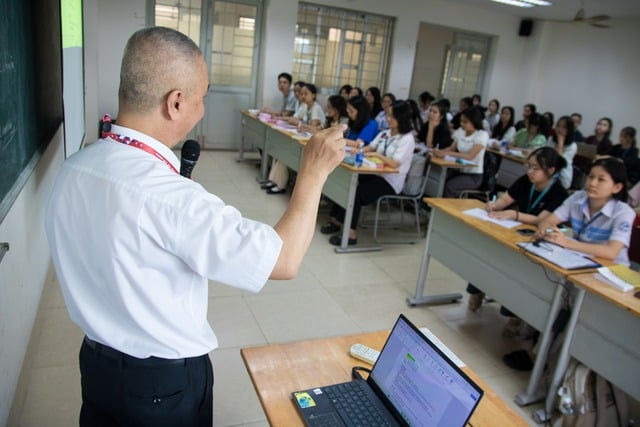
In the age of AI, what students expect from their teachers is the ability to enhance the learning experience and "guide" them.
Photo: Ngoc Long
FIND THE RIGHT WAY TO EVALUATE
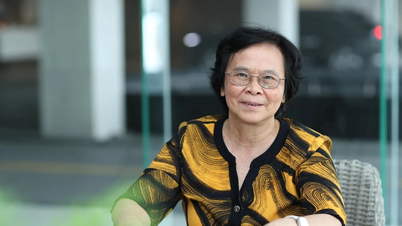
Ms. Luong Van Lam, a lecturer in professional communication at RMIT University Vietnam, believes that to make lectures more engaging, teachers must take on the role of "storyteller." She believes that with machines, the more information you give them, the more they learn. However, with humans, we remember better when information is linked to a specific context, object, event, or situation.
What benefits will high schools receive from AI legislation?



December 10th marked a significant milestone when the National Assembly officially passed the AI law, making Vietnam one of the few countries to have a comprehensive legal framework specifically for AI. Prior to this, the draft AI law stipulated that general education should integrate basic content on AI, computational thinking, digital skills, and ethics in technology use into its mandatory curriculum.
Simultaneously, the government will develop AI human resources in a comprehensive and synchronized manner across all educational levels and training programs. At the same time, it will encourage relevant parties to organize experiential activities, scientific research, and technological innovation in the field of AI. The AI Law will come into effect on March 1, 2026.
"When teachers help learners recognize the connection between knowledge and life, learning becomes a vibrant experience, not just dry information provided by AI," Ms. Lam said.
One point to note is that assessment methods must also change in the age of AI. Firstly, Master Lam argues that assignments should be more "real-world," linked to specific contexts and subjects in reality. In this case, AI can only support initial ideas; learners must independently research the context, culture, and society to provide specific answers. Secondly, teachers should combine both formative assessment and summative assessment of students' final results.
"To do this, assignments must be divided into smaller parts. Students need to submit drafts and reflection papers, and there should be feedback sessions, consultations, and exchanges between both sides. This method helps teachers observe the development of students' thinking skills and reduces reliance entirely on AI. In addition, teachers need to require learners to search for and interpret information from multiple sources, so that they can develop multi-faceted skills," shared Master Lam.
Source: https://thanhnien.vn/de-bai-giang-cua-thay-co-hap-dan-hoc-tro-thoi-ai-185251212223442379.htm


![[Image] National conference summarizing one year of operation of the overall organizational model of the political system, the three-tiered government model.](https://vphoto.vietnam.vn/thumb/1200x675/vietnam/resource/IMAGE/2026/07/01/1782882811691_ndo_br_1-jpg.webp)