

Located in the heart of the Pu Luong Nature Reserve, the traditional brocade weaving village of Lan Ngoai (Pu Luong commune, Thanh Hoa province) is becoming an attractive destination for international tourists thanks to the cultural stories told through each loom.
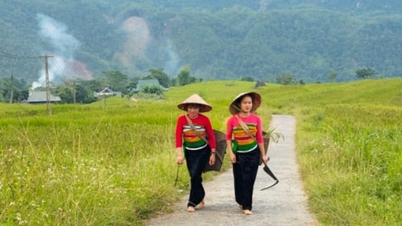
There, beside the stilt houses, the Thai ethnic women diligently work each day, weaving the distinctive patterns of the Pu Luong mountain forest.
The unique traditional brocade weaving village of Lặn Ngoài
The craft of brocade weaving originated in Lan Ngoai village, Pu Luong commune, in the 18th century (around 1749) when the Ha and Lo families (two major families of the Thai people of Thanh Hoa ) pioneered and established villages here.
At that time, the Lan Ngoai valley had fertile lands where people grew cotton, mulberry trees, and raised silkworms. From the materials they cultivated, the people developed the craft of weaving brocade.
To date, the craft village has undergone 276 years of formation and development and was recognized as a Traditional Craft Village by the People's Committee of Thanh Hoa province in 2021.
At 80 years old, Mrs. Ha Thi Nhan (Lan Ngoai village, Pu Luong commune) has been involved in brocade weaving for 65 years. Beside her loom, Mrs. Nhan recounts how she grew up listening to the rhythmic clacking of her grandmother's and mother's weaving, and how she followed adults to the fields to harvest cotton and pick mulberry leaves to feed silkworms. At over 10 years old, her mother taught her the craft by hand. Initially, she wove simple items, then she began weaving and coordinating colors and patterns for brocade fabrics.
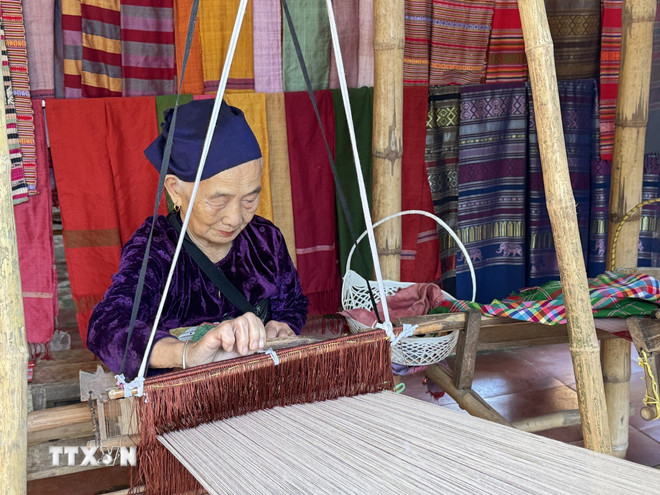
Ms. Nhan said that every Thai girl is taught the art of weaving brocade by her mother or grandmother from a young age. Therefore, Thai women are very skilled at silkworm breeding, spinning yarn, weaving fabric, sewing, and embroidery. As an unwritten rule, before getting married, Thai girls must weave and embroider their own blankets, mattresses, pillows, and skirts to bring to their husband's home. Therefore, for Thai women in Lan Ngoai village, preserving this traditional craft is not simply a matter of making a living, but also a conscious responsibility to safeguard the cultural heritage of their ancestors.
To weave a beautiful brocade fabric, many steps are required, demanding skill and meticulous attention to detail. From planting and harvesting cotton, processing the cotton bolls, and spinning the cotton into yarn... To ensure the fabrics have beautiful and eye-catching colors, before weaving, people go into the forest to find certain plants to collect leaves, bark, and roots, which they then boil to create dyes for the cotton yarn. The yarn is soaked in dye and dried to ensure its firmness, toughness, durability, and strength, before being strung onto a loom to weave colorful brocade fabrics.
According to Ms. Nhan, the most difficult part of brocade weaving is creating the patterns, as the patterns vary depending on the garment. The patterns can depict plants and flowers, animals, rhombus shapes, or eight-petaled flowers. Each pattern carries its own meaning, telling stories that reflect the richness and closeness to nature, and conveying profound cultural significance.
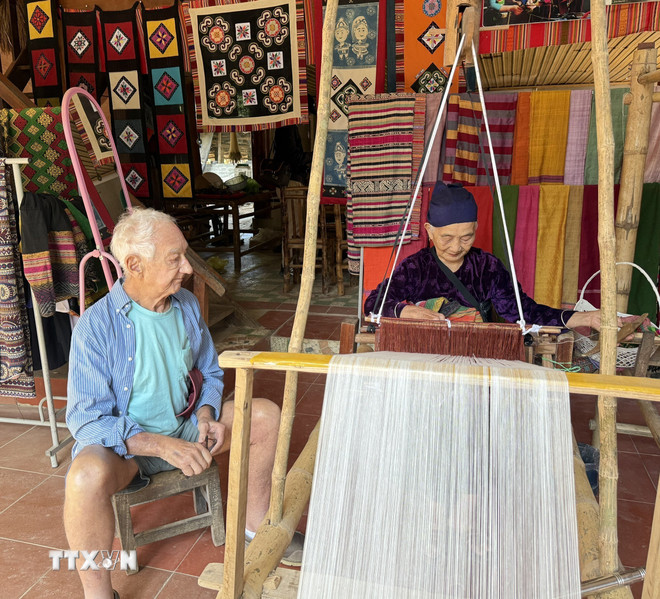
Ms. Ha Thi Nhan (Lan Ngoai village, Pu Luong commune) said that as a Thai woman, one must strive to preserve and weave beautiful traditional costumes. Each piece of fabric tells a story, deeply rooted in the ethnic identity, passed down from generation to generation. "I'm old now, I only hope my children and grandchildren will preserve the weaving craft of our ancestors."
Mrs. Nhan's daughter-in-law, Ms. Vi Thi Luyen, is also following in her mother-in-law's footsteps in the traditional brocade weaving craft. In addition to selling products in the craft village and traditional markets, Ms. Luyen has also promoted her hand-woven brocade products on social media platforms like Facebook and TikTok to reach a wider audience. As a result, these products, deeply rooted in the highland culture, have been chosen and purchased by many customers both domestically and internationally.
Ms. Vi Thi Luyen (Lan Ngoai village, Pu Luong commune) shared: “In my family, my mother-in-law is like a thread connecting the past and the present, ensuring that the traditional craft does not fade away with time. Every stitch she taught us was not just weaving fabric, but weaving memories and love. Thanks to people like her, the traditional craft is continued and passed down, so in the village, there are many families where both mother-in-law and daughter-in-law are passionate about the craft.”
Today, Lan Ngoai is no longer a quiet Thai village. The bustling sounds of looms and the vibrant colors of brocade fabrics – the revival of the craft village not only helps people increase their income but also contributes to preserving the unique cultural values of the Thai ethnic village amidst the vast Pu Luong mountains.
Foundation for sustainable tourism development
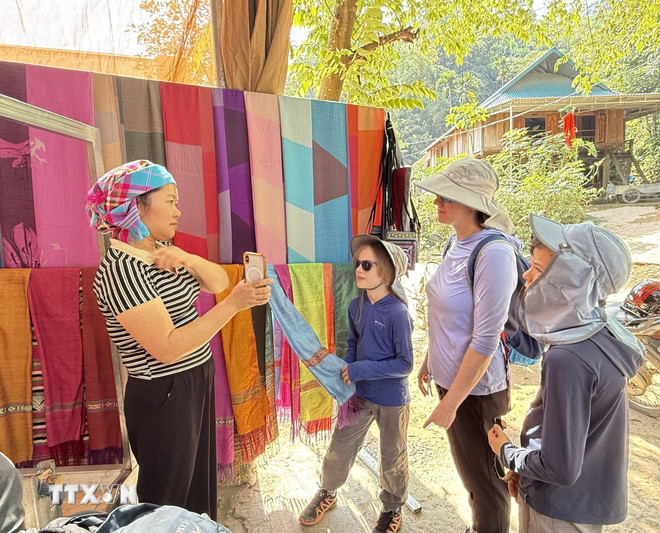
In recent years, the Pù Luông commune government has restored and developed the brocade weaving craft in Lặn Ngoài village, linking it with the exploitation of tourism advantages. Since the Pù Luông Tourist Area developed, the brocade weaving craft of Lặn Ngoài village has also become more well-known to tourists...
Over the past five years, the craft village has become an attractive tourist destination, where visitors can directly tour, experience the production process, and purchase unique handcrafted products.
The traditional brocade weaving village of Lặn Ngoài currently has 105 households directly involved in the craft, with an income of approximately 6-7 million VND per person per month. Besides serving the needs of the villagers, the handcrafted brocade products of Lặn Ngoài village are also popular with tourists, especially foreign visitors, who buy them as souvenirs.
Currently, the brocade products in Lan Ngoai are very diverse, including brocade fabric, scarves, hats, pillows, chair cushions, etc. The price of the products varies depending on the materials used. Traditional hand-woven brocade products are more expensive; those woven with industrial fibers are cheaper. Families in Lan Ngoai village clearly state the origin of their products to suit the tastes and budgets of their customers.
Mr. Roistacher Bob (82 years old), a tourist from New York, USA, said that he was very pleased to experience the process of spinning cotton and weaving brocade here. He was impressed with the skillful hands of Ms. Ha Thi Nhan and chose to buy two brocade scarves woven by her to give to his friends.
According to Mr. Ha Van Tung, Head of the Economic Department of Pu Luong Commune: The community-based tourism model associated with brocade weaving in Lan Ngoai village is becoming a highlight of the locality. Here, tourists can participate in the weaving process, attend traditional festivals, or enjoy local specialties prepared by the people themselves. This not only helps preserve the culture but also creates a sustainable source of income for the local community, helping them develop their economy based on the existing tourism potential.
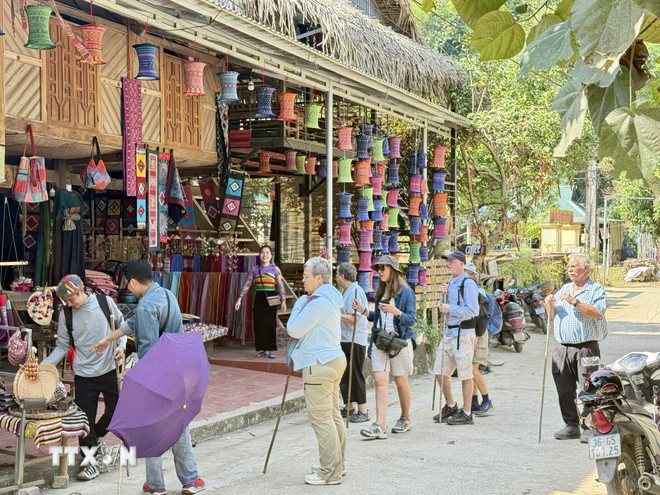
Every year, the local government, in coordination with the Department of Culture, Sports and Tourism and the University of Culture, Sports and Tourism, organizes training courses to improve the skills of brocade weavers. In 2024, Muong Khoong brocade scarves were recognized as a 3-star OCOP product at the provincial level. The locality is currently developing two more OCOP products: Thai ethnic costumes and brocade scarves for cushions and tablecloths.
The People's Committee of Pù Luông commune is actively connecting with travel agencies, especially those in Hanoi, to bring international tourists to the traditional brocade weaving village of Lặn Ngoài, while also seeking resources to expand common living spaces, vocational training areas, product displays, and tourist reception areas.
It is clear that combining tourism development and cultural preservation is the right direction for localities in the Pu Luong Nature Reserve.
This model not only helps local people increase their income, but also contributes to preserving traditional cultural values, creating a unique character, and positioning the Pu Luong brand on the Vietnamese tourism map.
Source: https://www.vietnamplus.vn/giu-hon-tho-cam-giua-dai-ngan-pu-luong-post1082816.vnp


![[Image] Close-up of the newly discovered "sacred road" at My Son Sanctuary](/_next/image?url=https%3A%2F%2Fvphoto.vietnam.vn%2Fthumb%2F1200x675%2Fvietnam%2Fresource%2FIMAGE%2F2025%2F12%2F13%2F1765587881240_ndo_br_ms5-jpg.webp&w=3840&q=75)
![[Infographic] Preventing students from making their own firecrackers: 7 things parents need to know](https://vphoto.vietnam.vn/thumb/402x226/vietnam/resource/IMAGE/2025/12/11/1765466656703_img_0320_20251211183542.jpeg)





































































Comment (0)