

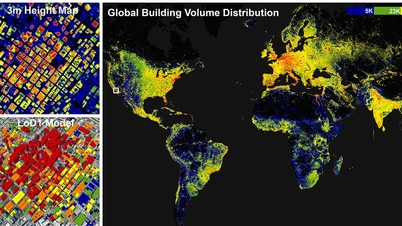
Scientists have just released the most detailed 3D map ever created, covering 97% of the buildings on Earth.
This massive database promises to be a valuable resource for urban planning, climate change monitoring, and disaster risk assessment.
The project, called GlobalBuildingAtlas, combines satellite imagery and machine learning technology to create 3D models of virtually every building structure on the planet.
Published in the journal Earth System Science Data, this dataset contains information on 2.75 billion buildings. Each building is mapped in detail with floor area and height, achieving a spatial resolution of 3 meters x 3 meters.
To complete this project, the research team processed approximately 800,000 satellite images taken in 2019. They used deep learning tools to predict building height, volume, and area. These tools were previously trained on reference data from laser scanning technology (LiDAR) of 168 cities, primarily in Europe, North America, and Oceania.
Data from the map shows that Asia accounts for nearly half of the world's buildings, with approximately 1.22 billion structures. The region also leads in total built volume (1.27 trillion cubic meters), reflecting the rapid urbanization and high population density in China, India, and Southeast Asia.
Africa ranks second in terms of number with 540 million buildings, but the total volume only reaches 117 billion cubic meters, indicating the prevalence of small and low-rise structures.
The study also highlighted stark disparities in living conditions and infrastructure. For example, Finland has six times the built-up area per capita of Greece, while Niger's is 27 times lower than the world average. These 3D models provide deeper insights than traditional 2D maps that only measure surface area.
According to co-author Xiaoxiang Zhu from the Technical University of Munich (Germany), this map opens up new possibilities in assessing natural disaster risks, modeling climate, and helping to monitor the United Nations Sustainable Development Goals.
Dorina Pojani, an urban planning researcher at the University of Queensland (Australia), believes this dataset is extremely valuable because it allows for real-time monitoring of urban development instead of relying on static data.
Notably, Pojani noted that this data also offers new opportunities to study corruption in construction. It allows researchers to "link buildings or projects to specific developers, companies, or political actors, and question whether certain networks of people are disproportionately positioned in high-value or strategically located projects."
Liton Kamruzzaman, a planning expert at Monash University (Australia), also praised the project's potential, particularly for areas around the world that currently lack planning information, helping to monitor urbanization more transparently.
Source: https://www.vietnamplus.vn/ban-do-3d-khong-lo-mo-phong-275-ty-toa-nha-tren-toan-the-gioi-post1082812.vnp





















































































Comment (0)