

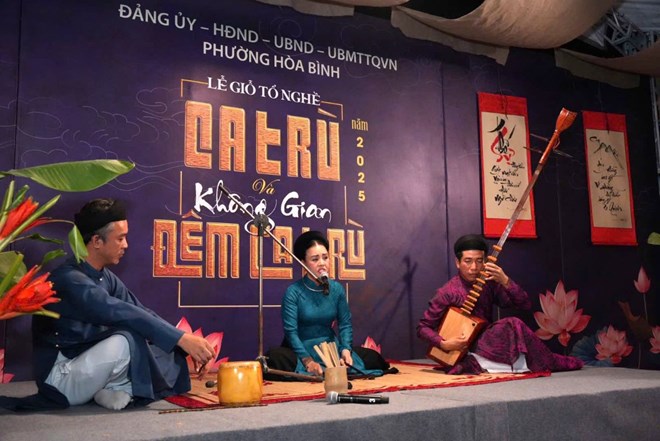
The Dong Mon Ca Tru Club continues to preserve and develop this traditional art form. Photo: Hoa Binh Ward , Hai Phong.
Preserving the cradle of Ca Tru singing in the Northern coastal region.
Dong Mon Village (Dong Mon residential area, Hoa Binh ward, Hai Phong city) is known as the cradle of Ca Tru singing in the Northern coastal region. It not only houses the Phu Tu temple dedicated to the founders of Ca Tru singing but was also once a large Ca Tru singing troupe in the region with famous male and female singers.
According to legends and historical documents, the founders of Ca Tru singing are the two revered masters, Dinh Du Thanh Xa Dai Vuong and Man Duong Hoa Cong Chua. Saint Dinh Du was a renowned scholar, the son of a high-ranking official during the Later Le Dynasty, possessing talent in poetry and music . He married Man Duong Hoa, a woman with a clear and refined singing voice. Their talent and singing impressed the King, who entrusted them with the important task of establishing a singing school in Lo Khe, founding the first A Dao singing troupe, and laying the foundation for Ca Tru art. In recognition of their merit, King Gia Long bestowed the titles "Dinh Du Thanh Xa Dai Vuong" and "Man Duong Hoa Cong Chua," officially recognizing them as the revered masters of Ca Tru.
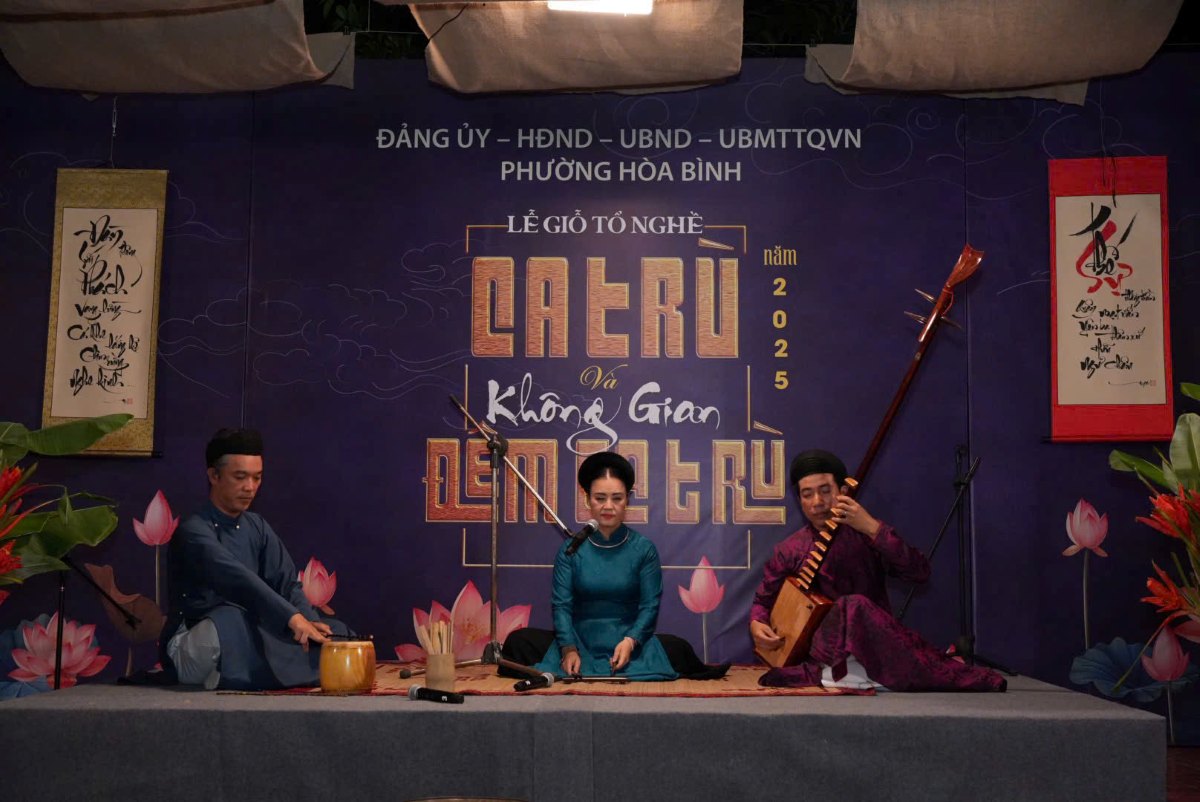
Hoa Binh Ward preserves the beautiful heritage of Dong Mon Ca Tru singing. Photo: Hoa Binh Ward
To commemorate the profound contributions of the two founding masters of the craft, in Dong Mon village, generations of students and villagers established the Ca Cong Temple, now known as Dong Mon Ancestral Temple. Throughout many historical events, the site suffered serious deterioration at times. However, the important artifacts were preserved and maintained by the local people, and later the temple was rebuilt on the old site to continue the worship, demonstrating their reverence and the continuation of the religious tradition.
During the period from 1940-1945, Ca Tru singing in Dong Mon became a livelihood for many large families in the village. Children grew up being taught the craft by their grandparents, becoming "ca nun" (female singers) and "kep dan" (male instrumentalists). Along with this, many families established performing troupes that specialized in performing in provinces and cities such as Hanoi, Thai Binh (now Hung Yen), Quang Ninh, and Nam Dinh (now Ninh Binh)... At its peak, Ca Tru singing was considered a source of income for hundreds of people.
In 1993, the local government established the Dong Mon Ca Tru Club with contributions from Ca Tru artist To Thi Che (singer), Mr. To Van Nghi (instrumentalist), and many other Ca Tru enthusiasts. In the early days, due to a shortage of members, the entire female and male ritual troupe of the temple was mobilized to participate. As a musical genre that is selective in both singers and listeners, requiring both talented singers and discerning listeners, maintaining its existence has been no easy feat. After nearly 20 years of revival and development, thanks to the guidance of dedicated Ca Tru artists, the Dong Mon Ca Tru Club has gradually regained its former prominence.
With 20 dedicated core members, this is one of the few clubs in Hai Phong city that still maintains its passion and regular activities. In particular, recognizing that teaching and preserving the heritage is a crucial and vital task, the local authorities have focused on nurturing and developing the next generation.
Currently, Ca Tru classes for 30 students are being held regularly. This is a strategic investment for the future, a foundational step to ensure the enduring vitality of Ca Tru in this heritage land.
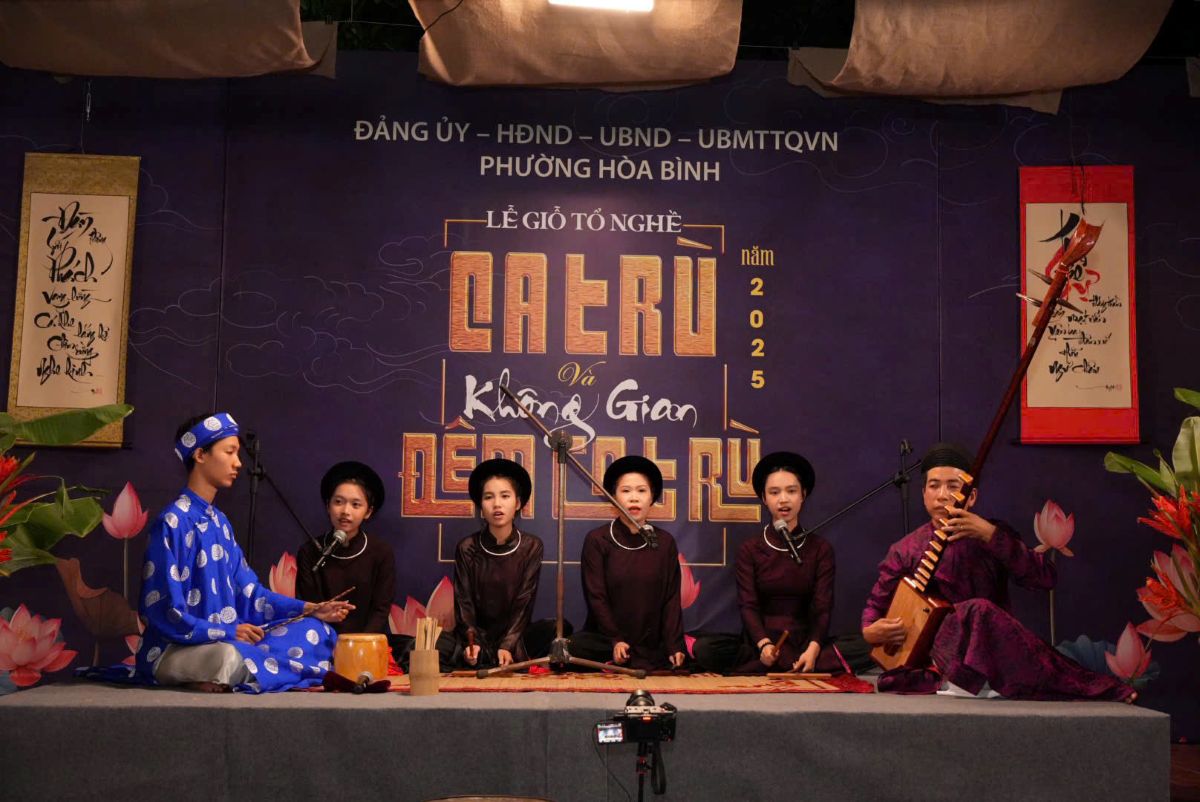
The people of Dong Mon are always proud to be the only locality in Hai Phong with so many students who know how to sing Ca Tru (a traditional Vietnamese folk singing style). Photo: Hoa Binh
Linking heritage preservation with tourism development.
Since establishing a two-tiered local government model, the leadership of Hoa Binh ward has paid close attention to the local cultural values, emphasizing that "Ca Tru is a World Cultural Heritage that needs urgent protection." The people of Dong Mon in particular, and the people of Hoa Binh ward in general, actively preserve, promote, and are constantly proud of the cultural beauty of their homeland.
The preservation and promotion of the cultural heritage of Ca Tru singing has been identified as one of the key tasks of Hoa Binh ward. A vivid example is the Dong Mon Temple and Shrine, which was renovated in 2019 and has become a worthy cultural and religious center. The Party Committee and local government always pay attention to and create favorable conditions for the Dong Mon Ca Tru Club to operate regularly.
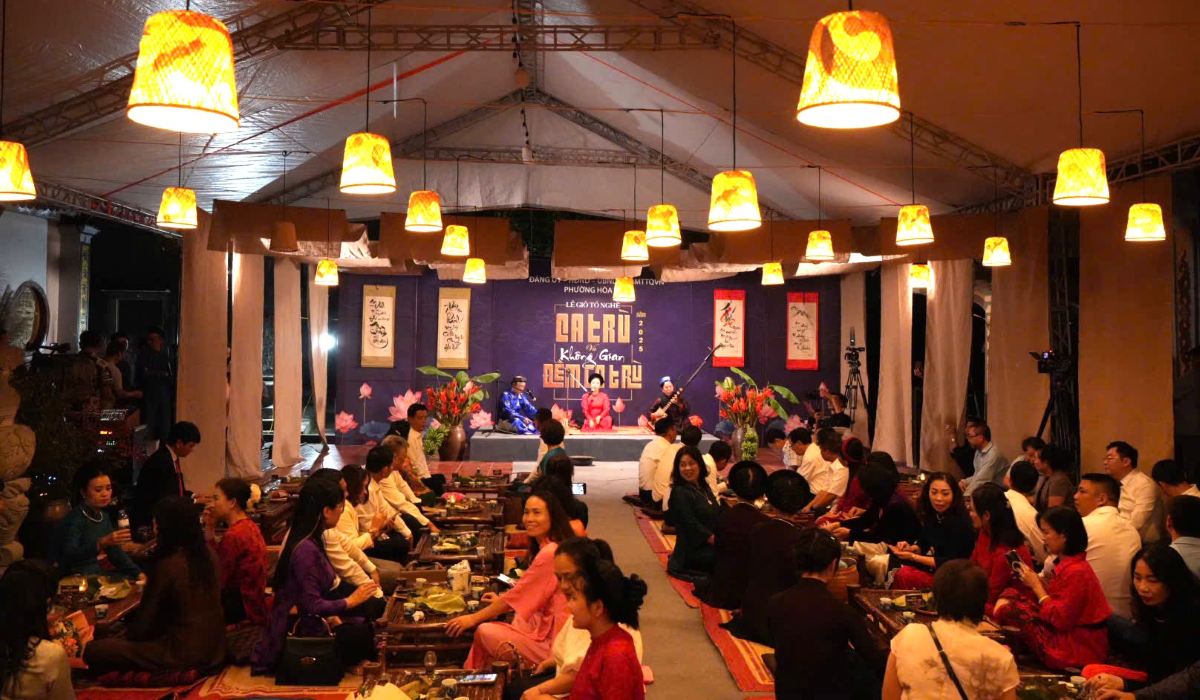
A unique cultural setting at the commemoration ceremony for the founder of Ca Tru singing. Photo: Hoa Binh Ward.
Based on these results, the Resolution and Action Program of the Hoa Binh Ward Party Committee have clearly identified strategic solutions for the 2026-2030 period. These include researching, developing, and implementing the project "Restoring the 'Cua Dinh' singing style within the Phu Tu - Den Ca Cong historical site," aiming to recreate the most original values of Ca Tru art. In addition, practical research will be conducted to implement tasks and solutions to honor and support the artisans – the living treasures preserving the essence of this art form. The ward also aims to closely link heritage preservation with the development of cultural and spiritual tourism, creating sustainable resources for reinvestment in preservation efforts.
Recently, in November, Hoa Binh ward organized the 2025 Ancestor Commemoration Ceremony for Ca Tru (traditional Vietnamese singing) in a unique, vibrant, and folk-inspired setting. This was accompanied by an art program called "Ca Tru Night," recreating the traditional singing and performance spaces of Ca Tru guilds and clubs such as the Dong Mon Ca Tru Club, the Hai Phong Ca Tru Guild, and the Dong Le Chan Ca Tru Club. At the ceremony, leaders from the Hai Phong City Department of Culture, Sports and Tourism and the Hoa Binh Ward Party Committee presented flowers and certificates to individuals who have made significant contributions to preserving Ca Tru art in Dong Mon. To date, the Ancestor Commemoration Ceremony for Ca Tru has become a major cultural festival, deeply rooted in the local identity, and is maintained annually.
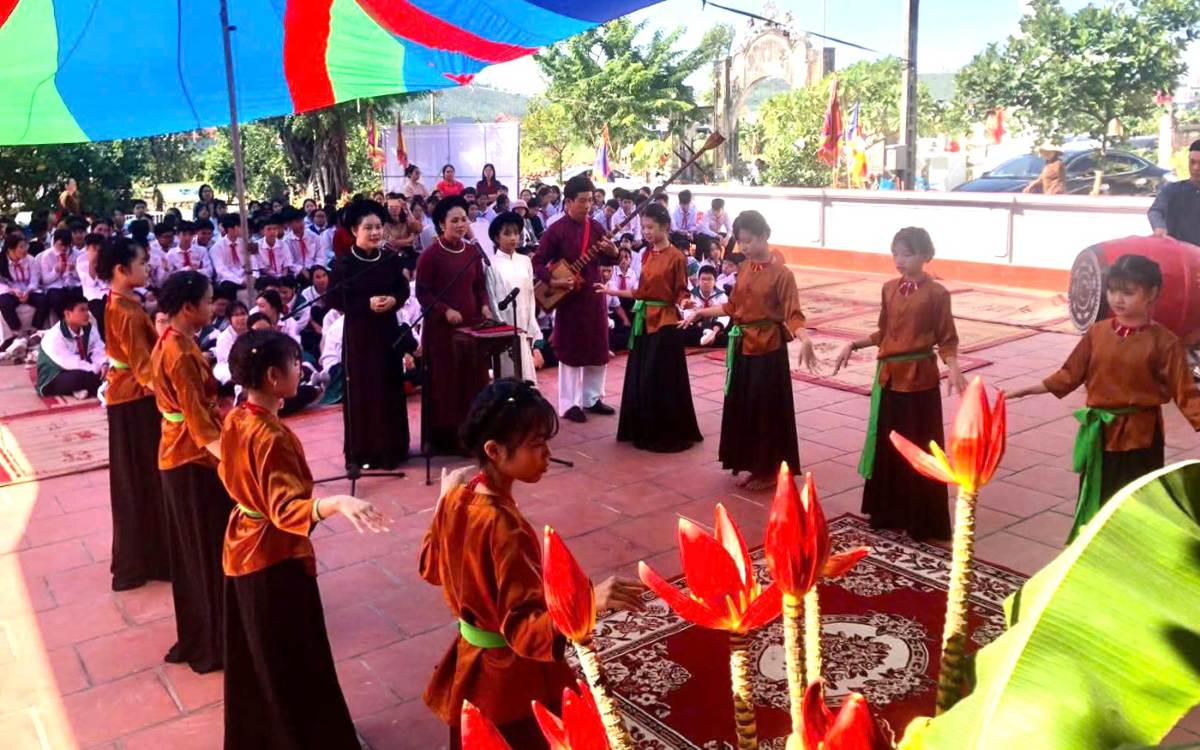
Hoa Binh Ward organized a program titled "Exchange and Exploration of Dong Mon Ca Tru Art" for students of all levels in the area. Photo: Hoa Binh Ward, Hai Phong.
The local authorities also organized exchange programs to learn about Dong Mon Ca Tru art for students in schools throughout the city. During these exchanges, teachers and students were introduced by artisans and artists to the history and development of Ca Tru art, especially Dong Mon Ca Tru.
Students also get to experience traditional art forms firsthand; learning about the ritual singing in traditional festivals.
Ms. Tran Thi Mai Phuong, Head of the Culture and Social Affairs Department of Hoa Binh Ward, said that at the end of December, the locality expects to welcome more groups of students to visit the Dong Mon Temple relic site, learn about and experience the Dong Mon Ca Tru art form. This shows that Ca Tru is not only attractive to older people and those who love traditional culture and art, but also attracts many young children and students to participate in learning about it. Through these practical experiences, the locality hopes that the younger generation will understand the spiritual significance of Ca Tru art, fostering an awareness of preserving and promoting this intangible cultural heritage.
Source: https://laodong.vn/van-hoa-giai-tri/gan-bao-ton-di-san-ca-tru-dong-mon-hai-phong-voi-phat-trien-du-lich-van-hoa-1623975.ldo

























![[Photo] Prime Minister Pham Minh Chinh holds a phone call with the CEO of Russia's Rosatom Corporation.](/_next/image?url=https%3A%2F%2Fvphoto.vietnam.vn%2Fthumb%2F1200x675%2Fvietnam%2Fresource%2FIMAGE%2F2025%2F12%2F11%2F1765464552365_dsc-5295-jpg.webp&w=3840&q=75)








































Comment (0)