


Overview of the Conference.
Theory: The nation's "operating system" in an era of change.
In his opening remarks at the workshop, Associate Professor Dr. Doan Minh Huan, Permanent Deputy Director of the Ho Chi Minh National Academy of Politics , stated that for each nation, the system of theoretical knowledge plays the role of an "operating system" for all development policies. Without a solid foundation in social sciences and humanities, development will lack direction, innovation will lack sustainability, integration will lack resilience, and social progress will lack depth of value.
According to Associate Professor Dr. Doan Minh Huan, humanity is witnessing an explosion of digital technology, artificial intelligence, and big data, leading to profound transformations in economic , political, and cultural life, along with the complexity of global issues such as social inequality, climate change, conflicts of interest, and the protection of human values. These rapid changes create not only opportunities but also pose many new challenges, requiring a comprehensive renewal of scientific thinking in terms of theory, methodology, and approach.
In this context, the social sciences and humanities play a particularly important role in helping people understand themselves, society, the driving forces of development, and the laws governing life.
Associate Professor Dr. Doan Minh Huan emphasized that, especially in an era of rapid transformation, we increasingly need profound theoretical foundations to guide development, formulate policies, and ensure harmonious, sustainable, and humane development.
NCCB in the field of social sciences and humanities is not only about building knowledge but also about establishing a foundation for strengthening values, shaping the future, preserving identity, and proactively adapting to a changing world .
The Deputy Director of the Ho Chi Minh National Academy of Politics emphasized: "Technology can help us go faster, but humanistic wisdom helps us go further."
According to him, the most fundamental issues such as values, ethics, social norms, thinking capacity, political acumen, and sense of responsibility can only be explained and guided through rigorous, accurate, and profound research in the social sciences and humanities. Fundamental research aims not only to answer the questions of what and how, but also to explore the "why" behind all social phenomena.
In this new context, the National Council for the Comprehensive and Progressive Trans-Pacific Partnership (NCCB) has four important tasks: Clarifying the new laws of social life; building a system of values and identity in the era of globalization; providing a theoretical foundation for national development strategies; contributing to humanization, technological development, ensuring that technology serves humanity, protecting ethical values, and strengthening the harmonious development between technology and society.
Associate Professor Dr. Doan Minh Huan affirmed: "Basic research is not only the foundation of knowledge but also the soft power of the nation. Investing in basic research is investing in development, in identity, in intellect, and in the self-reliance of the nation."

Associate Professor Dr. Doan Minh Huan, Permanent Deputy Director of the Ho Chi Minh National Academy of Politics, delivered the opening remarks at the conference.
Building a new knowledge base for social sciences and humanities in the age of data and AI.
Sharing the same view, Associate Professor Dr. Dao Ngoc Chien, Director of the National Science and Technology Development Fund, emphasized the central role of the National Center for Science and Technology in building a new knowledge foundation for social sciences and humanities, while also outlining the direction for improving the funding mechanism in the coming period.
According to Associate Professor Dr. Dao Ngoc Chien, the National Center for Scientific Research (NCCB) helps clarify the nature of social, cultural, and human phenomena; it builds a system of concepts, theories, and methods – the "pillars" of the entire social sciences and humanities. It also provides scientific evidence for policy planning, trend forecasting, human development program design, institutional reform, and digital transformation. Furthermore, NCCB serves as an environment for training a new generation of scholars, forming strong research groups, and contributing Vietnamese knowledge to the global academic forum.
Associate Professor Dr. Dao Ngoc Chien stated that, during the period 2011-2025, the National Science and Technology Development Fund sponsored 749 research projects in social sciences and humanities, with 478 projects successfully completed, resulting in the publication of 441 prestigious international articles and over 1,500 national articles; approximately 300 PhDs and 500 Master's degree holders were trained through these projects.
In 2025 alone, 60 out of 200 applications received funding, including 6 development projects and 53 exploratory projects. The results of the year's evaluation showed positive growth with 118 international publications, 134 national publications, and 40 postgraduate students trained.
However, according to Associate Professor Dr. Dao Ngoc Chien, the quality of research is still uneven, international publications are limited, and the level of connection with policy practice still needs improvement.
Associate Professor Dr. Dao Ngoc Chien emphasized that the National Science and Technology Development Fund plays a key role in creating a favorable, transparent, and competitive research environment; developing a high-quality team of scientists; prioritizing young scientists and developing strong research groups; and promoting international integration and research cooperation.
In the coming period, the Fund will focus on promoting funding for high-quality NCCB projects; prioritizing support for activities that enhance scientific and technological capacity; encouraging interdisciplinary research and innovation, especially linking social sciences and humanities with big data, technology, and AI; strengthening international integration in funding and conducting research; and promoting digital transformation and reducing administrative procedures.
In particular, on November 30, 2025, the Ministry of Science and Technology issued two important circulars: Circular 43/2025/TT-BKHCN on the management and support of activities to enhance science and technology capacity; and Circular 44/2025/TT-BKHCN stipulating the procedures for funding and managing science and technology tasks. These two circulars are expected to create a unified, transparent framework, reduce administrative procedures, improve the efficiency of budget utilization, and further boost the national science, technology, and innovation ecosystem.

Associate Professor Dr. Dao Ngoc Chien, Director of the National Science and Technology Development Fund, delivered a speech at the workshop.
In his presentation on "International Integration and the Mission of Social Sciences and Humanities: From Knowledge Acquisition to Contributions to Vietnamese Theories," Dr. Dao Ngoc Bau, Director of the Institute of Politics and International Relations, Ho Chi Minh National Academy of Politics, explained that international integration creates a profound restructuring of the knowledge space, where knowledge has become a form of "soft power" closely linked to the ability to shape discourse and enhance national standing.
However, according to Dr. Dao Ngoc Bau, Vietnamese social sciences and humanities currently still mainly operate in the role of knowledge recipients, with limited capacity for theoretical creation and independent doctrinal contributions, leading to the risk of "knowledge dependence." Therefore, the strategic mission of Vietnamese social sciences and humanities is to make a historical shift from a passive to an active role, specifically from localizing knowledge to contributing Vietnamese doctrinal knowledge—a system of scientific theories with international reference value based on the country's practical realities.
To realize this mission, Dr. Dao Ngoc Bau proposed a fundamental reform of the investment and scientific evaluation mechanisms, prioritizing long-term (5-10 years) foundational theoretical research, while also strongly reforming human resource training to foster theoretical creativity and critical thinking skills.

Dr. Dao Ngoc Bau, Director of the Institute of Politics and International Relations, Ho Chi Minh National Academy of Politics, delivered a speech at the conference.
Meanwhile, Associate Professor Dr. Nguyen Tai Dong, Director of the Institute of Philosophy, Vietnam Academy of Social Sciences, stated that digital transformation is placing social sciences and humanities before a systemic crisis, threatening the identity and methodology of the field. He pointed out fundamental challenges including the risk of tool dependence and a decline in critical thinking when researchers leave intellectual tasks to AI tools, losing the ability to deeply understand (embodied knowledge).
Associate Professor Dr. Nguyen Tai Dong also argues that imposing quantitative models under the guise of Big Data can undermine theoretical thinking, causing research to only answer the question "what" while ignoring the question "why" regarding causal mechanisms and ontological meaning. Along with this, another geopolitical and cultural challenge is the risk of "cognitive colonization" through the use of foreign AI systems, which are not primarily trained on Vietnamese data and values, potentially distorting fundamental concepts of Eastern philosophy and indigenous ethical values.
Regarding opportunities, Associate Professor Dr. Nguyen Tai Dong affirmed that the social sciences and humanities have the opportunity to reaffirm their strategic position, becoming the industry that produces "social software" (institutions, laws, ethics, cultural norms), an indispensable soft infrastructure of the digital society.
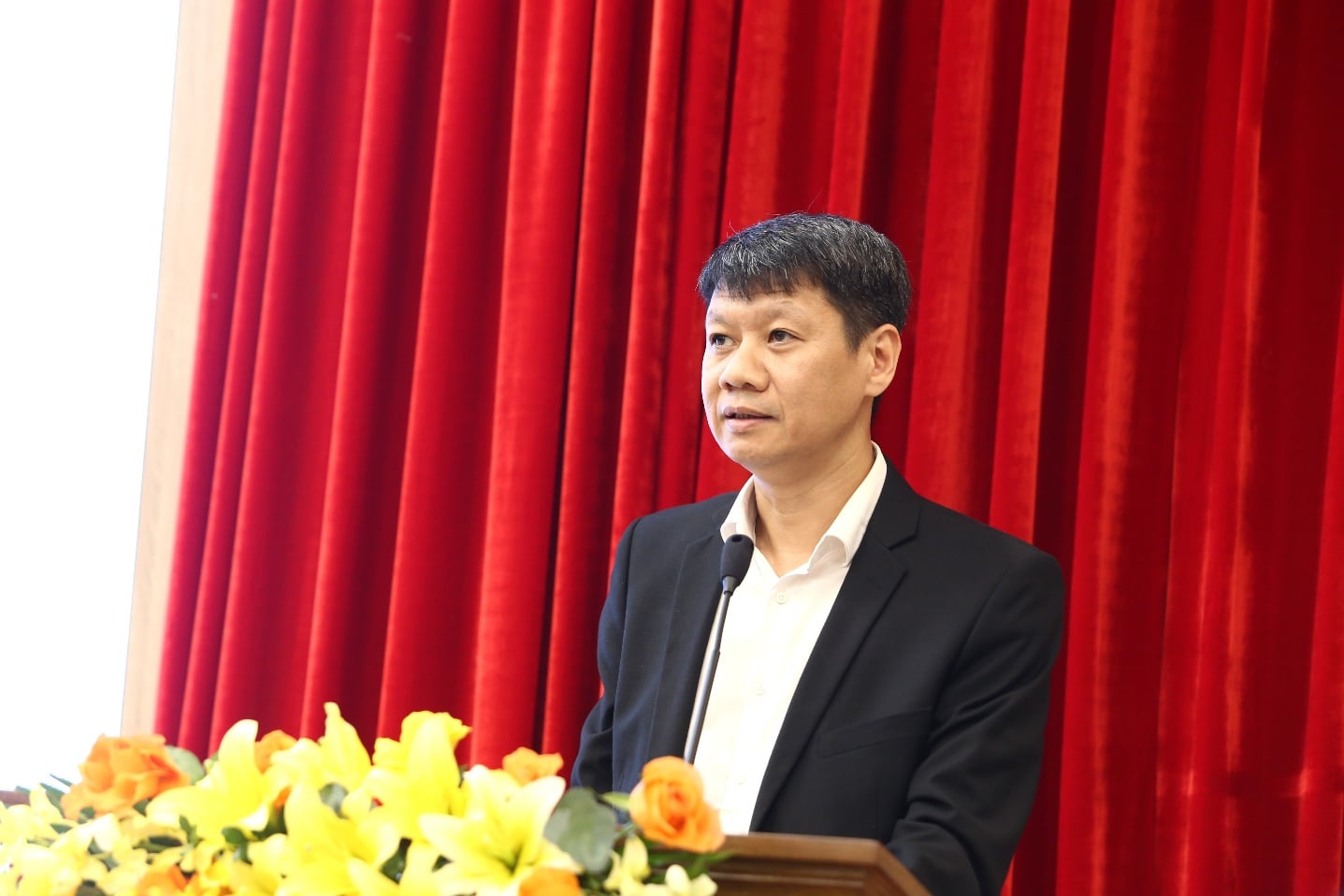
Associate Professor Dr. Nguyen Tai Dong, Director of the Institute of Philosophy, Vietnam Academy of Social Sciences, delivered a speech at the conference.
At the conference, many scientists affirmed that the National Key Framework is not only a knowledge base but also a soft power, a self-reliance capability, and an "operating system" for national development strategies.
The analyses and recommendations at the Conference further clarified the mission of the Social Sciences and Humanities, which is: to strengthen the value system, develop human resources, protect identity, design institutions, and elevate Vietnam's position in the global knowledge space. With a serious academic spirit and a desire for innovation, the Conference provided further impetus for the sector to confidently enter a new phase of development – proactive creativity, deep integration, and accompanying the nation on the path to sustainable development.

The delegates posed for a commemorative photo.
Source: https://mst.gov.vn/dinh-hinh-vai-role-vi-the-cua-nghien-cuu-co-ban-trong-linh-vuc-khoa-hoc-xa-hoi-va-nhan-van-trong-ky-nguyen-so-197251212185657099.htm

















![[Photo] Prime Minister Pham Minh Chinh holds a phone call with the CEO of Russia's Rosatom Corporation.](/_next/image?url=https%3A%2F%2Fvphoto.vietnam.vn%2Fthumb%2F1200x675%2Fvietnam%2Fresource%2FIMAGE%2F2025%2F12%2F11%2F1765464552365_dsc-5295-jpg.webp&w=3840&q=75)











































Comment (0)