

The draft law proposes adding provisions regarding the model of "roaming ambassadors extraordinary and plenipotentiary".
According to the draft, in cases where Vietnam does not have a representative office abroad and based on an agreement with the host country, the State will appoint a "Ride-to-Ride Ambassador Extraordinary and Plenipotentiary" to be in charge of and responsible for promoting relations between Vietnam and the relevant country.
The appointment process for this position is similar to the appointment process for Ambassadors Extraordinary and Plenipotentiary under the law on diplomatic missions.
This is a flexible model, already adopted by several countries, allowing Vietnam to expand its diplomatic presence without incurring additional fixed costs, aligning with its goal of expanding its network of representative offices to approximately 150 countries.
Current legislation does not yet regulate these positions. However, in international practice, many countries have adopted the position of Ambassador-at-Large (with over 40 Ambassador-at-Large), such as Maldives and Singapore.
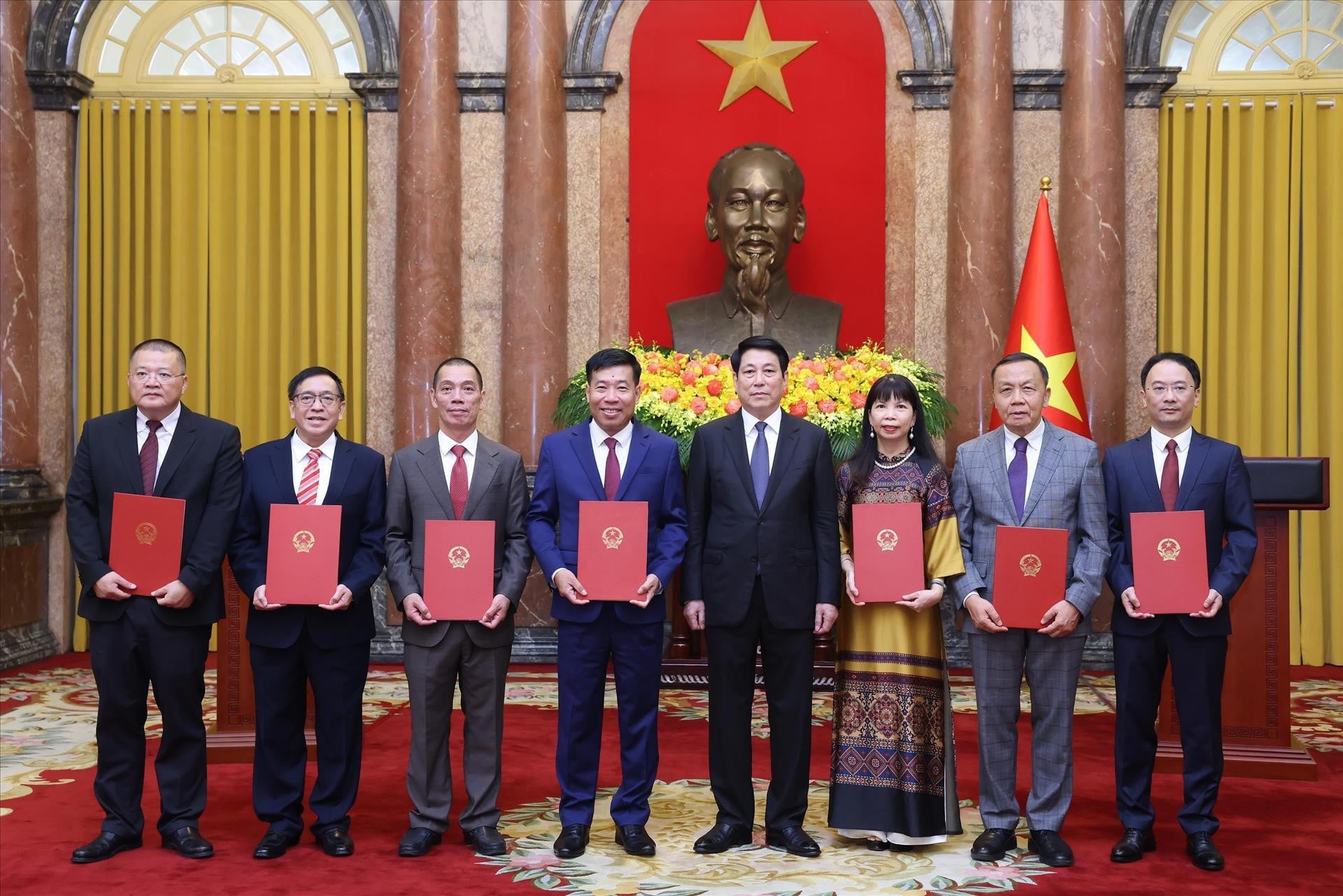
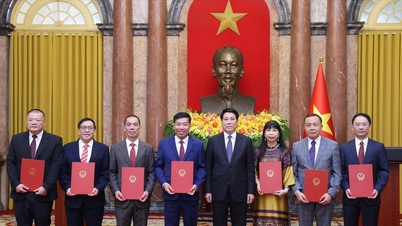
President Luong Cuong presented decisions on the conferment of ambassadorial ranks and the appointment of heads of Vietnamese representative offices abroad in October. Photo: VNA
An ambassador-at-home has the same functions, duties, and rights as an ambassador-at-home. Appointed diplomatic staff continue to work in their home country while performing the duties of an ambassador-at-home, and are present in the host country on important occasions.
The Ministry of Foreign Affairs assesses that, compared to the currently applied model of concurrently serving Ambassadors, the model of a mobile Ambassador Extraordinary and Plenipotentiary is similar in terms of efficiency in using state budget because it does not create additional personnel, does not incur costs for purchasing or renting office space, purchasing equipment, and saves budget for paying allowances to resident diplomatic staff.
Furthermore, the model of a roving Ambassador Extraordinary and Plenipotentiary helps reduce the workload, allowing the (concurrently accredited) Embassy to focus its resources on promoting bilateral relations with the region where it is based – a partner identified as of greater importance in foreign policy.
This model also helps to limit the occurrence of sensitive and complex situations in cases where the country where the embassy is located has a conflict with the country that the embassy is also accredited to, or where the area of accreditation is a region with conflicting interests between several countries.
The draft also proposes adding a range of powers to the Minister of Foreign Affairs.
Specifically, the Minister of Foreign Affairs has the authority to decide on extending the term of office of ambassadors; to regulate the functions, duties, and powers of Vietnamese Honorary Consuls abroad; and to decide on the establishment, expansion, and reduction of consular areas of Vietnamese consular missions abroad. Under current regulations, the Standing Committee of the National Assembly decides, and the President appoints, dismisses, assigns, and recalls the head of a representative office who is an ambassador.
The Minister of Foreign Affairs is also given the additional authority to recall or shorten the term of office of the head of a diplomatic mission under the authority of the President, as delegated to the Minister of Foreign Affairs.
Proposal to increase benefits for staff working at diplomatic missions and their family members.
The draft law adds many regulations and policies for members of diplomatic missions and their family members.
Specifically, the Ministry of Foreign Affairs proposed adjusting the health insurance coverage level according to two options. Option 1 is to set a fixed health insurance coverage limit, allowing members of diplomatic missions to proactively choose their coverage (reimbursement based on actual expenses and not exceeding the fixed limit). Option 2 is for the State to guarantee a health insurance coverage level equivalent to that of the host country.
The Ministry of Foreign Affairs stated that, after review, the current health insurance premium is $500 per person per year, totaling $1.3 million. Therefore, increasing the health insurance premium to $1,000 per person per year would require an additional $1.3 million (approximately 33 billion VND) from the budget.
The draft also adds a disease allowance for certain areas; for some dangerous diseases, there is a policy to support travel and treatment costs in Vietnam or a third country; and implements a dual-role allowance for certain areas where individuals hold multiple positions.
The draft law clearly states that the State encourages and provides financial support from the state budget for training and professional development of members of diplomatic missions in foreign languages, especially rare foreign languages, and specialized knowledge in foreign affairs and international integration before and during their term of office.
Notably, for minor children accompanying members of diplomatic missions, the draft law allows for "guaranteed" rather than "partial support" of tuition fees in the host country and the cost of health insurance; they are also entitled to airfare benefits similar to those granted to the spouse of a member of the diplomatic mission.
Allowances, subsidies, and living expenses for members of Vietnamese agencies abroad and their accompanying spouses are exempt from personal income tax. The basic living allowance is automatically adjusted upwards by 5% each year.
Source: https://vietnamnet.vn/de-xuat-co-chuc-danh-dai-su-dac-menh-toan-quyen-luu-dong-2471650.html


![[Image] Close-up of the newly discovered "sacred road" at My Son Sanctuary](/_next/image?url=https%3A%2F%2Fvphoto.vietnam.vn%2Fthumb%2F1200x675%2Fvietnam%2Fresource%2FIMAGE%2F2025%2F12%2F13%2F1765587881240_ndo_br_ms5-jpg.webp&w=3840&q=75)































































Comment (0)