

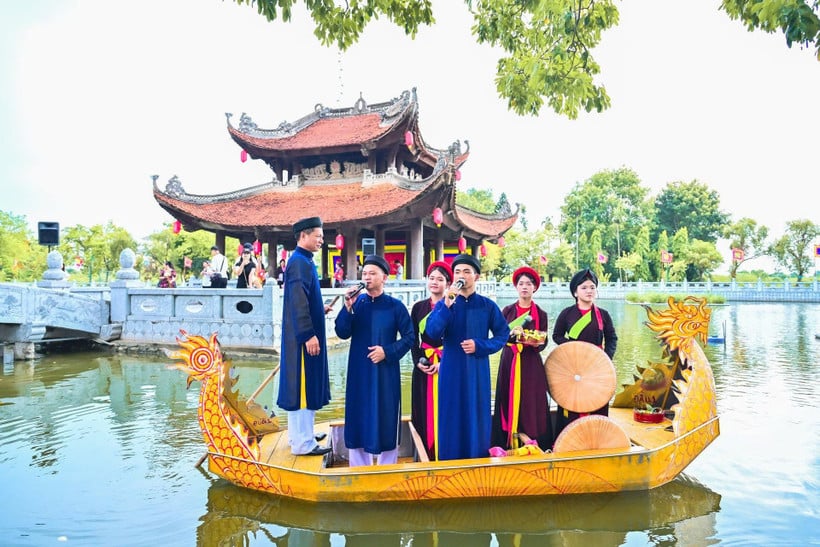
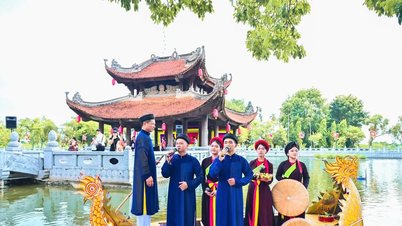
The Quan Ho Club of Den Do Temple performing Quan Ho folk songs at the Den Do Temple water pavilion in Bac Ninh . (Photo: Bao Long)
If we consider culture as the "gene" that defines the brand of traditional heritage, then community values will ensure that this "gene" remains vibrant and is passed down through generations.
Preserving the flame of tradition
The growing trend of seeking out traditional cultural values shows that heritage is not only found in museums or books, but lives on in the breath of labor and pride of the local people. It is their everyday lives that attract tourists and form the core element in starting the journey of creating green tourism .
My Thanh Fishing Village (Dan Dien commune, Hue city) is one example. This ancient fishing village, nestled beside the Tam Giang lagoon, often welcomes visitors from afar in the misty dawn, possessing the tranquil, pristine beauty of the lagoon area. Within the village, women like Mrs. Nguyen Thi Du, with their petite figures and diligent work amidst the vast expanse of water, have dedicated their lives to fishing and have become the "soul" of the destination.
For the people here, life by the lagoon is not just about making a living, but also about the responsibility of preserving their family and village traditions, ensuring that the traditional fishing profession is not interrupted, and simultaneously opening up a sustainable way to develop tourism. Tourists come to Ngu My Thanh not only to take photos, but also to paddle boats and listen to stories about the lagoon fishing experiences of their ancestors.
On her family's tourist boat, Mrs. Dự recounted: "We grew up on the water, knowing every shallow and deep spot in the lagoon. Wherever the boat goes, we can tell passengers about the different plants and fish species according to the season, the history associated with each name... Everyone is always eager to learn."
The authentic, simple, and proud stories shared by local guides like Ms. Dự contribute to making traditional cultural tours attractive to visitors. The vibrant presence of the community shows that, as tourism develops, traditional ways of life are not erased but are cherished and contribute to livelihoods.
While Ngư Mỹ Thạnh is known for its fishing industry, Thiềng Liềng (Thạnh An commune, Ho Chi Minh City) has a traditional salt-making industry. Here, salt farmers like Mr. Nguyễn Văn Đổi have dedicated their entire lives to the salt fields.
"Every year, my villagers are busy for six months during the dry season. This is the peak time for salt production, and recently, we've even had visitors," Mr. Doi recounted.
Previously, market competition threatened the survival of the Thieng Lieng salt-making craft. However, the local community found a new direction: transforming the traditional craft into a tourism product. Instead of abandoning the salt fields to pursue service industries, they turned the sweat and effort of salt-making into a fascinating living museum. Tourists are guided by locals through the manual salt-making process, from hauling the land and channeling the water to raking the salt. This allows them to learn more about a story, a labor experience, and a local culture being preserved by the community.

A Chũ noodle production facility at Trai Lam Cooperative, Nam Duong commune, Bac Ninh province. (Photo: BAO LONG)
Elevating the cultural experience
The simple stories of local cultural brands have gradually become a solid foundation for developing green tourism. For many young travelers, the appeal of authentic cultural regions comes from the genuineness of community life.
“During many trips, I had the opportunity to chat with locals about their occupations, their way of life, and how they preserve customs through generations. Through these very ordinary stories, I realized that culture is not just a memory, but a part of life that is constantly evolving,” shared Nguyen Trung Duc (Hanoi).
This partly explains the necessity of positioning tourism as a national brand, as well as the need for a systematic strategy to replicate and professionalize core cultural values, whether on a small or large scale.
Bac Ninh is a prime example of building a brand based on the intangible cultural heritage of Quan Ho folk singing. The province has brought Quan Ho back to its original setting, where the heritage flourishes most: on the Cau River ferry dock. There are already tours like this: early in the morning at the ferry dock along the Cau River, when wisps of smoke from cooking fires still linger in the wind, a few small boats quietly await passengers. On the shore, male and female singers in traditional four-panel dresses chat and laugh softly, creating a very "poetic" sound of the Kinh Bac region. As the boat gently leaves the dock, tourists can enjoy Quan Ho in the traditional courtship style. This is the key difference: the singers are not performing – they are living out their own cultural life.
Participating in the experience, Ms. Nguyen Minh Anh (a tourist from Ho Chi Minh City) shared: "I felt like I wasn't on vacation but living in an old story told by my grandparents."
Currently, Bac Ninh is developing its tourism brand with four strategic pillars: Quan Ho folk singing (the soul of the region), traditional craft villages (identity), rural ecotourism (green and sustainable tourism products), and traditional festivals (year-round tourism resources). This combination creates a unified brand strategy, elevating the value of intangible cultural heritage.
A prime example of this combination is the model of young investors like Mr. Dinh Phuong Nam (Garden Viet Eco-tourism Area, Chu Ward). Mr. Nam represents the pioneering generation: instead of building concrete resorts, he creates open spaces with abundant greenery, combining high-tech agriculture with traditional culture. His eco-tourism area is where visitors can enjoy clean agricultural products while experiencing traditional folk games. This model ensures harmony between conservation and development, promoting riverside eco-tourism and professionalizing traditional craft village services.
In addition, Bac Ninh's tourism industry is applying digital transformation and developing smart tourism in its communication efforts, building digital tourism maps, and using QR codes at historical sites and craft villages; and implementing a system for introducing Quan Ho folk songs through digital audio and visuals. As a result, tourists can easily access information, creating a modern impression of this traditionally rich destination.
It can be said that the true appeal of Vietnamese tourism lies in the depth of its local culture. The transformation of communities, from the burden of making a living to valuable experiences, has proven that cultural preservation is an endogenous resource for green and sustainable economic development. When people participate in, benefit from, and are proud of their ancestral heritage, they become the strongest "guardians." This is the path that ensures Vietnamese tourism can create a difference on the world map, where traditional values are cherished and developed sustainably.
VU THANH PHONG
Source: https://nhandan.vn/danh-thuc-di-san-kien-tao-du-lich-xanh-post929959.html

![[Image] Close-up of the newly discovered "sacred road" at My Son Sanctuary](/_next/image?url=https%3A%2F%2Fvphoto.vietnam.vn%2Fthumb%2F1200x675%2Fvietnam%2Fresource%2FIMAGE%2F2025%2F12%2F13%2F1765587881240_ndo_br_ms5-jpg.webp&w=3840&q=75)
















![[Image] Close-up of the newly discovered "sacred road" at My Son Sanctuary](https://vphoto.vietnam.vn/thumb/402x226/vietnam/resource/IMAGE/2025/12/13/1765587881240_ndo_br_ms5-jpg.webp)























































Comment (0)