

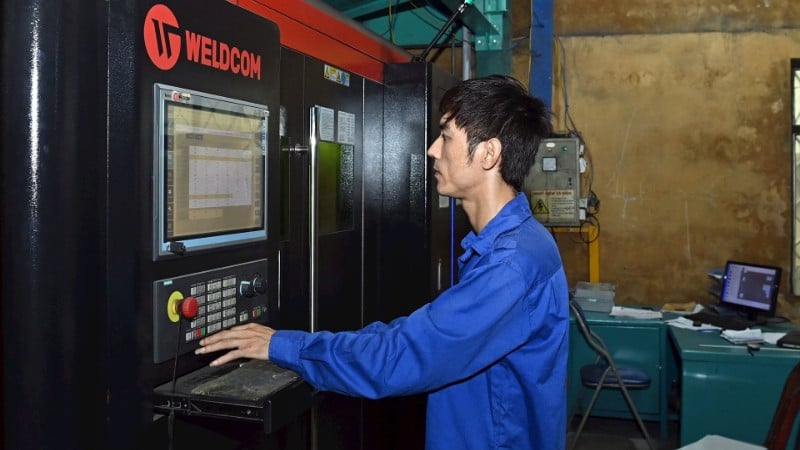
More than just a supporting tool, AI is also a driving force for innovation, helping to overcome the limitations of traditional methods in design and manufacturing. Previously, Vietnamese mechanical engineering relied mainly on automation and numerical control, but now the trend is shifting strongly towards intelligent autonomous manufacturing – where machines, robots, sensor systems, and intelligent control systems integrated with AI can make decisions, optimize, and adapt to real-world production conditions.
Dr. Nguyen Lac Hong, Vice President of the Vietnam Association of Mechanical Engineering, noted that technologies such as Big Data, the Internet of Things (IoT), industrial design, and "digital replica" models have created a strong shift in the way mechanical design and manufacturing are carried out. Through machine learning, various options are presented and evaluated according to standards of durability, production cost, or weight before proposing the optimal solution. This is particularly useful in industries requiring high precision such as automotive, aerospace, robotics, and machine manufacturing. In mechanical processing, AI is directly integrated into computer numerical control (CNC) systems to optimize the cutting process in real time.
Technologies such as Big Data, the Internet of Things (IoT), industrial design, and the "digital twin" model have brought about a dramatic shift in how mechanical design and manufacturing are carried out.
Dr. Nguyen Lac Hong, Vice President of the Vietnam Association of Mechanical Engineering
A prime example is the FANUC Intelligent Edge Link & Drive (FIELD) system, which combines AI and IoT to synchronize data from multiple CNC machines, analyze operating status, and automatically predict errors before they occur. As a result, AI helps increase cutting efficiency by 10-20% and reduce setup time by 40% in mass production. It also supports adaptive control, where the system learns from past data to determine optimal machining conditions for materials such as titanium or aluminum alloys.
Commenting on AI in mechanical engineering, Dr. Vu Duong (Duy Tan University) stated that AI is applied to optimize design, manufacturing processes, quality control, maintenance prediction, and new material development, thereby increasing productivity, accuracy, and overall efficiency. In addition, machining parameters such as cutting speed and feed rate can be flexibly adjusted to achieve optimal efficiency. The system uses cameras combined with AI algorithms to analyze product surfaces and detect defects such as cracks, warping, or dimensional errors.
Despite its great potential, the application of AI in Vietnam's mechanical engineering industry currently faces many obstacles. According to Dr. Dinh Van Chien, Director of the Institute of Mechanical Engineering, Automation and Environment, leveraging the potential of AI requires significant costs and resources: investment in establishing AI infrastructure; specialized software; and recruiting or training skilled personnel… On the other hand, the demand for high-performance computing can increase operating costs, requiring continuous investment in computing resources and maintenance…
The current level of AI application is still in the experimental stage, mainly in large corporations and research institutes. More than 90% of mechanical engineering businesses, especially small and medium-sized enterprises, do not yet have the resources to widely deploy AI in production. The first challenge is that production data has not been digitized and synchronized. Data from machining equipment, measuring devices, or design software is still scattered or not stored according to a unified standard. This leaves AI models lacking data to learn from and makes it difficult to achieve high accuracy.
The national strategy for AI research, development, and application until 2030 identifies mechanical engineering and manufacturing as one of the priority areas. AI is and will become a core element reshaping Vietnam's mechanical engineering industry, shifting from an "experience-based design" model to a "data-driven and artificial intelligence-based design" model.
Furthermore, there is a shortage of interdisciplinary personnel; engineers with simultaneous knowledge of mechanical engineering, AI, and numerical simulation are scarce. Meanwhile, smart manufacturing systems require a technical workforce capable of operating and maintaining equipment integrating sensors, machine learning algorithms, and numerical models. Technologically, many smart mechanical devices are currently imported at high costs. AI integrated into imported machines often operates like a "black box," making it difficult to customize them to suit domestic production conditions. Domestic businesses have not yet mastered sensor modules, data acquisition systems, or simulation software integrated with AI.
The national strategy for AI research, development, and application until 2030 identifies mechanical engineering and manufacturing as one of the priority areas. AI is and will become a core element reshaping Vietnam's mechanical engineering industry, shifting from an "experience-based design" model to a "data-driven and artificial intelligence-based design" model. This is not only a technological direction but also a strategic task for the mechanical engineering industry in the digital transformation era, contributing to Vietnam's progress towards smart, self-reliant, and globally competitive manufacturing.
However, according to experts in the field of mechanical engineering, achieving this requires a strategic and synchronized solution. First, it is necessary to build a national digitized mechanical engineering data repository, including design, machining, simulation, and sensor data. This data repository will serve as a platform for training AI models, enabling the technology to be more widely applied.
At the same time, it is necessary to promote interdisciplinary training in mechanical engineering, electronics, and AI, connecting schools and businesses so that engineers have the opportunity to practice on real production lines. In addition, it is necessary to promote the localization of smart mechanical products. Developing software for controlling machining equipment, machine vision systems, or digital replica models "Make in Vietnam" will help businesses reduce costs and take control of technology. Furthermore, it is necessary to strengthen research cooperation between institutes, universities, and businesses to form a smart mechanical ecosystem, creating conditions for testing and perfecting technology before bringing it to market.
Source: https://nhandan.vn/toi-uu-hoa-thiet-design-gia-cong-co-khi-tu-ung-dung-ai-post929960.html


















![[Image] Close-up of the newly discovered "sacred road" at My Son Sanctuary](https://vphoto.vietnam.vn/thumb/402x226/vietnam/resource/IMAGE/2025/12/13/1765587881240_ndo_br_ms5-jpg.webp)




































































Comment (0)