

In its national strategy, Vietnam aims to increase the number of semiconductor engineers from 50,000 to 100,000 by 2030. Ho Chi Minh City identifies semiconductor chips as a new driving force for economic growth. The city aims to train at least 9,000 personnel with university degrees or higher by 2030 to serve the semiconductor industry and core digital technologies.
Chip design engineer shortage crisis
After rearranging the development space between Ho Chi Minh City - Binh Duong - Ba Ria - Vung Tau , the city is moving towards a regional semiconductor ecosystem model. In this model, Ho Chi Minh City plays the role of a research and design center; Binh Duong focuses on production, packaging, and testing; and Ba Ria - Vung Tau takes on the role of logistics with the Cai Mep - Thi Vai port cluster.
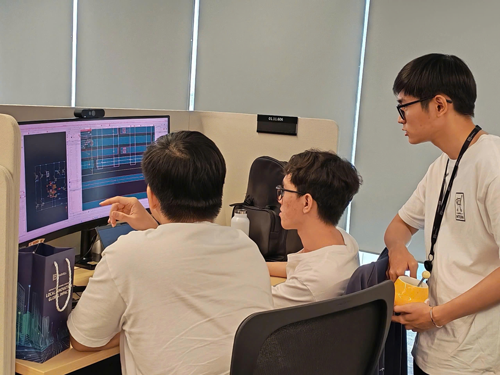
Vietnamese engineers are working at Marvell Company in Ho Chi Minh City.
In fact, the city has attracted several major technology corporations such as Intel, Samsung, Marvell, Renesas, Siemens EDA, Ampere Computing, etc. Within the Ho Chi Minh City High-Tech Park (SHTP) alone, there are 37 active electronics and integrated circuit projects with a total investment of over $7.7 billion. These figures demonstrate the city's strong appeal and significant potential in the semiconductor sector. However, to capitalize on these opportunities in the long term, the issue of human resources remains a considerable challenge.
Associate Professor Pham Tan Thi, Head of the Science Management Department at the University of Technology (Vietnam National University Ho Chi Minh City), noted that Vietnam currently has only about 5,600 semiconductor engineers; while the demand for personnel in this industry requires at least 500 engineers per year and could increase to 1,000 engineers per year in the future. Notably, the number of leading engineers capable of designing a complete chip remains very limited. Furthermore, the transfer of research results from universities to businesses is weak, and there are not many startups in the semiconductor field. "Current training programs are still pilot programs, and the number of lecturers with practical experience is limited; many have never directly participated in the stages of the semiconductor production chain. Along with that, there are limitations in infrastructure, which do not meet the requirements of the industry," Associate Professor Thi pointed out.
The leader of a semiconductor corporation operating in Vietnam shared that the majority of newly recruited personnel are recent graduates, due to the significant gap between academic training and practical requirements. The semiconductor industry is constantly changing, necessitating retraining for the company. "Over 70% of new hires are recent graduates, with the remainder being engineers with 3-5 years of experience; among them, foreign experts are highly valued for their in-depth expertise," this leader stated.
Building a complete semiconductor ecosystem.
According to many technology experts, to develop a high-quality semiconductor workforce, Vietnam, and Ho Chi Minh City in particular, need to attract more chip design and testing companies to invest in the market, while expanding undergraduate and postgraduate training programs. Building modern laboratories will create opportunities for students, graduate students, and researchers to participate directly in real-world projects. Only by comprehensively addressing the challenges of human resources, infrastructure, and the domestic business ecosystem can Ho Chi Minh City become a sufficiently strong semiconductor hub to participate deeply in the global value chain.
Associate Professor Dr. Le Quoc Cuong, Deputy Head of the SHTP Management Board, said that the semiconductor industry can only break through when it is connected instead of isolated, and when it collaborates instead of being dispersed. The "3+" model implemented by SHTP, connecting the State - scientists - businesses and international investors, is the foundation for creating common strength, making SHTP the leading high-tech center in the country and a launching pad for Vietnam to enter the global semiconductor value chain. Through this model, SHTP is gradually building a complete semiconductor ecosystem, including training and developing human resources to international standards; research - development - technology transfer; production - manufacturing - application; entrepreneurship - innovation; and linking global supply chains. The Ho Chi Minh City Department of Science and Technology said it is researching and proposing many policies including providing stable electricity and ultra-clean water; Partial support for investment costs, research and development (R&D) projects, pilot production, licensing; technological innovation, salaries for senior experts, etc.
Dr. Pham Tuan Anh, Director of Vietnam Technology and Communications Joint Stock Company (VNTT), believes that smart city solutions, IoT applications, and IoT devices are crucial outputs for the semiconductor industry. Without focusing on market development, nurturing, mastering technology, and participating in the microelectronics and semiconductor supply chain will face many obstacles. In reality, many Vietnamese technology companies are choosing an "application-to-the-bottom" approach, starting from market demand, and gradually building their brand and deepening value within the technology chain.
Training the next generation of skilled workforce.
According to Associate Professor Dr. Nguyen Van Hieu, Chairman of the Ho Chi Minh City Semiconductor Integrated Circuit Association (HSIA), the city focuses on training and developing human resources for integrated circuits and semiconductors. On August 21st, the Ho Chi Minh City Department of Science and Technology and HSIA announced the "Alliance on Semiconductor and Electronics Human Resource Research and Training" for the period 2025-2030. The purpose of the alliance is to become a common home – where members cooperate, share responsibilities, and jointly promote scientific research, technology transfer, and train a golden generation of human resources for Ho Chi Minh City's semiconductor industry.
Source: https://nld.com.vn/cap-toc-dao-tao-nhan-luc-cho-nganh-ban-dan-196251220213236028.htm


![[Photo] Prime Minister Pham Minh Chinh presides over a meeting on private sector economic development.](/_next/image?url=https%3A%2F%2Fvphoto.vietnam.vn%2Fthumb%2F1200x675%2Fvietnam%2Fresource%2FIMAGE%2F2025%2F12%2F20%2F1766237501876_thiet-ke-chua-co-ten-40-png.webp&w=3840&q=75)




















































































Comment (0)