The tiled-roof bridge gracefully spans the Hoành River, flowing through Hai Anh commune. Built in the unique "house above, pond below" architectural style (cool, clear water below, peaceful roof above providing shelter), it appears from afar as a soft, flowing curve. The bridge has nine spans supported by eighteen square stone pillars. Above the pillars is a system of sturdy horizontal and vertical beams made of ironwood to support the bridge girders and deck. The beam system is meticulously crafted, meeting both technical and aesthetic requirements, resulting in a frame that is both curved and undulating, showcasing the talent of the artisans of Quan Anh. The bridge's roof is skillfully covered with dragon-scale tiles, its curved shape resembling a dragon's body winding. The bridge's walkway is sturdily designed, providing a place for visitors to rest and admire the graceful bridge reflected in the clear, tranquil water, immersing themselves in the vast, serene river landscape and enjoying the gentle, peaceful beauty of this tranquil and poetic countryside. This place is renowned as one of the most beautiful ancient bridges in Northern Vietnam, and has even been immortalized in folk songs:
"Quan Anh has been famous since ancient times."
Phong Lac communal house plaque, Phuc Lam pagoda stele
Even after the guests left, they still asked about it.



"Tea from the tiled bridge, silk from Luong market."

Located about 100 meters from the tiled bridge, visitors can admire the ancient beauty of Luong Pagoda. Luong Pagoda, also known as Tram Gian Pagoda, or Phuc Lam Tu in Chinese characters, was built during the reign of King Le Hong Thuan (1509-1515). Initially small in scale, Luong Pagoda underwent numerous renovations and expansions, especially major ones in the late 19th and early 20th centuries. Currently, the pagoda is quite large, comprising 100 rooms, showcasing architectural styles from various eras, but clearly reflecting the style of the 17th and 18th centuries. The pagoda grounds are divided into two closely interconnected areas. The first area consists of important structures with 49 rooms, including the front hall, the triple-tiered hall, the bell tower, the rear hall, and two east-west corridors connected by overlapping roofs and rhyming patterns, creating a harmonious overall architecture. The second area, with 49 rooms, includes the guesthouse, monks' quarters, warehouse, kitchen, etc., built in the traditional Vietnamese architectural style. The overall architecture of Luong Pagoda reflects the skillful craftsmanship and refined aesthetic sense of folk artisans. The high level of assembly and mortise and tenon jointing techniques, along with the distinctive sculptural art depicting dragons bowing to the moon, dragons entwined with water, dragons holding pearls, and dragons playing with birds and horses, leave visitors amazed and impressed. In front of the pagoda is a large, clear blue lake, like a mirror reflecting the three-arched gate, and ancient trees that enhance the majestic and ancient beauty of the entire structure. A highlight of visiting Luong Pagoda is the unique beauty of its well. The well is constructed from layers of stone mortars arranged in a harmonious and unique circular pattern. The crystal-clear, pure well water is often used for steaming sticky rice and preparing offerings to Buddha, reflecting the sincere, pure, respectful, and grateful hearts of the people of Hai Anh who pioneered and established the village.
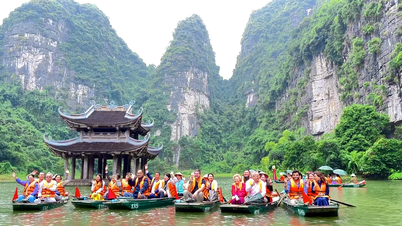
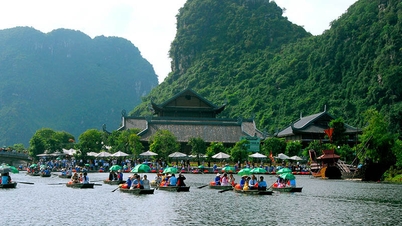
In recent years, Ninh Binh 's spiritual tourism products have attracted the attention of both domestic and international tourists. Many domestic and international travel companies have organized survey programs to develop routes and tours visiting historical sites in Ninh Binh , connecting cultural tourism destinations with natural and ecological tourism destinations in the province. To better serve the needs of tourists, the tourism industry has oriented itself towards exploiting cultural tourism products with unique local characteristics, such as admiring the tiled bridge at Luong Pagoda - one of the three most beautiful and ancient tiled bridges in Vietnam, as an interesting highlight in a wonderful tourist experience.
Having weathered the ups and downs and transformations of history, the tiled-roof bridge at Luong Pagoda has become a cultural symbol, a focal point of community solidarity, deeply ingrained in the consciousness of every resident of Hai Anh commune . It instills the moral principle of "drinking water, remembering the source," expressing profound gratitude to the ancestors who contributed to the founding, reclamation, and expansion of the land from the sea. It also serves as a testament to a proud period of prosperity. To enhance the historical value of the tiled-roof bridge at Luong Pagoda in tourism development, attention should be paid to restoring and preserving the monument according to regulations, standardizing explanatory content, and coordinating with travel companies to strengthen publicity and promotion of the destination... so that the tiled-roof bridge at Luong Pagoda becomes a meaningful and attractive cultural tourism destination for visitors from all over in the future .



Excerpt: VHTTDL Newsletter
Source: https://sodulich.ninhbinh.gov.vn/vi/tin-tuc-su-kien/cau-ngoi-chua-luong-diem-du-lich-hap-dan-2443.html





































![[Image] Ho Chi Minh City: Ma Lang area, Chicken-Rice Market about to change its appearance](https://vphoto.vietnam.vn/thumb/1200x675/vietnam/resource/IMAGE/2026/06/25/1782377698627_ndo_br_m1-jpg.webp)